
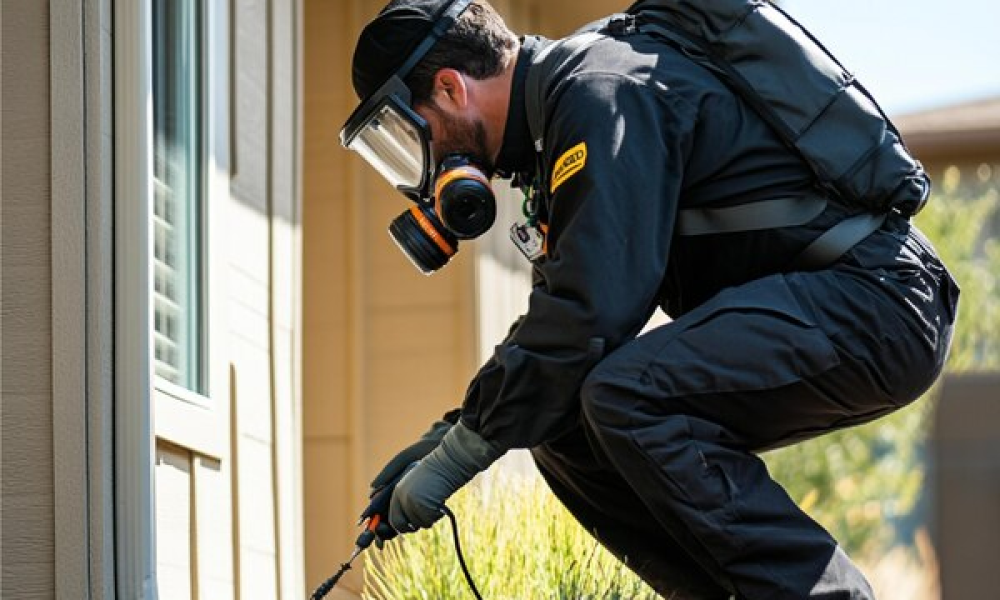
Ant infestations are consistently the most common pest complaint across the Atlanta metro and throughout middle Tennessee, and they’re also the most consistently underestimated. Homeowners who discover a trail of ants along a kitchen counter or bathroom baseboard often reach for an over-the-counter spray, eliminate the visible ants, and assume the problem is solved. It almost never is.
What that visible trail represents is a small fraction of the colony, which may contain hundreds of thousands of workers and is almost certainly nesting somewhere the homeowner can’t see — inside a wall void, beneath a slab, in the soil around the foundation, or inside wooden structural elements. Contact sprays kill surface ants and may temporarily disrupt the trail, but they don’t reach the queen or the main colony. Within days the trail reconstitutes, often in a slightly different location. The cycle repeats until the underlying colony is addressed directly.
Effective ant control requires a different approach — one focused on bait products that workers carry back to the colony rather than contact products that kill what’s visible on the surface. The specific bait formulation matters, because different ant species have different food preferences, and a product that works on fire ants won’t necessarily work on Argentine ants or odorous house ants. A technician who can correctly identify the species present and select the appropriate treatment approach produces results that a spray-it-yourself strategy reliably can’t. Residential pest control services that include species-specific ant treatment are built around exactly this kind of targeted approach.
Termites: The Damage Is Already Happening Before You See It
Georgia and Tennessee are both in the highest termite pressure zones in the United States, and the Formosan subterranean termite — one of the most destructive species in North America — is established across much of the region. The climate conditions that make both states attractive to residents are equally attractive to termite colonies, which thrive in the warm, humid conditions that define the regional spring and summer.
The feature of termite infestations that makes them uniquely costly is their invisibility. Unlike ants or rodents that leave obvious evidence of their presence, subterranean termites feed from inside structural wood members, working outward while the external surface remains intact. By the time visible evidence appears — swarms of winged termites in spring, sagging floors, hollow-sounding wood — the damage is typically well-established and significant. Repair costs for serious termite damage routinely run into the tens of thousands of dollars.
Annual termite inspections and preventive treatment are the clearest path to avoiding that outcome. In pest control Georgia and Tennessee requires ongoing termite monitoring rather than one-time treatment, because termite pressure in both states doesn’t stop after a single application. Colonies in adjacent properties can re-establish pressure on a treated home within a few years without continued monitoring in place.
Rodents: A Year-Round Problem in Suburban Georgia and Tennessee
Mice and rats don’t hibernate, and in a climate where winters are mild enough that they remain active year-round, the suburban and semi-rural properties common throughout the Atlanta metro and Nashville areas provide ideal conditions. Wooded lots, crawl spaces, garages with gaps around utility penetrations, and attached structures give rodents easy access to shelter that stays warm and dry through the cooler months.
The damage a rodent infestation causes goes well beyond food contamination and droppings. Mice and rats gnaw constantly to manage their incisor growth, and they do so indiscriminately — on structural wood, insulation, HVAC ductwork, and most importantly on electrical wiring. Rodent gnawing on wiring is a documented contributor to residential electrical fires, and it tends to happen in wall voids, attics, and crawl spaces where it goes undetected until something goes wrong.
Effective rodent control requires exclusion — physically sealing the entry points through which rodents are accessing the structure — alongside population reduction. Without exclusion, bait stations and traps produce temporary results as new individuals replace those eliminated. A thorough inspection to identify and seal gaps around utility penetrations, foundation cracks, vents, and roofline areas is what separates a solution from a cycle of repeated treatment.
Why the Eco-Friendly Approach Doesn’t Mean Compromise
The assumption that eco-friendly or organic-based pest control is less effective than conventional chemical treatment has been largely overtaken by the evidence. Modern integrated pest management approaches that prioritize targeted, lower-toxicity treatments — applied with precision to where pests actually are rather than broadcast across entire living spaces — consistently produce results comparable to or better than blanket conventional treatment, with significantly reduced exposure for residents, children, and pets.
VerdX serves homeowners across Atlanta and Nashville with commercial and residential pest control built around organic-based solutions that prioritize targeted treatment and exclusion over broad chemical application. For homeowners in Marietta, Alpharetta, Roswell, Nashville, Brentwood, and Franklin who want reliable protection without the concerns that come with heavy chemical applications, that approach represents the best of both outcomes.
The pest pressure in Georgia and Tennessee is real and year-round. The most effective response is professional, informed, and consistent — not reactive, not seasonal, and not based on whatever’s on the shelf at the hardware store. If you’re ready to get ahead of it, VerdX offers free inspections across both service areas with Atlanta pest control and Nashville pest control coverage available now.




