
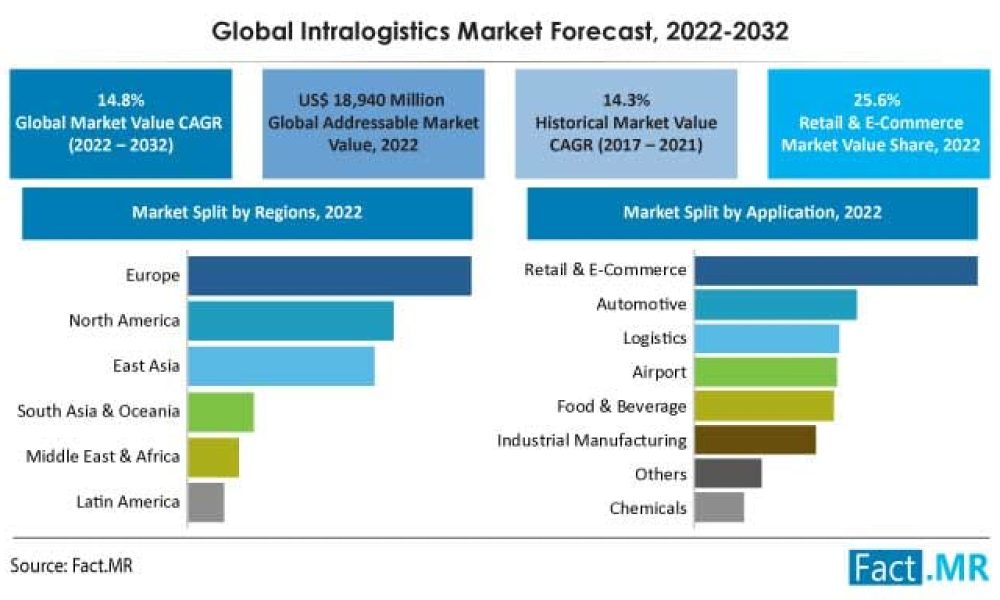
The intralogistics market in the United States demonstrated remarkable expansion, achieving a Compound Annual Growth Rate (CAGR) of 13.2% over the historical period spanning from 2017 to 2021. The United States has a track record of promptly embracing technology, encompassing the digitalization of supply chains and the deployment of advanced technologies like intralogistics solutions and 5G.
The global intralogistics market is anticipated to experience robust growth, with a substantial compound annual growth rate (CAGR) of 14.8%. This surge is expected to propel the market value from US$ 18.94 billion in 2022 to an estimated US$ 75.36 billion by the conclusion of 2032.
Download a Sample Copy of This Report:
https://www.factmr.com/connectus/sample?flag=S&rep_id=3446
In an era marked by rapid technological advancements, the global intralogistics market is experiencing an unprecedented surge, driven by innovative automation solutions reshaping the landscape of supply chain management. As businesses strive for increased efficiency, reduced costs, and heightened productivity, the integration of cutting-edge technologies within intralogistics operations has become paramount.
The Rise of Automation: Transforming Warehouse Dynamics
One of the key drivers behind the surge in the intralogistics market is the widespread adoption of automation solutions within warehouses and distribution centers. From autonomous robotic systems to smart conveyor belts, companies are leveraging automation to streamline processes and minimize manual intervention. This not only accelerates order fulfillment but also significantly reduces errors, leading to enhanced customer satisfaction.
Technological Integration for Real-Time Visibility
Technological advancements are enabling real-time visibility and control over the entire supply chain. Internet of Things (IoT) devices, sensors, and RFID technology are being employed to track the movement of goods within the warehouse, providing valuable insights into inventory levels, order status, and equipment performance. This data-driven approach enhances decision-making processes, allowing businesses to respond swiftly to market demands and fluctuations.
Robotics Revolutionizing Intralogistics Operations
The integration of robotics is a game-changer in the intralogistics sector. Autonomous mobile robots (AMRs) are increasingly being utilized for tasks such as material handling, picking, and packing. These robots navigate warehouses intelligently, optimizing routes and adapting to changes in the environment. This not only improves operational efficiency but also addresses challenges associated with labor shortages and the need for 24/7 operations.
Artificial Intelligence (AI) and Machine Learning (ML) Optimizing Processes
AI and ML algorithms are playing a crucial role in optimizing various intralogistics processes. Predictive analytics help forecast demand, preventing overstock or stockouts. Machine learning algorithms continuously analyze data to identify patterns and anomalies, enabling proactive maintenance of equipment and reducing downtime. These intelligent systems contribute to a more resilient and agile supply chain.
Competitive Landscape
Noteworthy providers in the intralogistics sector include Daifuku Co., Ltd, Interroll, Jungheinrich AG, KION Group, Korber AG, Krones AG, KUKA Group, Material Handling Systems, Murata Machineries Ltd., and Toyota Industries Corporation.
Leading companies in intralogistics are integrating sustainable technologies and optimization systems to cater to diverse end-users. Key manufacturers are dedicated to the development and enhancement of new software and service designs, addressing challenges related to material arrangement and storage. Distinguished market players are exploring acquisitions and mergers as strategic avenues for growth in this dynamic market.
In 2020, Interroll unveiled the high-performance MX 025H Crossbelt Sorter, boasting a capacity to handle approximately 20,000 conveyed goods per hour.
Telus, in a recent development, has commenced offering customized solutions, encompassing journey management, smart building solutions, contact tracing, and more, solidifying its position as a reputable brand for enhanced and connected workplace solutions.
Segmentation of Intralogistics Industry Research
- By Component :
- Hardware
- Automated Storage and Retrieval Systems (AS/RS)
- Unit-Load
- Fixed-aisle Cranes
- Moveable-aisle Cranes
- Mini-Load
- AS/RS Cranes
- AS/RS Shuttles
- Unit-Load
- Automated Guided Vehicles (AGVs)
- Conveyor Systems
- Horizontal Carousels
- Vertical Carousels
- Vertical Lift Modules (VLMs)
- Sorting Systems
- Industrial Robots
- Others
- Automated Storage and Retrieval Systems (AS/RS)
- Software
- Services
- Hardware
- By End Use :
- Logistics
- Food & Beverages
- Retail & e-Commerce
- Airports
- Automotive
- Chemicals
- Industrial Manufacturing
- Others
- By Region :
- North America
- Latin America
- Europe
- East Asia
- South Asia & Oceania
- MEA
Get Customization on this Report:
https://www.factmr.com/connectus/sample?flag=RC&rep_id=3446
The confluence of technological advancements and automation solutions is reshaping the global intralogistics market. Businesses that strategically invest in these innovations are poised to gain a competitive edge, ensuring their operations remain agile, efficient, and responsive to the dynamic demands of the modern market. The surge in the intralogistics sector is not merely a trend but a paradigm shift towards a more intelligent and connected supply chain ecosystem.
Contact:
US Sales Office
11140 Rockville Pike
Suite 400
Rockville, MD 20852
United States
Tel: +1 (628) 251-1583, +353-1-4434-232
Email: [email protected]




