
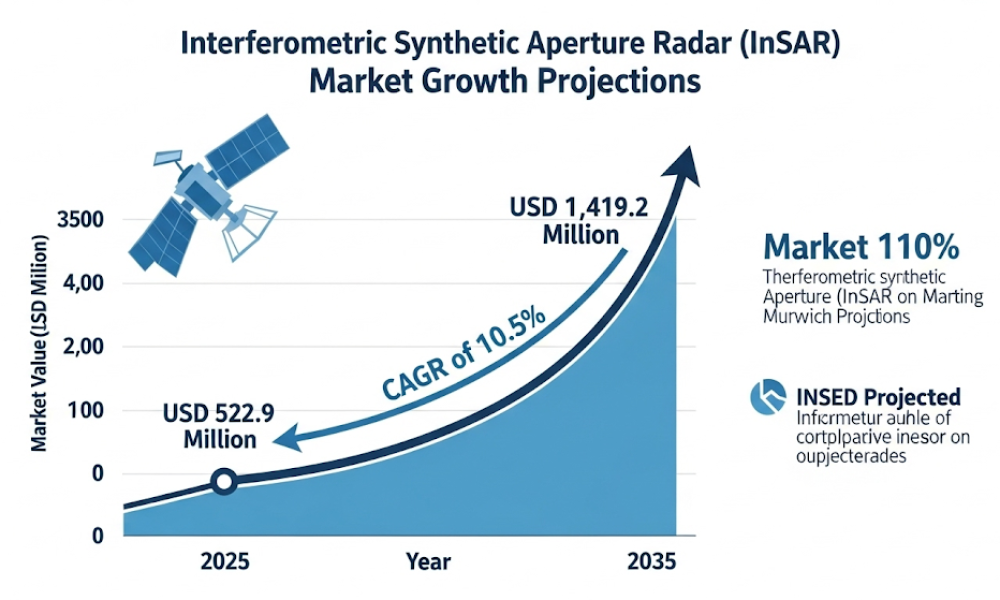
The Interferometric Synthetic Aperture Radar (InSAR) market is on a remarkable growth trajectory, expected to climb from an estimated USD 522.9 million in 2025 to USD 1,419.2 million by 2035. This translates to a robust compound annual growth rate (CAGR) of 10.5% over the forecast period, with an absolute gain of USD 896.3 million and a growth multiplier of 2.71x. Increasing demand for high-resolution Earth observation, infrastructure monitoring, and environmental applications underpins this surge.
In the initial five-year window from 2025 to 2030, the market is anticipated to reach USD 861.5 million, accounting for approximately 37.8% of the decade’s incremental growth. The subsequent period from 2030 to 2035 is projected to contribute USD 557.7 million, reflecting a stronger momentum driven by the adoption of advanced radar technologies in sectors such as defense, agriculture, and urban planning. Annual market increments are expected to accelerate from USD 62.2 million in the early years to USD 105.4 million by 2035, underscoring the impact of technological advancements and expanding applications, including climate change studies, flood management, and autonomous vehicle systems.
Companies investing in advanced radar sensor systems, scalable solutions, and real-time monitoring are expected to capture a significant share of this USD 896.3 million opportunity. Leading market players include Airbus Defence and Space, Capella Space, ICEYE, MDA Ltd., CGG, L3Harris Technologies, and e-GEOS (a Telespazio/ASI company), which are continuously innovating to meet evolving market demands.
Full Market Report available for delivery. For purchase or customization, please request here: https://www.futuremarketinsights.com/customization-available/rep-gb-24301
Market Drivers: High-Resolution Earth Observation and Geospatial Intelligence
The expansion of the InSAR market is driven primarily by the rising demand for high-resolution Earth observation and geospatial intelligence. Governments and commercial sectors increasingly rely on InSAR for surface deformation mapping, environmental risk assessment, and long-term subsidence monitoring. Satellite constellations and technological advances in SAR imaging have enhanced coverage, temporal resolution, and cost-efficiency, making InSAR more accessible for civil and defense applications.
In addition, the integration of AI-driven analytics is revolutionizing data interpretation and operational deployment, enabling precise decision-making in time-sensitive scenarios. Public-private partnerships, investments in Earth observation, and continuous improvements in satellite payload design and image processing further catalyze market growth.
Segment Insights: Multiple SAR Images Leading the Market
Among technology types, multiple synthetic aperture radar (SAR) images are expected to contribute 58.4% of total market revenue in 2025. Their dominance is attributed to the ability to generate high-precision interferograms and detect subtle surface movements over extended periods. By stacking multiple images, signal coherence is enhanced while atmospheric and temporal noise is reduced, providing unmatched accuracy in deformation analysis.
This capability is critical for applications such as fault detection, mining subsidence studies, and glacier motion tracking. As the volume of archived SAR data grows, supported by commercial and government missions, multi-temporal datasets are poised to remain the preferred approach for detailed ground movement analytics.
Platforms and Applications: Airborne and Spaceborne Solutions Drive Market Adoption
Airborne and spaceborne platforms are forecasted to hold 66.9% of market share in 2025, reflecting their widespread adoption for broad-area, repeatable coverage with minimal environmental constraints. Innovations in SAR satellite constellations, reduced launch costs, and public data-sharing initiatives have bolstered the adoption of these platforms for defense surveillance, environmental protection, and infrastructure monitoring.
Monitoring applications account for 39.5% of the InSAR market’s revenue in 2025, emerging as the largest application segment. Real-time tracking of ground deformation, landslide risks, and structural stability across large-scale infrastructure projects is driving growth. Industries such as oil & gas, mining, and urban development leverage InSAR solutions to ensure regulatory compliance and asset safety, while public sector applications focus on climate resilience, geohazard mitigation, and floodplain mapping.
Market Trends: AI, Agriculture, and Infrastructure Monitoring
AI and machine learning integration is shaping the next wave of InSAR adoption. By analyzing large datasets, AI enhances predictive capabilities, allowing faster and more accurate interpretations of geospatial information. This trend is particularly significant for monitoring urban growth, disaster preparedness, and climate change impacts.
Expanding applications in agriculture and infrastructure monitoring further amplify opportunities. InSAR solutions track subsidence, landslides, and vegetation changes, while detecting structural deformations in large projects such as bridges and dams. As industries increasingly prioritize efficiency and risk mitigation, InSAR technology is recognized as indispensable for accurate monitoring and timely interventions.
Request Market Research Draft Report: https://www.futuremarketinsights.com/reports/sample/rep-gb-24301
Regional Market Outlook: Asia-Pacific Leading the Charge
The global InSAR market demonstrates varied growth across regions. China leads with a CAGR of 14.2%, fueled by investments in space exploration, satellite systems, and remote sensing technologies. India follows at 13.1%, driven by the growing need for Earth observation data in agriculture, infrastructure, and defense. Germany’s CAGR of 12.1% reflects strong demand for InSAR in environmental monitoring, defense, and infrastructure sectors. The United Kingdom and the United States post steady growth of 10.0% and 8.9%, respectively, reflecting mature markets with continued emphasis on technological innovation and advanced radar applications.
China’s market is particularly buoyed by rapid expansion in space exploration and Earth observation programs, while India’s adoption of InSAR aligns with environmental sustainability, flood monitoring, and urban planning initiatives. Germany’s focus on satellite-based remote sensing for climate change research and defense applications further fuels demand, while the UK and US markets benefit from commercial applications alongside government initiatives.
Competitive Landscape: Established Leaders and Emerging Players
Airbus Defence and Space dominates the InSAR market with high-resolution satellite radar imaging solutions for Earth observation, environmental monitoring, and defense applications. Its global reach, focus on innovation, and ability to provide reliable, precise geospatial data ensure its leadership position.
Other key players, including Capella Space, ICEYE, and L3Harris Technologies, maintain significant market shares by offering cutting-edge systems for topographic mapping, infrastructure monitoring, and climate change studies. Emerging participants such as MDA Ltd., CGG, and e-GEOS are expanding their presence through cost-effective InSAR services tailored to agriculture, oil & gas exploration, and urban planning. Their strategies emphasize flexible satellite constellation options and advanced data processing capabilities for actionable insights.
Market growth is fueled by increasing demand for geospatial data, rising interest in environmental monitoring, and growing adoption of InSAR across defense and commercial sectors. Innovations in radar resolution, satellite constellations, and AI-enhanced data analysis continue to reshape competitive dynamics.
About Future Market Insights (FMI)
Future Market Insights, Inc. (ESOMAR certified, recipient of the Stevie Award, and a member of the Greater New York Chamber of Commerce) offers profound insights into the driving factors that are boosting demand in the market. FMI stands as the leading global provider of market intelligence, advisory services, consulting, and events for the Packaging, Food and Beverage, Consumer Technology, Healthcare, Industrial, and Chemicals markets. With a vast team of over 400 analysts worldwide, FMI provides global, regional, and local expertise on diverse domains and industry trends across more than 110 countries.
Contact Us:
Future Market Insights Inc.
Christiana Corporate, 200 Continental Drive,
Suite 401, Newark, Delaware – 19713, USA
T: +1-347-918-3531
For Sales Enquiries: [email protected]



