
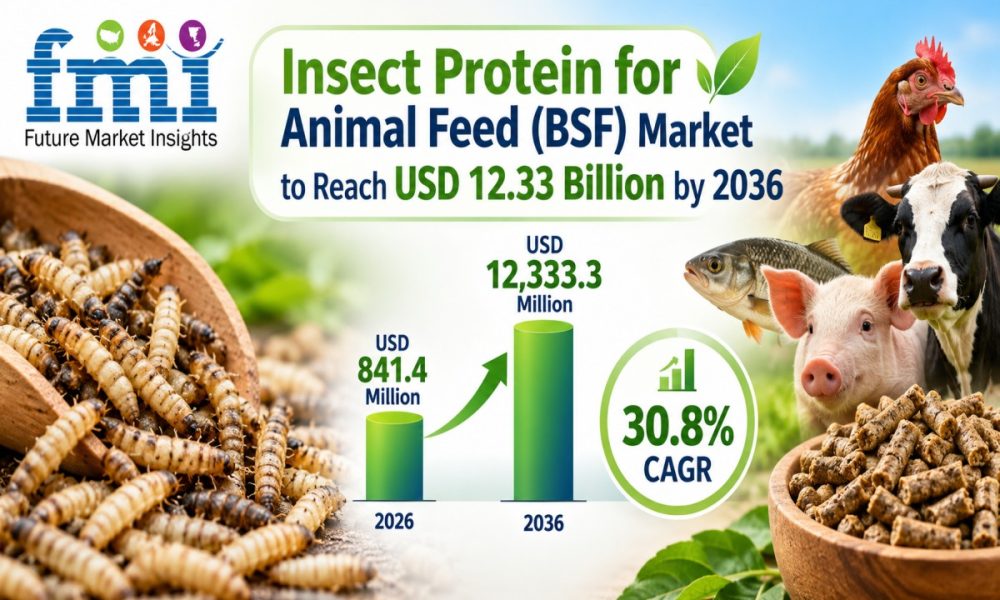
Summary: Global insect protein for animal feed market is set to reach USD 12.33 billion by 2036, driven by growing aquafeed demand, expanding commercial qualification of insect ingredients, and advances in scalable black soldier fly production.
The global insect protein for animal feed (BSF) market is expanding as feed formulators increasingly evaluate insect-based ingredients as alternatives to conventional protein sources. The market is projected to grow from USD 841.4 million in 2026 to USD 12,333.3 million by 2036, registering a 30.8% CAGR during the forecast period, according to the latest insights by Future Market Insights (FMI).
Global Insect Protein for Animal Feed (BSF) Market Snapshot
2026 market value: USD 841.4 million
2036 forecast: USD 12,333.3 million
CAGR, 2026–2036: 30.8%
Leading insect: Black soldier fly
Black soldier fly share, 2026: 41.1%
Leading product: Protein meal
Protein meal share, 2026: 49.6%
Leading livestock: Aqua
Get detailed market forecasts, competitive benchmarking, and pricing trends:
https://www.futuremarketinsights.com/reports/sample/rep-gb-34644
Why Is the Insect Protein for Animal Feed Market Growing?
Feed formulators are expanding insect protein trials as aquaculture demand and clearer species eligibility bring more applications into commercial qualification. The Food and Agriculture Organization reported in June 2026 that aquaculture produced 103 million tonnes of aquatic animals in 2024, creating a substantial testing base for alternative proteins.
Insect ingredient producers are increasingly focusing on lawful feedstock inputs, repeatable nutrient specifications, and local production capacity. Vietnam’s Directorate of Fisheries reported in January 2026 that aquaculture output exceeded 5.98 million tonnes in 2025, placing BSF production near a significant feed market.
Black Soldier Fly Leads the Insect Category
Black soldier fly is estimated to account for 41.1% of insect demand in 2026, making it the leading insect category.
BSF production provides multiple outputs from one rearing cycle, including protein meal, oil, and frass. Its relatively short larval cycles can align with drying and processing schedules, supporting commercial production models.
Nasekomo reported a 25% feed conversion ratio near Sofia in March 2025. Feed manufacturers increase contracted volumes once rearing consistency keeps nutrient specifications stable across scheduled commercial batches and repeated formulation runs.
Why Does Protein Meal Lead Product Demand?
Protein meal is projected to represent 49.6% of product demand in 2026.
The product fits existing specification practices used for fishmeal and soy alternatives, allowing nutrition teams to compare amino-acid profiles and delivered costs. Its dried format also fits established storage and dosing equipment used for pet food and compound feed.
BioFlyTech reported in July 2025 that its Palas de Rei plant produced protein meal with 12,000 tonnes of annual production capacity, highlighting the importance of storage, batch consistency, and dosing performance as commercial volumes expand.
Why Does Aqua Lead Livestock Demand?
Aqua is expected to account for 33.1% of livestock demand in 2026, supported by established qualification routes for alternative proteins.
Aquafeed programs provide a major commercial opportunity because feed mills can evaluate insect meal against defined species nutrition requirements. ICAR-CMFRI transferred its BSF larvae fish-feed technology to Bhairav Renderers in January 2025 for planned industrial production in Tamil Nadu, placing insect protein within an established aquafeed development route.
Decentralized Conversion Improves Feedstock Economics
Locating BSF plants near lawful residual streams can reduce inbound transport requirements while improving feedstock control. A single conversion system can produce protein, oil, and fertilizer from documented local inputs.
The EU’s CINEA reported in March 2026 that LIFE Waste2Protein’s ReFarmUnit processes 10,000 tonnes of local residues into protein, feed products, and fertilizer within one modular commercial unit.
USA Leads the Profiled Country Growth
The USA is projected to register a 31.1% CAGR through 2036, supported by clearer ingredient eligibility and growing commercial interest among poultry and aquaculture formulators.
USA feed companies qualify BSF ingredients under species-specific AAFCO definitions. January 2026 committee minutes accepted official definitions for dried BSF larvae and BSF oil in aquaculture and poultry uses. Regulatory clarity improves trial planning, although manufacturers still require traceable feed-grade substrates and stable nutrient specifications.
Vietnam follows with a 30.7% CAGR, supported by industrial BSF production, favorable rearing conditions, and proximity to aquaculture customers.
China is projected to grow at 28.9% CAGR, supported by production models combining insect rearing with feed processing near major animal-production regions.
The Netherlands is projected at 25.3% CAGR, supported by local production experience and established EU feed qualification routes.
France follows with a 23.8% CAGR, with industrial assets and research programs supporting efforts to overcome large-scale production barriers.
Competitive Landscape: Protix, Innovafeed and Entobel Strengthen BSF Production
The competitive environment includes integrated BSF producers, rearing-technology specialists, and modular conversion operators.
Protix, Innovafeed, Entobel, Sentara Group and EnviroFlight combine insect rearing with processed feed ingredients. Nasekomo and BioFlyTech combine European BSF processing with engineering and animal-feed commercialization capabilities, while REPLOID Group AG focuses on modular conversion systems connecting local residual streams with insect-derived outputs.
Key Developments Strengthen Commercial Adoption
In February 2026, Nasekomo and REINARTZ signed a strategic partnership combining automated BSF rearing with downstream processing for protein meal and oil.
In September 2025, Innovafeed joined BioMar and Auchan in a commercial Ecuador shrimp-feed program linking insect meal supply with feed manufacturing and retail.
In April 2025, Protix reported a commercial salmon trial using 4% insect protein that produced higher average weight and slaughter yield in the tested group.
What Does the Market Mean for Industry Decision-Makers?
The 30.8% CAGR signals rapid expansion of insect protein as feed manufacturers seek alternative protein sources for aquaculture, poultry, pet, and swine applications.
For feed manufacturers, the priority is selecting insect ingredients with consistent nutrient profiles, reliable supply, species eligibility, and competitive delivered economics. For producers, the strongest commercial advantage comes from combining lawful feedstock sourcing with efficient rearing, processing, and multi-output production.
The strongest opportunities are likely to emerge where local residual streams, scalable BSF production, established feed qualification, and recurring aquafeed programs come together.
Get the Complete Story—Read More About Our Latest Report:
https://www.futuremarketinsights.com/reports/insect-protein-for-animal-feed-bsf-market
Related Food & Beverages Industry Reports
For companies tracking alternative proteins, animal nutrition, and sustainable feed technologies, relevant FMI research areas include:
Insect Protein Market
Animal Feed Protein Market
Aquafeed Market
Alternative Protein Market
Pet Food Ingredients Market
About Future Market Insights (FMI)
Future Market Insights, Inc. is an ESOMAR-certified, ISO 9001:2015 market research and consulting organization trusted by Fortune 500 companies. With a global presence across the U.S., UK, India and Dubai, FMI delivers data-driven insights across 30+ industries and 1,200 markets worldwide.



