
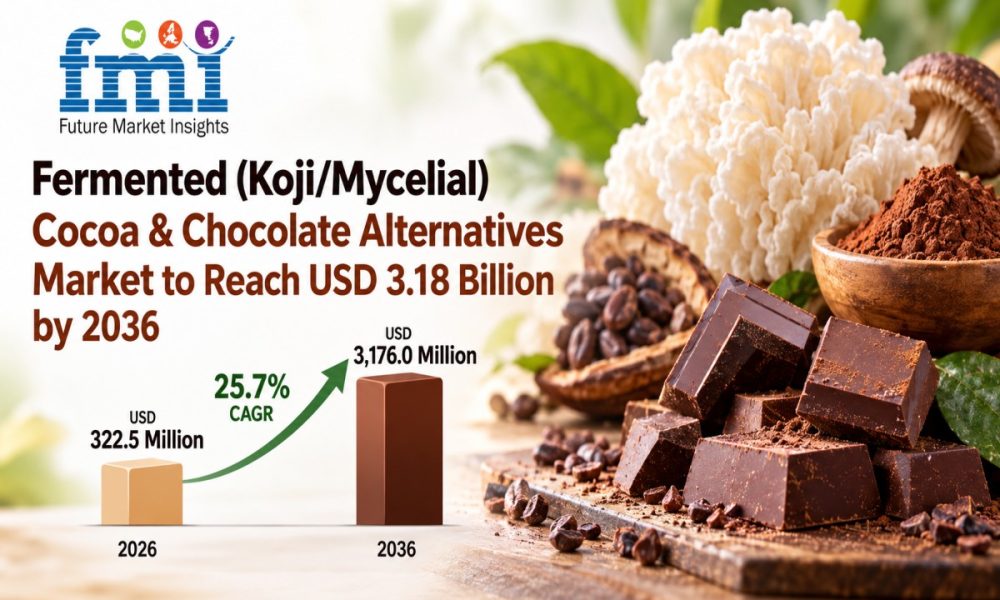
Summary: Global fermented (koji/mycelial) cocoa and chocolate alternatives market is set to reach USD 3.18 billion by 2036, driven by cocoa price volatility, demand for cocoa-free formulations, and advances in fermentation-based ingredient production.
The global fermented (koji/mycelial) cocoa and chocolate alternatives market is expanding as food manufacturers qualify alternatives that can reduce exposure to volatile cocoa purchasing while maintaining familiar flavor and processing characteristics. The market is projected to grow from USD 322.5 million in 2026 to USD 3,176.0 million by 2036, registering a 25.7% CAGR during the forecast period, according to the latest insights by Future Market Insights (FMI).
Global Fermented (Koji/Mycelial) Cocoa & Chocolate Alternatives Market Snapshot
- 2026 market value: USD 322.5 million
· 2036 forecast: USD 3,176.0 million
· CAGR, 2026–2036: 25.7%
· Leading technology: Koji fermentation
· Koji fermentation share, 2026: 58.1%
· Leading product: Cocoa-free chocolate
· Cocoa-free chocolate share, 2026: 59.8%
· Leading application: Confectionery
Get detailed market forecasts, competitive benchmarking, and pricing trends:
https://www.futuremarketinsights.com/reports/sample/rep-gb-34640
Why Is the Fermented Cocoa & Chocolate Alternatives Market Growing?
The strongest growth driver is cocoa cost volatility, which encourages manufacturers to qualify alternatives that can protect recipe economics without sacrificing finished-product performance. The International Cocoa Organization reported in January 2025 that London cocoa futures ended 2024 at USD 11,441 per tonne, increasing the commercial incentive to evaluate cocoa-free bases.
Food manufacturers are increasingly validating alternatives for taste, melt behavior, line performance, and scalability before committing to recurring ingredient purchases. Cocoa-free formulations therefore become not only a sustainability option but also a risk-management tool for cocoa-heavy recipes.
Koji Fermentation Leads the Technology Category
Koji fermentation is estimated to account for 58.1% of technology demand in 2026, making it the leading technology category.
Koji fermentation uses fungal cultures on solid substrates to develop cocoa-like flavor from cocoa shells and other plant material without conventional cacao beans. Its substrate flexibility supports cocoa-reduction recipes without requiring specialized liquid bioreactors.
Commercial activity is also moving beyond laboratory development. The BioIndustry Association reported in April 2026 that Koji Cocoa was Fermtech’s first commercial product and that production was expanding internationally.
Why Does Cocoa-Free Chocolate Lead the Product Category?
Cocoa-free chocolate is projected to represent 59.8% of product demand in 2026.
The category benefits from its direct replacement potential in familiar bars, coatings, and other chocolate applications. Unlike chocolate flavoring compounds, cocoa-free chocolate needs to provide flavor as well as melt and handling behavior across industrial recipes.
Commercial validation requires manufacturers to repeat the same specification across several production runs before approving volume contracts. Foreverland reported in March 2026 that its Puglia plant had opened in October 2025 with annual capacity of 500 tonnes for cocoa-free chocolate.
Why Does Confectionery Lead Application Demand?
Confectionery is expected to account for 45.7% of application demand in 2026.
The segment directly exposes alternative bases through coatings, chocolate inclusions, and snack formats, making flavor, snap, melt, and cooling performance critical during qualification.
Martin Braun reported in April 2025 that WNWN chip-format alternatives had been introduced to the German market, offering one-to-one couverture replacement and convenient chip-format dosing for professional bakers. Confectionery teams are more likely to expand usage once line trials demonstrate consistent performance under commercial production and storage conditions.
Cocoa Volatility Funds Qualification
High cocoa prices raise working capital requirements for conventional recipes and provide manufacturers with a commercial reason to test cocoa-free bases. The International Cocoa Organization also reported that European and Asian fourth-quarter cocoa grindings had fallen to their lowest levels since 2020.
This cost pressure increases qualification spending, although recurring orders still depend on stable taste, melt behavior, and line performance.
Netherlands Leads the Profiled Country Growth
The Netherlands is projected to register a 27.3% CAGR through 2036, supported by cross-border distribution and regional application access.
Planet A Foods reported in September 2025 that ChoViva was available in the Netherlands within an eight-country network serving Dutch manufacturers and nearby European markets. EU novel-food dossiers remain an important commercial gate for unfamiliar fermentation-derived ingredients.
The USA follows with a 26.9% CAGR, supported by broad manufacturing coverage and established ingredient distribution. Cargill launched NextCoa across the United States in May 2026 as exclusive global distributor for Voyage Foods, targeting confectionery, bakery, and ice cream applications.
Competitive Landscape: Fermtech, Planet A Foods and Voyage Foods Strengthen Cocoa-Free Alternatives
The competitive environment includes fermentation developers, cocoa-free formulation specialists, and ingredient companies providing manufacturing scale or distribution.
Fermtech, Planet A Foods (Choviva) and WNWN focus on converting non-cocoa feedstocks into application-ready bases. Foreverland, Nukoko and Voyage Foods develop alternative bases for familiar confectionery processing and formats.
Cargill and Döhler strengthen manufacturing scale, distribution, and B2B market access. Competition increasingly depends on repeatable sensory performance, food-grade production volumes, application support, and the ability to satisfy regulatory requirements across different markets.
Key Developments Strengthen Commercial Adoption
In June 2026, Döhler acquired Nukoko, adding its fava bean-based cocoa-free platform to a global ingredient network.
In June 2026, Foreverland launched two no-added-sugar cocoa-free formulations for commercial confectionery and bakery manufacturers.
In November 2025, Planet A Foods entered a long-term commercial partnership with Barry Callebaut for cocoa-free chocolate alternatives, combining ChoViva with Barry Callebaut’s manufacturing and application capabilities.
What Does the Market Mean for Industry Decision-Makers?
The 25.7% CAGR signals rapid movement toward fermented and mycelial alternatives as manufacturers seek ways to reduce cocoa exposure while maintaining familiar product performance.
For food manufacturers, the priority is selecting alternatives that deliver consistent flavor, melt behavior, and processing performance at commercial scale. For ingredient developers, regulatory readiness, production consistency, and application-specific support are becoming critical to converting trials into recurring B2B orders.
Get the Complete Story—Read More About Our Latest Report:
Related Food & Beverages Industry Reports
For companies tracking ingredients and technologies surrounding cocoa alternatives and confectionery innovation, relevant FMI research areas include:
- Cocoa Market
- Chocolate Market
- Cocoa Powder Market
- Confectionery Ingredients Market
- Plant-Based Ingredients Market
About Future Market Insights (FMI)
Future Market Insights, Inc. is an ESOMAR-certified, ISO 9001:2015 market research and consulting organization trusted by Fortune 500 companies. With a global presence across the U.S., UK, India and Dubai, FMI delivers data-driven insights across 30+ industries and 1,200 markets worldwide.



