
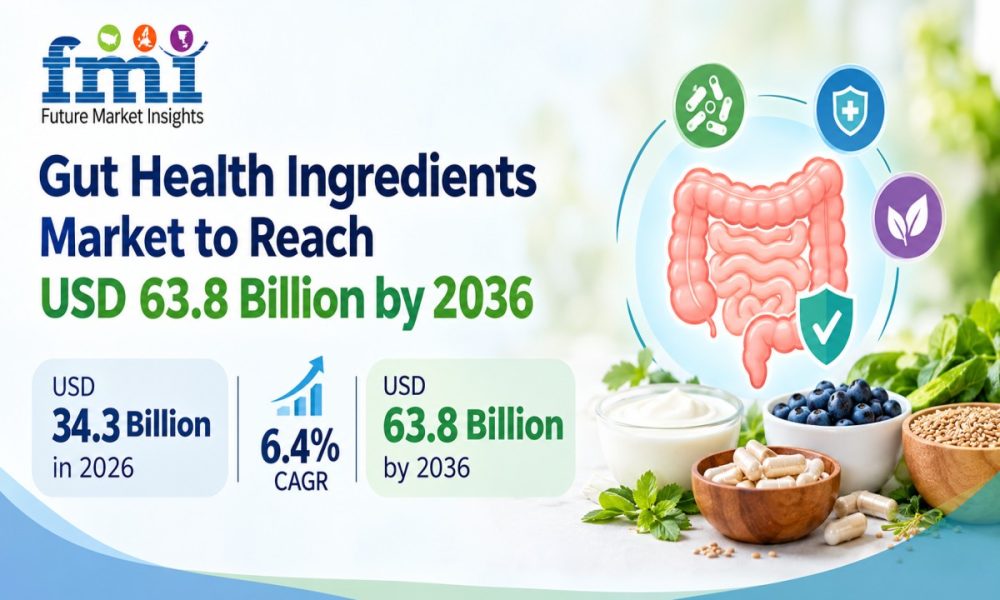
Summary: Global gut health ingredients market is set to reach USD 63.8 billion by 2036, driven by demand for documented probiotic strains, controlled-dose supplement formats, and stable biotic ingredients for functional foods and beverages.
The global gut health ingredients market is expanding as food, beverage, and supplement manufacturers increasingly seek ingredients supported by documented identity, safety, application data, and strain-level evidence. The market is projected to grow from USD 34.3 billion in 2026 to USD 63.8 billion by 2036, registering a 6.4% CAGR during the forecast period, according to the latest insights by Future Market Insights (FMI).
Global Gut Health Ingredients Market Snapshot
2026 market value: USD 34.3 billion
2036 forecast: USD 63.8 billion
CAGR, 2026–2036: 6.4%
Leading ingredient: Probiotics
Probiotics share, 2026: 33.8%
Leading application: Supplements
Supplements share, 2026: 36.7%
Leading profiled country: USA
USA CAGR: 10.3%
Get detailed market forecasts, competitive benchmarking, and pricing trends:
https://www.futuremarketinsights.com/reports/sample/rep-gb-34638
Why Is the Gut Health Ingredients Market Growing?
Demand is rising as formulation teams seek gut-health ingredients with documented identity, safety, and application data that can survive local qualification requirements. Product developers increasingly evaluate ingredients against intended-use requirements before committing material volumes to commercial formulations.
The FDA closed GRN 1242 for short-chain fructooligosaccharides on July 14, 2025, with no questions across numerous food and beverage uses. The decision reduces one safety-review uncertainty for an established prebiotic ingredient before commercial formulation and repeat purchasing.
Probiotics Lead the Ingredient Category
Probiotics are estimated to account for 33.8% of ingredient demand in 2026, making them the leading ingredient category.
Probiotic ingredients require strain identity and viable-dose control because commercial use depends on evidence tied to the named microorganism. Formulation teams also evaluate survival during manufacturing and shelf life before committing a strain to repeat production.
Novonesis reported in August 2025 that Health Canada approved ASTARTE™ with gastrointestinal and vaginal health claims for a four-strain Lactobacillus combination formulated for women’s health. Such approvals provide supplement developers with regulatory references when comparing strain identity and substantiation.
Why Do Supplements Lead Application Demand?
Supplements are projected to represent 36.7% of application demand in 2026.
Capsules, powders, and sachets provide manufacturers with greater control over dosage and excipients compared with many heat-processed food formats. This flexibility can reduce formulation challenges when viability data require higher overage or changes to the finished format.
Lallemand Health Solutions launched Cerenity in March 2025 as a three-strain probiotic formula studied with a prebiotic in sachets, demonstrating the continuing development of controlled-dose probiotic products.
Postbiotics Create New Formulation Opportunities
Postbiotics are broadening the usable format range by reducing the live-cell viability constraints associated with conventional probiotics.
Heat and moisture can reduce viable counts in shelf-stable foods, narrowing the formats suited to conventional live cultures. Postbiotic preparations remove the live-cell requirement and can reduce one formulation stability constraint.
Evidence and Claim Requirements Remain a Major Challenge
Strain-specific evidence and local claim rules can increase rework when one technical dossier cannot transfer directly between applications or countries.
Japan’s Consumer Affairs Agency published revised Foods with Function Claims guidance and questions in March 2025 for companies using the notification route. Probiotic and prebiotic companies that organize safety records and human evidence around the intended claim can reduce repeated dossier work during formulation.
USA Leads the Profiled Country Growth
The USA is projected to register a 10.3% CAGR through 2036, supported by broad formulation activity and established food and supplement channels.
FDA GRAS notices provide strain-specific safety precedents for conventional food uses. FDA closed GRN 1239 with no questions on June 11, 2025, for Bifidobacterium animalis subsp. lactis PTA-126817 in specified conventional foods. However, a GRAS precedent does not automatically cover another organism’s stability or labeling requirements.
India follows with a 10.0% CAGR, supported by organized supplement manufacturing and expanding functional-food programs. FSSAI prior-approval requirements for non-specified ingredients can influence inventory commitments and pilot-to-production timelines.
China is projected to grow at 9.5% CAGR, driven by health-food development requiring controlled probiotic specifications. SAMR opened consultation in July 2026 on new probiotic ingredient registration and filing rules involving strain-level identification, genetic stability, safety evidence, and viable-count controls.
Germany is projected at 7.7% CAGR, supported by established supplement use and mature food manufacturing. Japan follows at 7.4% CAGR, supported by established functional-food channels and documented biotic applications.
Competitive Landscape: Novonesis, dsm-firmenich and Kerry Strengthen Biotic Platforms
The competitive environment includes live-biotic strain owners, postbiotic developers, and prebiotic-fiber specialists serving different formulation requirements.
Novonesis (Chr. Hansen) and dsm-firmenich combine microbiome portfolios with broader nutrition and application support. Kerry, ADM, IFF (Danisco), Lallemand and Probi compete around documented biotics and formulation or technical support. Tate & Lyle focuses strongly on prebiotic fibers and soluble-fiber formats across food applications.
Competition increasingly depends on documented identity, repeatable manufacturing records, technical support, and the ability to adapt evidence packages to different regulatory markets.
What Does the Market Mean for Industry Decision-Makers?
The 6.4% CAGR indicates continued expansion of gut-health ingredients across supplements, functional foods, beverages, and dairy.
For manufacturers, the priority is selecting ingredients with credible strain-level evidence, stable performance, and regulatory documentation appropriate for the intended market. For suppliers, technical support and country-specific dossiers can become important differentiators beyond unit price.
The strongest opportunities are likely to emerge where documented functionality, stable biotic formats, application expertise, and regulatory readiness come together.
Get the Complete Story—Read More About Our Latest Report:
https://www.futuremarketinsights.com/reports/gut-health-ingredients-market
Related Food & Beverages Industry Reports
For companies tracking ingredients and technologies connected with digestive health and functional nutrition, relevant FMI research areas include:
- Probiotics Market
- Prebiotics Market
- Postbiotics Market
- Dietary Fibers Market
- Functional Foods Market
About Future Market Insights (FMI)
Future Market Insights, Inc. is an ESOMAR-certified, ISO 9001:2015 market research and consulting organization trusted by Fortune 500 companies. With a global presence across the U.S., UK, India and Dubai, FMI delivers data-driven insights across 30+ industries and 1,200 markets worldwide.



