
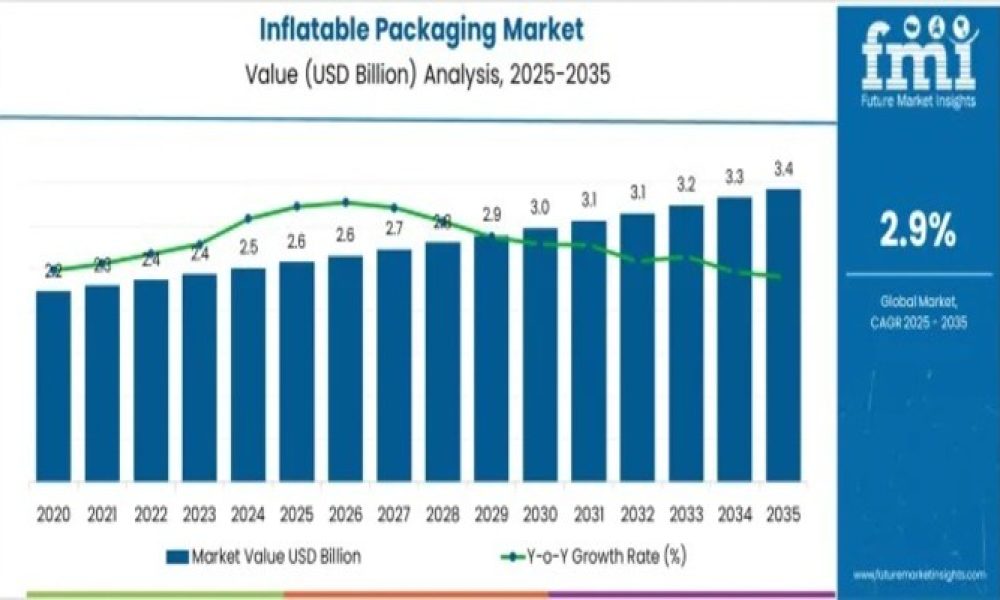
The global Inflatable Packaging Market is set to expand steadily over the next decade, supported by rising e-commerce activity, heightened focus on product protection, and increasing regulatory pressure to reduce packaging waste. Valued at USD 2.6 billion in 2025, the market is projected to reach USD 3.4 billion by 2035, growing at a compound annual growth rate (CAGR) of 2.9% during the forecast period.
Inflatable packaging widely used in the form of bubble wrap, air pillows, and inflated packaging bags has become a preferred solution across logistics-intensive industries due to its lightweight structure, cost efficiency, and superior cushioning performance. As global supply chains become more complex and customer expectations around damage-free delivery rise, demand for adaptable protective packaging solutions continues to strengthen.
Explore Opportunities – Get Your Sample of Our Industry Overview Now!
Quick Market Snapshot
- Market Value (2025): USD 2.6 billion
- Forecast Value (2035): USD 3.4 billion
- Forecast CAGR (2025–2035): 2.9%
- Leading Material Segment (2025): PE (LDPE & HDPE) – 45.0% share
- Leading Packaging Type (2025): Bubble Wrap – 50.0% share
- Key Growth Regions: North America, Asia-Pacific, Europe
Growth Drivers Reshaping the Inflatable Packaging Landscape
The market’s growth trajectory is being shaped by a combination of operational, environmental, and consumer-driven factors:
- Rising E-Commerce and Logistics Activity: Online retail expansion has amplified the need for reliable protective packaging that minimizes product damage and costly returns.
- Lightweight and Cost-Efficient Design: Inflatable packaging reduces freight weight, enabling lower transportation costs and reduced carbon emissions.
- Material Innovation: Advances in polymer science have improved durability, puncture resistance, and flexibility while using less material.
- Sustainability and Regulation: Increasing adoption of recyclable and reusable materials aligns inflatable packaging with circular economy goals.
Industries such as personal care, cosmetics, electronics, healthcare, and consumer goods are increasingly relying on inflatable solutions to balance product protection with sustainability commitments.
Polyethylene (PE) Emerges as the Leading Material
The PE (LDPE and HDPE) segment is projected to account for 45.0% of total market revenue in 2025, reinforcing its position as the most widely used material in inflatable packaging.
Key advantages driving PE adoption include:
- High strength-to-weight ratio for superior cushioning
- Excellent flexibility for customized packaging formats
- Cost-effectiveness at scale
- Compatibility with recycling initiatives
Continuous improvements in manufacturing efficiency and material consistency have further strengthened PE’s role across diverse end-use industries.
Bubble Wrap Continues to Dominate Packaging Types
Among packaging formats, bubble wrap is expected to command 50.0% of market revenue in 2025, driven by its versatility and proven performance.
- Superior protection for fragile and irregularly shaped items
- Ease of handling and application across fulfillment operations
- Reusability and recyclability supporting sustainability goals
- Reduced product damage and return rates in e-commerce shipments
Technological advancements have also enabled manufacturers to reduce material thickness while maintaining cushioning effectiveness, improving both cost and environmental efficiency.
Personal Care and Cosmetics Lead End-Use Demand
The personal care and cosmetics segment is anticipated to account for 20.0% of total market revenue in 2025, making it the largest end-use category.
Growth is fueled by:
- High product fragility and premium brand positioning
- Rapid growth of direct-to-consumer and e-commerce channels
- Need for visually appealing yet protective packaging
- Increased global consumption driven by urbanization and rising disposable income
Inflatable packaging plays a crucial role in preserving product integrity and brand reputation while optimizing shipping costs.
Sustainability Trends Gain Momentum
Environmental responsibility is becoming a defining competitive factor in the inflatable packaging industry.
Key sustainability-led developments include:
- Shift toward recyclable and paper-based alternatives, such as paper bubble solutions
- R&D investments focused on reducing plastic usage and carbon footprint
- Adoption of high recycled-content materials in air pillows and cushions
- Alignment with global packaging regulations and ESG reporting standards
These initiatives are positioning inflatable packaging as a viable alternative to traditional single-use protective materials.
Asia-Pacific Emerges as a High-Growth Region
Country-level analysis highlights strong growth momentum in Asia-Pacific markets:
- India: Growth is driven by online grocery, pharmacy deliveries, and expanding rural e-commerce penetration.
- China: Dominance in cross-border e-commerce and live-commerce platforms is accelerating demand for lightweight, customizable packaging.
- Thailand: Tourism growth and food delivery expansion are supporting increased adoption of protective inflatable solutions.
Competitive Landscape and Recent Developments
The inflatable packaging market remains moderately consolidated, with leading players focusing on sustainability, automation, and geographic expansion.
Key companies include:
- SEE (formerly Sealed Air Corporation)
- Pregis LLC
- Storopack Hans Reichenecker GmbH
- Smurfit Kappa Group
- Ranpak Holdings Corp.
Recent industry developments:
- March 2025: SEE launched an on-demand inflatable packaging system for medium-throughput operations.
- November 2025: SEE introduced air pillows containing a minimum of 95% recycled plastic, targeting sustainability-driven e-commerce clients.
Outlook: Steady Growth with Innovation at the Core
From 2025 to 2035, the inflatable packaging market is expected to maintain steady expansion as e-commerce penetration deepens, sustainability requirements tighten, and supply chains prioritize efficiency. Opportunities in temperature-sensitive packaging, niche applications, and emerging markets are likely to further diversify growth pathways.
Why FMI: https://www.futuremarketinsights.com/why-fmi
About Future Market Insights (FMI)
Future Market Insights, Inc. (FMI) is an ESOMAR-certified, ISO 9001:2015 market research and consulting organization, trusted by Fortune 500 clients and global enterprises. With operations in the U.S., UK, India, and Dubai, FMI provides data-backed insights and strategic intelligence across 30+ industries and 1200 markets worldwide.



