
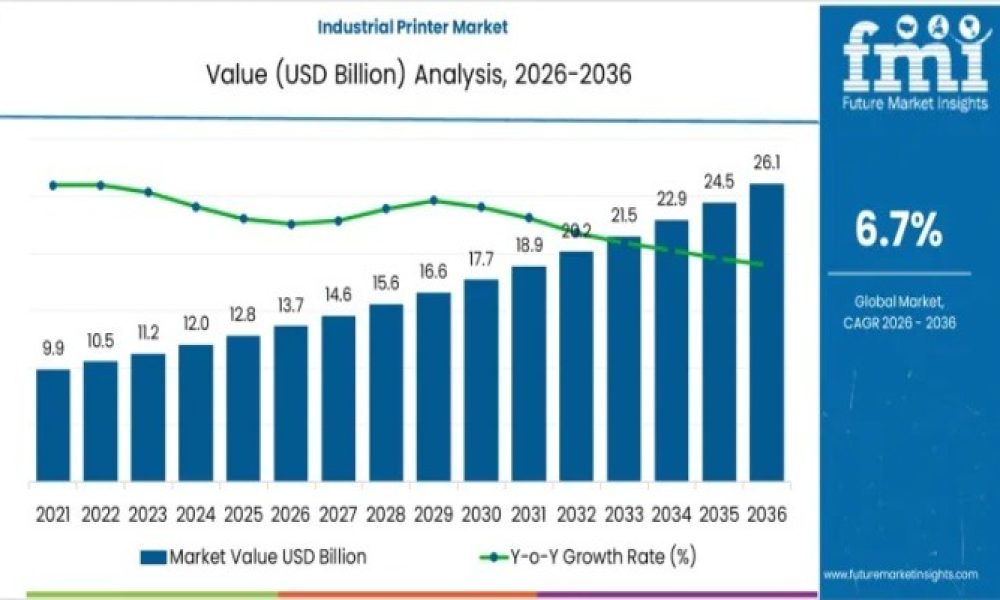
The global industrial printer market is entering a decade of steady, structurally driven expansion as manufacturing ecosystems deepen their reliance on traceability, compliance marking, and uninterrupted production workflows. Valued at USD 13.7 billion in 2026, the market is forecast to reach USD 26.3 billion by 2036, advancing at a CAGR of 6.7%. This growth trajectory reflects not discretionary technology refresh cycles, but a fundamental dependence on industrial printing as an operational backbone across modern supply chains.
Unlike consumer or office printing, industrial printer demand is anchored to serialized production, regulatory enforcement, and shipment approval requirements. From packaging lines to electronics assembly and logistics hubs, printers operate as mission-critical assets where uptime, code permanence, and data accuracy are non-negotiable. As a result, spending behavior aligns more closely with production density, output variability, and compliance exposure than with episodic capital upgrades.
Discover Growth Opportunities in the Market – Get Your Sample Report Now
Market Value Anchored in Operational Continuity
Revenue expansion in the industrial printer market is driven by two reinforcing forces: installed base growth and recurring consumables consumption. Inks, ribbons, and printheads generate continuous revenue streams tied directly to production throughput. This model anchors market value to operational continuity rather than one-time equipment replacement, while also reinforcing pricing discipline as buyers benchmark lifecycle costs carefully across vendors.
However, scalability is not without friction. Cost structures are shaped by consumables intensity, maintenance downtime risk, and the complexity of integrating printers into heterogeneous factory environments. Environmental sensitivity—such as dust, vibration, or temperature variation—introduces performance variability, increasing qualification and validation requirements before deployment. In legacy production lines, non-standardized interfaces can further slow adoption across multi-site manufacturing operations.
Quick Stats: Industrial Printer Market
- Market Value (2026): USD 13.7 billion
- Forecast Value (2036): USD 26.3 billion
- Forecast CAGR (2026–2036): 6.7%
- Leading Technology: Inkjet Printing
- Fastest-Growing Countries: China, India, USA, Germany, Japan
Why Demand for Industrial Printers Is Rising
Demand for industrial printers continues to grow as manufacturers require high-speed, high-quality marking solutions for labeling, coding, and identification across automated production lines. Industries such as automotive, electronics, pharmaceuticals, and consumer goods increasingly depend on printers that deliver durable output on metals, plastics, textiles, and packaging substrates.
Key demand drivers include:
- Rising enforcement of traceability, serialization, and regulatory compliance
- Expansion of automated identification and inventory systems
- Growth in contract manufacturing and customized production
- Increased need for variable data printing and rapid changeovers
- Integration of printers with enterprise software and MES platforms
Procurement teams now prioritize serviceability, consumable availability, and total cost of ownership over initial purchase price. As production complexity increases, manufacturers scaling operations seek printers capable of handling diverse substrates, formats, and duty cycles without compromising uptime.
Industrial Printer Market Segmentation Overview
Industrial printer adoption reflects the intersection of technology capability and application intensity. Equipment selection emphasizes durability, substrate compatibility, and continuous-duty performance under demanding industrial conditions.
By Technology Type: Inkjet Leads Global Demand
Inkjet printing systems account for 46.0% of total market demand, making them the dominant technology segment.
Key reasons for inkjet dominance include:
- Non-contact printing suitable for uneven or sensitive surfaces
- High-speed operation aligned with modern packaging lines
- Flexibility for variable data, barcodes, and serialization
- Seamless integration with digital workflows and automation systems
Other technologies—such as laser, thermal transfer, and dot matrix—continue to serve specialized durability, heat-resistance, or legacy applications, but within narrower operating envelopes.
By Application: Packaging and Labeling at the Core
Packaging and labeling represent 52.0% of total demand, driven by compliance, branding, and traceability requirements.
Application highlights include:
- Continuous marking on high-volume packaging lines
- Mandatory lot, batch, and expiry coding
- Growing logistics and distribution labeling needs
- Supplemental use in industrial manufacturing, electronics, and textiles
Global Growth Patterns Reflect Manufacturing Intensity
Geographically, market value concentrates in regions with dense manufacturing clusters, export-oriented production, and stringent coding regulations. Growth remains steady rather than explosive, shaped by automation penetration and compliance persistence.
Industrial Printer Market CAGR by Country:
- China: 8.1%
- India: 7.9%
- USA: 7.4%
- Germany: 6.6%
- Japan: 6.2%
China’s growth is fueled by large-scale electronics and consumer goods manufacturing, export compliance, and logistics expansion. India’s momentum reflects regulatory enforcement, pharmaceutical production growth, and formalization of packaging operations. In the USA, serialization mandates, automation investments, and replacement of aging installed bases sustain demand. Germany and Japan exhibit measured growth, driven by precision manufacturing, quality assurance, and disciplined capital spending within mature industrial ecosystems.
Competitive Landscape: Established Leaders and Emerging Innovators
The competitive landscape of the industrial printer market reflects a balance between established global manufacturers and newer technology-driven entrants seeking to expand their footprint. Buyers increasingly favor suppliers that combine robust hardware with software integration, service coverage, and lifecycle support.
Key global players include:
- HP Inc. – Leading with a broad portfolio of industrial inkjet systems and global service infrastructure
- Epson (Seiko Epson) – Strong presence in high-speed industrial inkjet and label printing platforms
- Canon – Industrial print solutions spanning large-format, commercial, and specialty applications
- Brother International – Durable industrial label printers widely deployed in manufacturing and warehousing
- Xerox – Digital press platforms and workflow software supporting automation and print quality
Alongside these leaders, emerging manufacturers are investing in new ink chemistries, smarter connectivity, and modular system designs to lower integration barriers and appeal to cost-sensitive, fast-scaling producers.
Why FMI: https://www.futuremarketinsights.com/why-fmi
About Future Market Insights (FMI)
Future Market Insights, Inc. (FMI) is an ESOMAR-certified, ISO 9001:2015 market research and consulting organization, trusted by Fortune 500 clients and global enterprises. With operations in the U.S., UK, India, and Dubai, FMI provides data-backed insights and strategic intelligence across 30+ industries and 1200 markets worldwide.



