
The increasing digitization and automation of industrial operations have transformed how industries operate across the globe. Industrial Control Systems (ICS) are at the core of this transformation, enabling real-time monitoring and management of critical infrastructure such as power grids, oil and gas pipelines, manufacturing plants, and water treatment facilities. However, this growing reliance on ICS also exposes industries to significant cyber threats, making security a top priority. The global Industrial Control Systems (ICS) security market is experiencing rapid growth, driven by the need to protect critical infrastructure, ensure operational resilience, and adopt next-generation technologies.
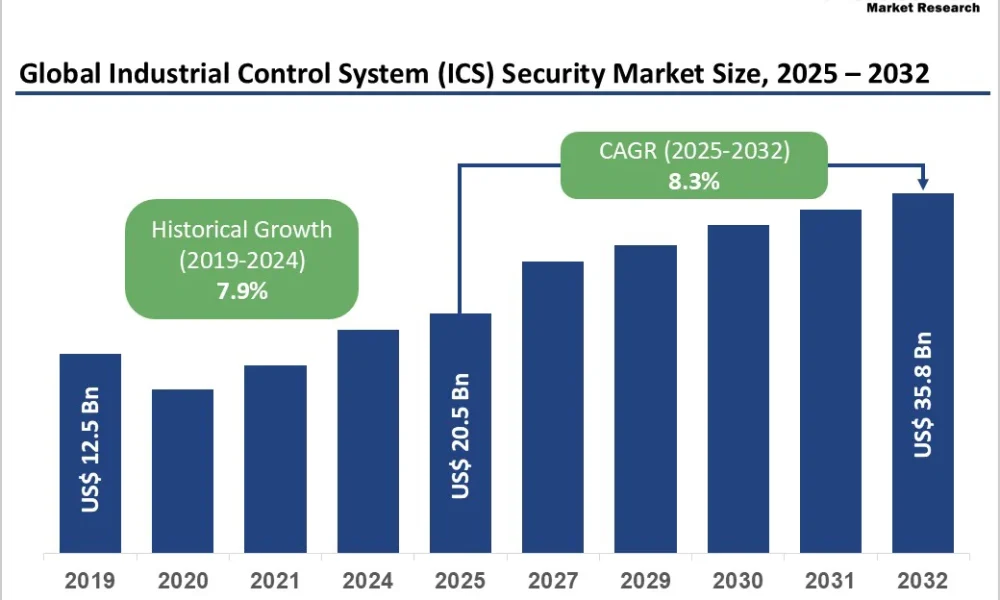
According to market estimates, the ICS security market is expected to reach US$20.5 billion in 2025, with projections indicating it will rise to US$35.8 billion by 2032, growing at a CAGR of 8.3% from 2025 to 2032. This growth is fueled by increasing cyber threats, the adoption of AI-based threat detection, OT/IT convergence, and regulatory requirements across various industries.
What are Industrial Control Systems (ICS) and Why is Security Critical?
Industrial Control Systems (ICS) refer to a variety of control systems used in industrial production and critical infrastructure. These systems include Supervisory Control and Data Acquisition (SCADA) systems, Distributed Control Systems (DCS), and Programmable Logic Controllers (PLC). ICS enable industries to automate operations, optimize efficiency, and maintain operational stability.
However, the growing integration of ICS with corporate IT networks, cloud computing platforms, and Internet of Things (IoT) devices has expanded the potential attack surface for cybercriminals. Threats such as ransomware attacks, malware infiltration, insider threats, and unauthorized remote access pose significant risks to operational continuity and public safety. As a result, ICS security has become essential for protecting critical infrastructure, safeguarding sensitive data, and ensuring regulatory compliance.
Market Drivers of ICS Security
Several key factors are driving the rapid growth of the ICS security market:
- Increasing Cyber Threats to Critical Infrastructure
Critical infrastructure sectors, such as energy, utilities, and manufacturing, are frequent targets of cyber attacks. High-profile incidents, including ransomware attacks on power grids and industrial espionage in manufacturing plants, have highlighted the need for robust ICS security. Organizations are now prioritizing proactive threat detection and incident response strategies to minimize potential operational and financial losses.
- OT/IT Convergence
Traditionally, Operational Technology (OT) networks operated separately from Information Technology (IT) systems. However, the convergence of OT and IT networks to enable smarter industrial operations has also increased security vulnerabilities. ICS security solutions are now essential to bridge this gap, ensuring seamless communication while mitigating cyber risks.
- Adoption of AI-based Threat Detection
Artificial intelligence (AI) and machine learning (ML) are revolutionizing ICS security. AI-powered solutions can detect anomalies, predict potential threats, and automate incident response. Predictive analytics enhances the ability to prevent attacks before they disrupt industrial operations, reducing downtime and operational losses.
- Regulatory Compliance and Zero-Trust Architecture
Governments and regulatory bodies are increasingly implementing stringent cybersecurity regulations for critical infrastructure. In the U.S., the Cybersecurity and Infrastructure Security Agency (CISA) mandates security protocols and risk management strategies for industrial networks. Additionally, zero-trust architectures are becoming essential, emphasizing identity verification and access control to limit unauthorized system access.
- Cloud and Smart Grid Deployments
The adoption of cloud-based SCADA systems and smart grid technologies is expanding industrial networks, increasing the attack surface for potential cyber threats. This has accelerated demand for advanced ICS security solutions that provide comprehensive protection for both on-premises and cloud-connected infrastructure.
Elevate your business strategy with comprehensive market data. Request a sample report now: https://www.persistencemarketresearch.com/samples/13426
Market Segmentation
The ICS security market can be analyzed across multiple segments, including components, security types, control system types, and end-use industries.
By Component
ICS security solutions are primarily categorized into solutions and services.
- Solutions dominate the market, holding approximately 60% of the market share. These include threat detection tools, firewalls, intrusion detection systems (IDS), antivirus solutions, and advanced endpoint security for industrial networks.
- Services complement these solutions by providing consulting, system integration, risk assessment, and managed security services.
By Security Type
Network security is the most critical aspect of ICS protection.
- Network Security accounts for over 40% of market revenue, driven by the need to secure industrial networks, prevent unauthorized access, and ensure real-time monitoring of cyber threats.
- Other security types include application security, endpoint security, and data security, which collectively enhance the overall resilience of industrial systems.
By Control System Type
- SCADA (Supervisory Control and Data Acquisition) systems are the most widely deployed, contributing nearly 45% of market revenue. SCADA systems are used for remote monitoring and control of industrial operations, making them a prime target for cyber threats.
- Other control systems include DCS and PLC, which also require dedicated security solutions to prevent operational disruptions.
By End-Use Industry
- Power and Utilities remain the leading end-use segment, with a 30% market share, due to the critical nature of electricity grids and water treatment facilities.
- Other industries include oil and gas, manufacturing, transportation, and chemical processing, all of which are increasingly adopting ICS security solutions to protect operational continuity and safeguard sensitive data.
Regional Insights
North America
North America is the leading region in ICS security, commanding a 38% market share in 2025. The dominance of this region is attributed to several factors:
- Stringent CISA regulations ensure robust cybersecurity practices for industrial operations.
- High prevalence of critical infrastructure such as power plants, oil refineries, and water treatment facilities.
- Strong R&D activities in cybersecurity technologies, particularly in the U.S., drive innovation and adoption of advanced ICS security solutions.
Asia Pacific
Asia Pacific is the fastest-growing region, driven by rapid industrialization, increasing awareness of OT security, and large-scale investments in smart grids and industrial automation. Countries like China and India are actively modernizing their industrial sectors, boosting demand for ICS security solutions.
Europe and Other Regions
Europe is also witnessing steady growth, supported by regulatory initiatives such as the NIS Directive, which mandates cybersecurity standards for critical infrastructure. Other regions, including the Middle East and Latin America, are gradually adopting ICS security solutions as they modernize industrial operations and digitalize critical infrastructure.
Key Market Trends
- Integration of AI and Predictive Analytics
The integration of AI-driven threat detection and predictive analytics is transforming ICS security. Organizations are now adopting intelligent systems capable of analyzing network traffic, detecting anomalies, and initiating automated responses. This proactive approach minimizes downtime and ensures operational resilience.
- Increasing Focus on Zero-Trust Architecture
Zero-trust architecture is emerging as a standard for ICS security, emphasizing identity verification and least-privilege access. This framework limits unauthorized access and prevents lateral movement of attackers within industrial networks.
- Proactive Threat Intelligence
Real-time threat intelligence is increasingly integrated into ICS security solutions. By continuously monitoring threat landscapes and sharing insights, organizations can proactively defend against emerging cyber threats.
- Expansion of Managed Security Services
Managed security services (MSS) for ICS are gaining popularity, especially among mid-sized enterprises that may lack in-house cybersecurity expertise. MSS providers offer continuous monitoring, threat detection, and incident response, ensuring comprehensive protection.
- Convergence of IT and OT Security
The convergence of IT and OT security is reshaping the market. Vendors are now offering unified solutions that provide end-to-end protection across industrial networks, IT infrastructure, and cloud-based systems, ensuring holistic security.
Challenges in ICS Security
Despite the market’s growth, several challenges remain:
- Legacy Systems: Many industrial facilities operate legacy systems that are difficult to secure and integrate with modern security solutions.
- Skill Shortages: A shortage of cybersecurity experts with knowledge of industrial environments hinders effective ICS protection.
- Complex Regulatory Requirements: Navigating varying regional and industry-specific regulations can be challenging for multinational organizations.
- High Cost of Implementation: Deploying advanced ICS security solutions can be costly, particularly for small and mid-sized enterprises.
Market Opportunities
The ICS security market offers several promising opportunities for vendors and stakeholders:
- AI-driven Security Solutions: Developing AI and ML-based tools for predictive threat detection and automated incident response presents significant growth potential.
- Industrial IoT Security: With the rise of Industrial IoT (IIoT) devices, securing connected devices offers a new revenue stream for ICS security providers.
- Cloud Security for ICS: As cloud-based SCADA and DCS systems become more prevalent, specialized cloud security solutions are in high demand.
- Integration with Compliance Solutions: Solutions that integrate ICS security with regulatory compliance monitoring are likely to see increased adoption.
Future Outlook
The Industrial Control Systems security market is expected to maintain strong growth over the coming decade, driven by digital transformation, increasing cyber threats, and regulatory compliance requirements. AI and predictive analytics, zero-trust architectures, and managed security services will be key enablers for future growth. Additionally, the expansion of industrial automation and smart grid deployments in Asia Pacific and other emerging markets will further propel market demand.
By 2032, the market is projected to reach US$35.8 billion, reflecting a robust CAGR of 8.3%. Organizations that prioritize proactive security measures, leverage advanced technologies, and adopt integrated solutions will be best positioned to mitigate risks and maintain operational resilience.
Conclusion
Industrial Control Systems are critical for the seamless operation of essential industries, from power and utilities to manufacturing and oil and gas. As these systems become more interconnected and reliant on digital technologies, the need for comprehensive ICS security becomes paramount. The market is growing rapidly, driven by increasing cyber threats, regulatory compliance, and technological advancements in AI and predictive analytics.
North America remains the leading region, while Asia Pacific emerges as the fastest-growing market, reflecting the global emphasis on protecting critical infrastructure. By adopting proactive security strategies, integrating AI-driven solutions, and leveraging zero-trust frameworks, industries can enhance resilience, minimize operational disruptions, and safeguard sensitive infrastructure.
The ICS security market is not just a response to growing cyber threats—it is a strategic enabler for operational excellence in an increasingly digital and interconnected industrial world.
Related Reports:




