
Market Overview
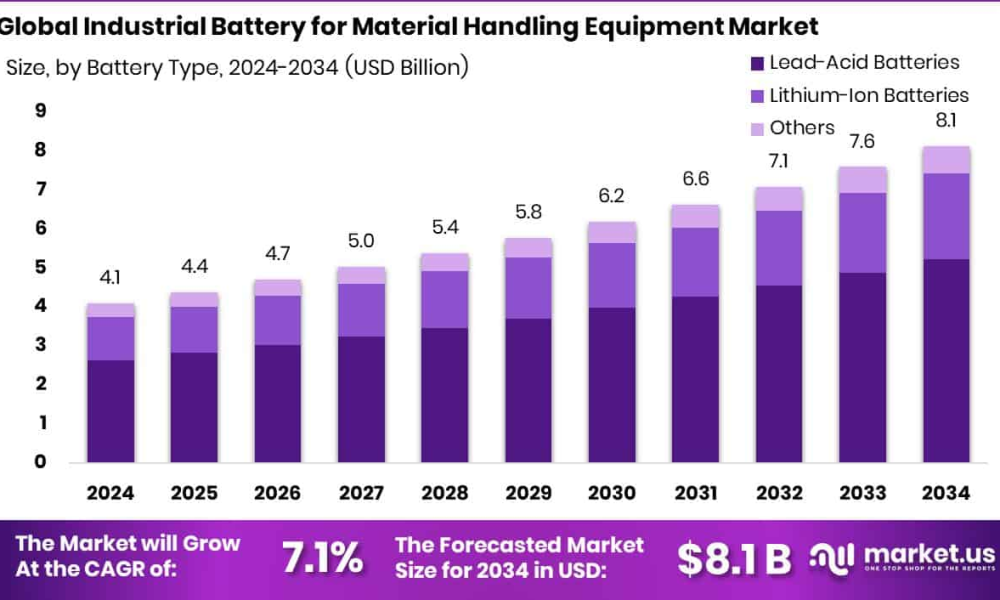
According to market.us, The global Industrial Battery for Material Handling Equipment Market is projected to reach approximately USD 8.1 billion by 2034, up from USD 4.1 billion in 2024, growing at a compound annual growth rate (CAGR) of 7.1% between 2025 and 2034. Europe currently leads the market, accounting for a 45.3% share, valued at around USD 1.8 billion. Industrial batteries serve as essential power sources for equipment used in handling and managing materials, such as forklifts, electric pallet jacks, and automated guided vehicles (AGVs).
These batteries are designed to deliver high performance, durability, and efficiency in demanding industrial environments, ensuring long operational lifespans. In India, efforts to enhance domestic battery manufacturing are accelerating. According to the Geological Survey of India (GSI), recently discovered lithium reserves could fulfill nearly 80% of the country’s total demand. India’s energy storage demand is expected to reach 903 GWh by 2030, with technologies including lithium-ion, redox flow, and solid-state batteries playing key roles.
The lithium-ion battery segment alone is projected to grow at a CAGR of 50%, from 20 GWh in 2022 to 220 GWh by 2030. To support this growth, the Indian government has committed approximately USD 2.5 billion under an incentive scheme to develop 50 GWh of Advanced Chemistry Cell (ACC) capacity and 5 GWh of niche ACC capacity. The National Programme on ACC Battery Storage, launched in 2021 with a budget of INR 18,100 crore, aims to establish giga-scale manufacturing facilities.
Further support was provided in the Union Budget for FY2025–26 through customs duty exemptions on 35 capital goods used in EV battery production, aimed at lowering costs and fostering local manufacturing capabilities. These initiatives are intended to position India as a competitive hub for ACC battery production and to promote both domestic use and export opportunities.
Important Revelation
- Global Industrial Battery for Material Handling Equipment Market is expected to be worth around USD 8.1 billion by 2034, up from USD 4.1 billion in 2024, and grow at a CAGR of 7.1% from 2025 to 2034.
- Lead-Acid Batteries dominate with a 64.3% share, preferred for their reliability and cost-effectiveness.
- Batteries ranging from 301 Ah to 800 Ah hold a 47.4% market share, supporting medium to high-capacity needs.
- Forklifts represent the largest application area, commanding a 52.8% market share due to widespread use.
- Warehousing and Distribution lead in end-use, with a 37.1% share, driven by the growth in e-commerce.
- Strong warehouse automation in Europe drives 45.3% market share, reaching USD 1.8 Bn.
Download Exclusive Sample Of This Premium Report (Including Full TOC, Table & Figures): https://market.us/report/global-industrial-battery-for-material-handling-equipment-market/free-sample/
Factors Affecting the Growth of the Industrial Battery for Material Handling Equipment Market
- Rapid Industrial Automation and E-commerce Growth: The rising demand for efficient warehouse and logistics operations, especially in sectors such as e-commerce, retail, and manufacturing, is significantly boosting the adoption of electric material handling equipment. Equipment such as electric forklifts and automated guided vehicles (AGVs) require reliable and high-performance battery systems, thereby driving demand for industrial batteries.
- Shift Toward Electrification and Emission Reduction: There is a global shift from internal combustion engine-based equipment to electric alternatives in material handling, driven by stricter emission norms and sustainability targets. Electric-powered machinery not only reduces carbon emissions but also offers lower operating costs and maintenance, making industrial batteries an attractive investment.
- Advancements in Battery Technologies: Technological improvements in battery chemistry, particularly lithium-ion, have led to higher energy density, longer cycle life, and faster charging capabilities. These advancements support round-the-clock operations in demanding industrial settings and reduce equipment downtime, contributing to increased adoption.
- Government Incentives and Policy Support: Governments across key markets are providing substantial support to promote battery manufacturing and adoption. For instance, the Indian government launched the National Programme on Advanced Chemistry Cell (ACC) Battery Storage with a budget of INR 18,100 crore to establish large-scale battery manufacturing facilities. The Union Budget for FY2025–26 also introduced customs duty exemptions on capital goods used in EV battery production to lower manufacturing costs.
- Domestic Lithium Resource Development: The discovery of significant lithium reserves in India—enough to meet nearly 80% of national demand—has the potential to reduce reliance on imports and enhance local battery production. This aligns with broader goals to strengthen domestic supply chains and boost self-sufficiency in critical battery materials.
Report Segmentation
By Battery Type Analysis: In 2024, Lead-Acid Batteries held a leading position in the “By Battery Type” segment of the Industrial Battery for Material Handling Equipment Market, accounting for 64.3% of the total share. These batteries continue to be widely adopted due to their cost efficiency, ease of availability, and dependable performance in demanding industrial environments. Their rugged construction and capacity to endure deep discharge cycles make them particularly suitable for equipment like forklifts, especially in medium-to-large warehouses where durability and budget-conscious solutions are prioritized. While lithium-ion batteries are gaining attention for their advanced features, their higher initial cost has led to slower adoption, particularly in price-sensitive sectors. As a result, the dominance of lead-acid batteries reflects the market’s ongoing preference for tried-and-tested technologies.
By Battery Capacity Analysis: Batteries with a capacity range between 301 Ah and 800 Ah captured a significant 47.4% market share in the “By Battery Capacity” segment in 2024. This capacity range is favored for its ability to support longer operating hours without frequent recharging, meeting the demands of standard forklifts and electric pallet jacks. These batteries are extensively used in high-throughput logistics centers and warehousing facilities where energy reliability and minimal downtime are critical. Their balance of energy density, cost, and operational efficiency makes them a preferred choice across industries such as manufacturing, freight distribution, and retail logistics.
By Application Analysis: Forklifts emerged as the dominant application in 2024, holding a commanding 52.8% share in the “By Application” segment of the market. Forklifts are essential across industrial and warehousing operations for tasks such as loading, unloading, and transporting goods internally. Their effectiveness is directly tied to battery performance, especially as electric models become standard in modern logistics. The continued growth of e-commerce and the shift toward 24/7 warehouse operations have further intensified the demand for reliable and long-lasting battery solutions in forklifts, reinforcing this segment’s leading role in the market.
By End-Use Analysis: Warehousing and Distribution led the “By End-Use” segment in 2024, securing a 37.1% market share. These facilities rely heavily on battery-powered material handling equipment to maintain smooth inventory flow, enhance logistics operations, and reduce manual handling delays. The growing deployment of electric forklifts, reach trucks, and stackers in warehouse environments is directly contributing to the demand for industrial batteries. This dominance is further driven by the expansion of warehousing infrastructure across logistics hubs and industrial parks, where operational efficiency and sustainability are key priorities.
To Purchase this Premium Report@ https://market.us/purchase-report/?report_id=146437
Market Key Segmentation List
By Battery Type
- Lead-Acid Batteries
- Lithium-Ion Batteries
- Others
By Battery Capacity
- Up to 300 Ah
- 301 Ah to 800 Ah
- Above 800 Ah
By Application
- Forklifts
- Automated Guided Vehicles (AGVs)
- Reach Trucks
- Pallet Jacks
- Warehouse Management Systems
- Others
By End-Use
- Warehousing and Distribution
- Manufacturing
- Retail
- Food and Beverage
- Pharmaceuticals
- Others
Regional Analysis
In 2024, Europe emerged as the leading region in the Industrial Battery Market for Material Handling Equipment, capturing a 45.3% share valued at USD 1.8 billion. This dominant position is driven by the region’s well-developed logistics infrastructure, extensive warehouse automation, and the rising use of electric material handling equipment in countries such as Germany, France, and the United Kingdom.
North America followed as a key market, bolstered by strong industrial activity and the rapid expansion of e-commerce fulfillment centers that increasingly rely on battery-powered forklifts and pallet trucks. Meanwhile, the Asia Pacific region is witnessing growing demand, fueled by the rise of large-scale manufacturing hubs in China, India, and Southeast Asia. These regions are investing heavily in logistics and warehousing capabilities, particularly in high-density industrial zones, further supporting the adoption of industrial batteries for efficient material handling operations.
Competitive Landscape
- Trojan Battery
- Valence Technology
- Exide
- Crown Battery
- EverExceed
- HOPPECKE
- MIDAC Batteries
- Navitas System
- BYD Company Limited
- East Penn Manufacturing Co., Inc.
- EnerSys
- GS Yuasa Corporation
- Johnson Controls International plc
- Panasonic Corporation
- Saft
Recent Developments
- In March 2025, Trojan launched the Lithium OnePack™ XR, a 48V, 171Ah lithium-ion battery specifically engineered for golf carts and low-speed vehicles. This advanced battery pack delivers a range of up to 75 miles on a single charge—an improvement of approximately 30 miles over conventional 105Ah battery models, significantly boosting vehicle performance and efficiency.
In October 2024, the company introduced the Solition battery, a lithium iron phosphate solution tailored for forklifts and automated guided vehicles (AGVs). Offering over 98% charging efficiency and a lifespan of up to 4,000 cycles, the Solition battery enhances operational reliability while helping reduce long-term energy and maintenance costs.
Get in Touch with Us
Market.us (Powered By Prudour Pvt. Ltd.)
Address: 420 Lexington Avenue, Suite 300 New York City, NY 10170, United States
Send Email: [email protected]



