
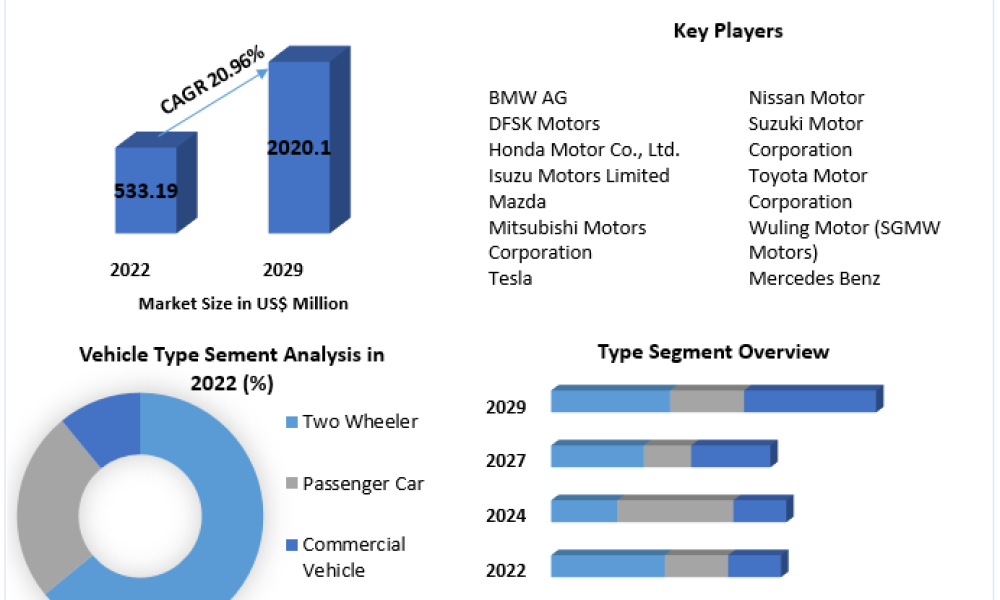
As per a recent study released by Maximize Market Research, titled, “Indonesia Electric Vehicle Market,” The Indonesia electric vehicle market was valued at USD 533.19 million in 2022 and is estimated to grow at a CAGR of 20.96%, reaching around USD 2,020 million by 2029.
Indonesia Electric Vehicle Market Overview:
The Indonesia electric vehicle (EV) market encompasses battery electric vehicles (BEVs), plug-in hybrid electric vehicles (PHEVs), and hybrid electric vehicles (HEVs), covering segments such as two-wheelers, passenger cars, and commercial vehicles. As Indonesia accelerates its efforts toward decarbonization, the EV market is receiving increasing attention from both policy makers and industry players.
Rising environmental concerns, increasing fuel prices, and urban air quality challenges are motivating consumers and governments to adopt cleaner mobility solutions. Moreover, Indonesia’s strategic position as a major global nickel producer gives it a potential competitive edge in the EV battery supply chain, which is helping to attract investment into local EV manufacturing and battery facilities.
Download a Free Sample Report Today :https://www.maximizemarketresearch.com/request-sample/65817/
Indonesia Electric Vehicle Market Dynamics
On the driver side, a key growth engine is Indonesia’s rich nickel reserves and the national push to localize battery and EV component manufacturing. By leveraging nickel as a core raw material, Indonesia aims to move up the EV value chain, reducing dependence on imports and improving domestic competitiveness. Policy incentives play a major role: recent tax breaks, import duty reductions, and lowered value-added tax (VAT) for EVs are intended to stimulate both supply and demand.
However, the EV market in Indonesia faces challenges. Charging infrastructure outside major urban centers remains sparse, limiting EV adoption beyond city areas. The high upfront cost of EVs compared to conventional internal combustion engine (ICE) vehicles is another barrier, especially for price-sensitive consumers. In addition, local vehicle production capacity is still maturing, which constrains the affordability and availability of EV models tailored to domestic demand.
Indonesia Electric Vehicle Market Outlook and Future Trends :
Looking ahead to 2023–2029, the Indonesia EV market is expected to follow a steep upward trajectory thanks to continued supportive policies, rising consumer acceptance, and improved infrastructure rollout. The projected growth toward USD 2,020 million by 2029 reflects both expanding vehicle sales and deeper market penetration into new vehicle segments.
Key trends likely to shape the next phase include:
Localization and vertical integration: More automakers and battery firms will invest in Indonesia to create integrated battery-EV ecosystems leveraging nickel.
Charging network expansion and smart infrastructure: Deployment of fast-charging stations, interoperability, and grid integration will become priorities to reduce range anxiety.
Affordable EV models and financing innovations: To reach mass adoption, manufacturers may focus on lower-cost EVs and flexible financing or leasing options.
Hybrid powertrain and transitional models: Hybrids and plug-in hybrids might serve as transitional offerings in regions where full electrification is less feasible immediately.
Indonesia Electric Vehicle Market Regional Insights:
Within Indonesia, EV uptake is strongest in metropolitan and Java-based regions, where incomes are higher and infrastructure is better developed. Cities such as Jakarta, Surabaya, and Bandung are expected to lead in EV penetration due to more aggressive policy support, better charging access, and greater consumer awareness. Outside Java, uptake is likely to lag initially but may accelerate with government incentives and infrastructure investments.
Some regions with abundant nickel mining (e.g., parts of Sulawesi and Maluku) are poised to benefit from upstream battery processing and related industrial investments, potentially turning them into localized EV or battery clusters. Success in these areas will depend heavily on logistics, grid capacity, and local incentives to encourage manufacturing and charging deployment.
Indonesia Electric Vehicle Market Segmentation
by Type
• BEV
• PHEV
• HEV
by Vehicle Type
• Two Wheeler
• Passenger Car
• Commercial Vehicle
Some of the current players in the Indonesia Electric Vehicle Market are:
• BMW AG
• DFSK Motors
• Honda Motor Co., Ltd.
• Isuzu Motors Limited
• Mazda
• Mitsubishi Motors Corporation
• Nissan Motor
• Suzuki Motor Corporation
• Toyota Motor Corporation
• Wuling Motor (SGMW Motors)
• Mercedes Benz
• Tesla
About Maximize Market Research:
Maximize Market Research is one of the fastest-growing market research and business consulting firms serving clients globally. Our revenue impact and focused growth-driven research initiatives make us a proud partner of majority of the Fortune 500 companies. We have a diversified portfolio and serve a variety of industries such as IT & telecom, chemical, food & beverage, aerospace & defense, healthcare and others.
Contact Maximize Market Research:
MAXIMIZE MARKET RESEARCH PVT. LTD.
⮝ 3rd Floor, Navale IT park Phase 2,
Pune Banglore Highway, Narhe
Pune, Maharashtra 411041, India.
✆ +91 9607365656
🖂 [email protected]




