
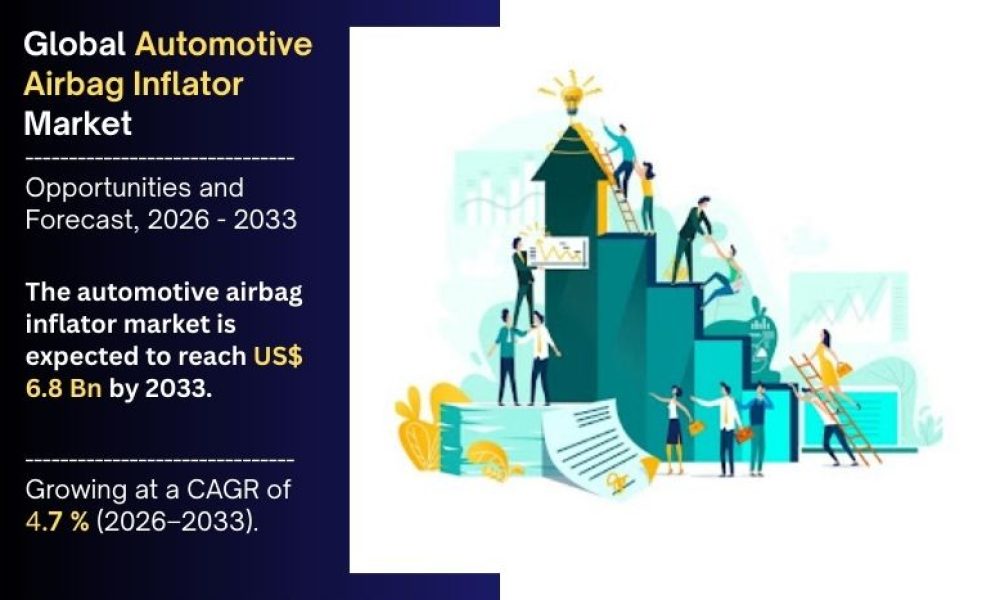
The global automotive airbag inflator market is poised for steady growth over the coming decade, with an estimated market valuation of USD 4.9 billion in 2026. Market projections indicate a rise to USD 6.8 billion by 2033, reflecting a compound annual growth rate (CAGR) of 4.7% during the forecast period from 2026 to 2033. This growth trajectory is largely driven by increasing safety concerns among consumers, stringent automotive safety regulations across major regions, and the growing adoption of advanced driver assistance systems (ADAS) in modern vehicles.
A surge in vehicle production, especially in emerging markets, coupled with rising awareness of passenger safety and the adoption of technologically enhanced inflators, further supports market expansion. Additionally, the trend toward lightweight, energy-efficient vehicles is promoting the development of compact, high-performance airbag inflators that meet both regulatory and consumer expectations. As automotive manufacturers continue to prioritize occupant protection, the airbag inflator market is witnessing consistent demand across passenger cars, commercial vehicles, and electric vehicles alike.
Get Your FREE Sample Report Instantly Click Now: https://www.persistencemarketresearch.com/samples/34902
Market Segmentation
By Product Type
- Pyrotechnic Inflator
- Stored Gas Inflator
- Hybrid Inflator
By Component Type
- Airbag Inflator Filter
- Airbag Tubes
- Others
By Vehicle Type
- Passenger Vehicle
- Light Commercial Vehicle
By Region
- North America
- Europe
- Asia Pacific
- Latin America
- Middle East & Africa
Regional Insights
North America and Europe are currently leading the automotive airbag inflator market, collectively accounting for a significant portion of global demand. The presence of stringent safety regulations, including U.S. Federal Motor Vehicle Safety Standards (FMVSS) and European New Car Assessment Program (Euro NCAP) guidelines, has driven high adoption rates of advanced airbag inflators across passenger and commercial vehicles.
The Asia Pacific region is emerging as the fastest-growing market, fueled by rapid urbanization, rising disposable incomes, and increased vehicle production in countries like China, India, and Japan. Government initiatives promoting vehicle safety standards, coupled with expanding automotive manufacturing hubs, are accelerating the deployment of airbag systems. Additionally, the growing presence of global automotive OEMs in the region and increasing penetration of EVs and hybrid vehicles further enhance market growth prospects in Asia Pacific.
Customize This Report for Your Exact Requirements: https://www.persistencemarketresearch.com/request-customization/34902
Unique Features and Innovations in the Market
Modern airbag inflators are distinguished by their enhanced safety, compact design, and integration with smart automotive technologies. Companies are increasingly incorporating AI-driven algorithms to optimize airbag deployment timing based on crash severity, occupant size, and seating position. IoT-enabled inflators allow for real-time monitoring and predictive maintenance, ensuring reliability and minimizing operational risks. The adoption of 5G connectivity further enhances system responsiveness, enabling faster data transmission between vehicle sensors and inflator units.
Innovations also include multi-stage and variable-output inflators that adapt deployment pressure based on the nature of the collision, reducing the risk of injury while maintaining optimal protection. Sustainable materials and eco-friendly pyrotechnic compounds are being developed to meet environmental regulations and reduce the carbon footprint associated with airbag deployment.
Market Highlights
The automotive airbag inflator market is driven by several key factors. Foremost among these is regulatory compliance, as governments worldwide mandate the inclusion of airbags in new vehicles to improve occupant safety. Businesses are increasingly adopting advanced inflator solutions to reduce liability risks and enhance vehicle safety ratings, which in turn influences consumer purchasing decisions.
Cost reduction through lightweight and efficient inflator designs, coupled with the ability to integrate with ADAS, adds further value for manufacturers. Sustainability also plays a critical role, with innovations focusing on environmentally friendly propellants and recyclable components. Overall, the market is characterized by the convergence of safety, efficiency, and technological advancement, creating a compelling growth environment for both established players and new entrants.
Key Players and Competitive Landscape
The automotive airbag inflator market features a competitive landscape with several global leaders driving innovation and expansion. Key players include:
- Autoliv Inc. – A global leader in automotive safety systems, Autoliv continues to focus on advanced airbag technologies, including multi-stage inflators and AI-enabled safety solutions, while expanding its manufacturing footprint in Asia.
- Daicel Corporation – Recognized for its high-performance pyrotechnic and hybrid inflators, Daicel emphasizes research in environmentally sustainable propellants and collaborates with OEMs on next-generation safety systems.
- Joyson Safety Systems – Focused on integrating airbags with smart vehicle electronics, Joyson is expanding its presence in the EV sector and advancing connected inflator solutions.
- Takata Corporation (Now part of Key Safety Systems) – Specializes in inflator reliability and large-scale production, leveraging its expertise to deliver innovative hybrid solutions in global markets.
- Hankook Tire & Technology Group – While traditionally a tire manufacturer, Hankook has diversified into vehicle safety systems, targeting niche inflator markets with advanced compact designs.
These companies adopt strategies ranging from regional expansion, partnerships with automotive OEMs, and continuous R&D investments to maintain competitive advantage in the rapidly evolving market. Product innovations, particularly in the areas of multi-stage and smart inflators, are central to their growth strategies.
Recent Developments
- Launch of AI-Enabled Inflators: Several leading manufacturers have introduced AI-powered airbag inflators capable of adjusting deployment intensity based on crash analytics, improving occupant safety and reducing injury risks.
- Expansion into Asia Pacific: Major players have established new production facilities and strategic partnerships in China and India to meet rising demand in the fastest-growing regional market.
Ready to Dive Deep? Buy Full Report Today: https://www.persistencemarketresearch.com/checkout/34902
Future Opportunities and Growth Prospects
Looking ahead, the automotive airbag inflator market is poised for sustained growth, driven by evolving vehicle technologies, stricter safety regulations, and the increasing popularity of EVs and autonomous vehicles. Opportunities exist in developing ultra-compact, lightweight inflators compatible with battery-electric vehicles, as well as in smart, connected systems that integrate with ADAS and predictive crash detection technologies.
Emerging regulations emphasizing vehicle safety, crashworthiness, and environmental sustainability are expected to shape product development, compelling manufacturers to innovate further. Advanced propellants, recyclable materials, and integration with AI and IoT will remain critical areas of focus, enhancing performance while meeting stringent environmental and safety standards.
The convergence of these trends ensures a dynamic and competitive environment, where technological sophistication, regulatory compliance, and market expansion will define the next phase of growth for the global automotive airbag inflator market. As the industry moves toward smarter, safer, and more sustainable solutions, businesses positioned at the intersection of innovation and regulatory adherence will likely reap the greatest benefits in the years ahead.




