
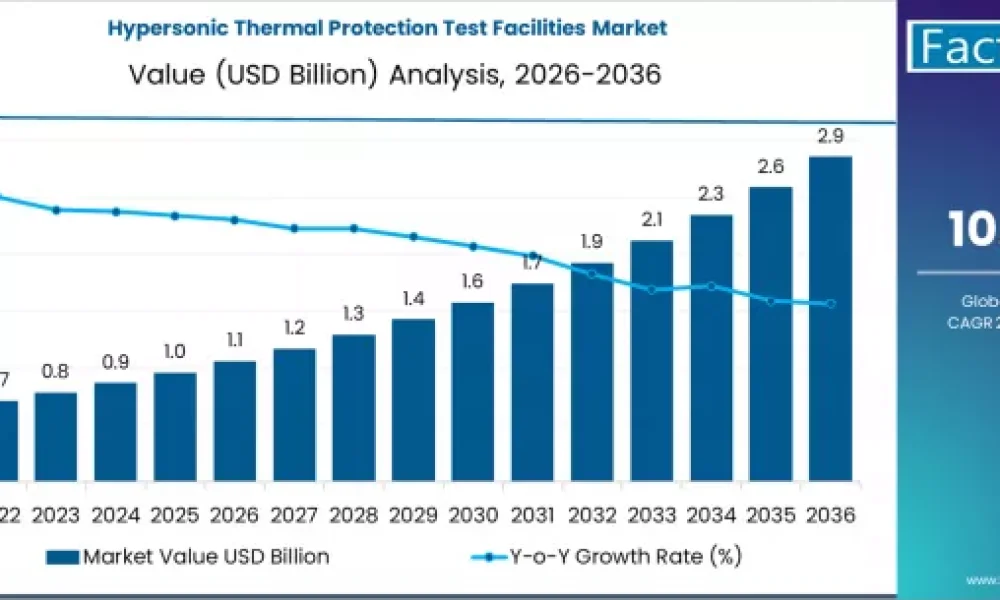
The Hypersonic Thermal Protection Test Facilities Market is projected to witness robust growth through 2036, driven by the rapid development of hypersonic vehicles, advanced missile systems, reusable launch vehicles, and space exploration programs. Hypersonic flight—typically defined as speeds above Mach 5—poses extreme thermal and aerodynamic challenges that require advanced thermal protection systems (TPS). As a result, the demand for specialized test facilities capable of simulating high-temperature environments and validating TPS performance is increasing across aerospace, defense, and space research organizations globally.
Thermal protection test facilities play a crucial role in evaluating materials, coatings, and structural components under conditions that mimic the intense heat flux, pressure, and shock environments encountered at hypersonic speeds. These facilities support development programs by providing reliable data that inform design decisions, improve safety margins, and reduce development risks. As countries pursue strategic hypersonic capabilities and private spaceflight continues to expand, the market for test infrastructure and services is expected to grow substantially.
Market Outlook (2026–2036)
Market Value (2026): USD 890.6 million
Market Forecast Value (2036): USD 2,456.8 million
Forecast CAGR (2026–2036): 11.2%
Leading End Uses: Aerospace manufacturers, defense research establishments, space agencies
Growth Drivers: Defense modernization, space exploration, commercial hypersonic craft development
Key Regions: North America, Europe, Asia Pacific
To Access the Complete Data Tables & in-depth Insights, Request a Discount on this report: https://www.factmr.com/connectus/sample?flag=S&rep_id=13091
Market Overview
Hypersonic thermal protection test facilities provide controlled environments in which prototype materials and systems can be subjected to extreme thermal loads, rapid heating cycles, and aerodynamic forces. Facilities include plasma wind tunnels, arc heaters, shock tubes, high-enthalpy tunnels, and other advanced test rigs that replicate the aerodynamic heating and pressure conditions experienced by hypersonic vehicles.
Testing conducted in these facilities enables engineers to assess thermal resistance, ablation characteristics, structural integrity, and material degradation. The data generated support certification, material selection, and optimization of thermal protection systems for reusable launch vehicles, hypersonic missiles, space re-entry capsules, and high-speed aircraft.
Key Growth Drivers
1. Expansion of Hypersonic Programs in Defense and Security
Defense agencies across multiple nations are investing heavily in hypersonic weapons, reconnaissance platforms, and counter-hypersonic defense systems. These initiatives require extensive testing of thermal protection technologies to ensure performance under extreme conditions. As hypersonic programs accelerate, dedicated test facilities are emerging as essential infrastructure investments.
2. Increased Commercial Space Activities
The commercial space sector is growing rapidly, with private companies developing reusable launch vehicles, space tourism platforms, and high-speed atmospheric flight concepts. These systems require advanced thermal protection validated through rigorous testing. Private aerospace firms are investing in test infrastructure or collaborating with government-owned facilities to support development cycles and reduce time-to-market.
3. Government and Agency Funding for Research Infrastructure
Government space agencies, national laboratories, and research institutions are increasing funding for advanced test facilities that support next-generation aerospace technologies. Public-sector investments are critical for maintaining technological leadership and supporting domestic R&D, making test infrastructure a priority in national aerospace agendas.
4. Technological Innovation and Material Advances
Advances in thermal protection materials—such as ultra-high temperature ceramics, composite ablative systems, and carbon-based heat shields—necessitate specialized test environments that can simulate real-world conditions. As material science evolves, the need for sophisticated testing capabilities that provide accurate performance data will expand.
Market Segmentation Insights
By Facility Type
Plasma Wind Tunnels: Simulate high-enthalpy, high-temperature flows for aerodynamic and material testing.
Arc Heater Facilities: Provide intense thermal loads to assess ablation and surface response.
Shock Tubes and Shock Tunnels: Enable rapid transient testing of materials under controlled pressure and temperature shocks.
Hypersonic Blowdown Tunnels: Replicate sustained high-speed flow conditions.
Other Specialized Test Rigs: Include radiant heating systems, laser thermal simulators, and combined environment chambers.
By End Use
Aerospace Manufacturers: Major adopters as companies develop reusable vehicles and advanced flight systems.
Defense and Military Research: Significant demand for testing thermal protection on high-speed weapons and reconnaissance systems.
Space Agencies and Research Institutions: Use facilities to evaluate materials for re-entry vehicles, planetary probes, and crewed spacecraft.
Academic and Collaborative Research Programs: Universities and consortia involved in hypersonic research contribute to market demand.
Regional Demand Dynamics
North America is anticipated to hold a leading share of the market due to extensive defense spending, strong aerospace manufacturing presence, and established testing infrastructure. The United States remains a focal point for hypersonic development programs and public-private research collaborations.
Europe is also a key regional market, supported by coordinated research efforts, government funding for aerospace technology, and growing commercial space activities. European nations are expanding high-enthalpy testing capabilities to support domestic and collaborative projects.
Asia Pacific is expected to exhibit rapid growth as China, India, Japan, and other countries increase investment in hypersonic research, space exploration, and defense modernization programs. Regional test infrastructure is expanding to support state-backed and commercial technological initiatives.
Emerging markets in Latin America, the Middle East, and Africa are gradually developing capabilities as regional aerospace and research initiatives gain traction.
Competitive Landscape
The hypersonic thermal protection test facilities market is moderately competitive and characterized by large government-funded research establishments, specialized test service providers, and partnerships between aerospace companies and public agencies. Key players invest in facility upgrades, capabilities expansion, and technology enhancements to support high-fidelity testing.
Strategic collaborations between defense contractors, research consortia, and material developers are common, enabling shared use of expensive test assets and cross-institutional innovation. Competitive differentiation often centers on test accuracy, environment range, scalability, and advanced data analytics capabilities.
Challenges and Market Restraints
Despite the strong growth outlook, the market faces challenges including high capital expenditure for facility construction and maintenance, complex regulatory approval processes, and a limited number of high-end test installations capable of replicating true hypersonic conditions. Additionally, long development cycles and specialized technical expertise requirements can slow adoption among smaller firms.
Future Outlook
The hypersonic thermal protection test facilities market is expected to sustain strong growth through 2036 as global hypersonic programs mature and demand for advanced testing capabilities rises. Continued innovation in materials and propulsion systems will further drive the need for sophisticated test environments. Strategic investments by governments, expanding commercial aerospace initiatives, and collaborative research platforms are set to enhance market prospects.
As hypersonic technologies transition from research phases to operational deployment, thermal protection testing will remain critical for ensuring safety, performance, and regulatory compliance across military, space, and commercial applications.
Have specific requirements or need assistance on report pricing or have a limited budget? Please contact [email protected]
About Fact.MR:
Fact.MR is a global market research and consulting firm, trusted by Fortune 500 companies and emerging businesses for reliable insights and strategic intelligence. With a presence across the U.S., UK, India, and Dubai, we deliver data-driven research and tailored consulting solutions across 30+ industries and 1,000+ markets. Backed by deep expertise and advanced analytics, Fact.MR helps organizations uncover opportunities, reduce risks, and make informed decisions for sustainable growth



