

Hydrogen Energy Storage Market Overview
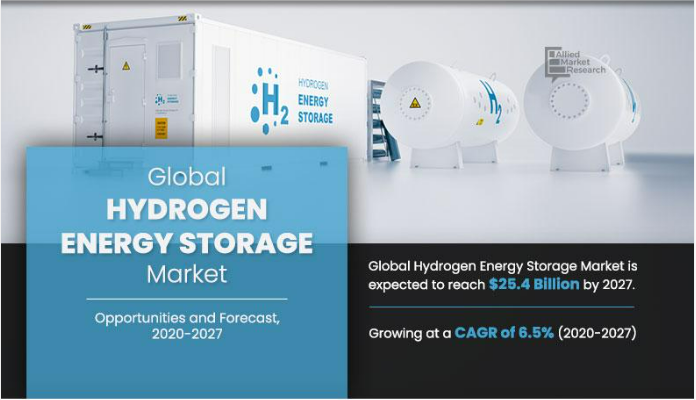
According to a new report published by Allied Market Research, The global hydrogen energy storage market size was valued at $15.4 billion in 2019, and is projected to reach $25.4 billion by 2027, growing at a CAGR of 6.5% from 2020 to 2027.
What is Hydrogen Energy Storage?
Hydrogen energy storage involves the production, storage, and use of hydrogen as a means to store excess energy generated from renewable sources. It serves as a flexible and efficient solution for balancing energy supply and demand.
Download PDF Brochure: https://www.alliedmarketresearch.com/request-sample/10943
The Asia-pacific region dominated the hydrogen energy storage market with around 47% revenue share in 2019.
Asia-Pacific accounted for highest revenue share, owing to the impact of productivity improvements. The emerging economies in Asia-Pacific are adopting various foreign equipment; thus, improving the production efficiency.
Some of the key players profiled in the global hydrogen energy storage industry report include Air Liquide (France), Air Products and Chemicals, FuelCell Energy, Hexagon Composites, Hydrogenics, ITM Power, Linde, Nel Hydrogen, Plug Power, and Worthington Industries.
Proliferating demand for sustainable energy resource is expected to drive the hydrogen energy storage market growth.
Hydrogen energy storage as a replacement of conventional fossil fuel energy is expected to foster the market growth.
As governments across the globe are focusing more on decarbonization, the market is expected to witness steady growth during the forecast period.
High capital cost of liquid hydrogen and solid hydrogen energy storage is a big challenge for small and medium scale applications.
Liquid hydrogen storage involves high insulation cost to prevent vaporization.
The solid hydrogen storage segment is projected to grow at the highest CAGR of approximately 9.2%, in terms of revenue, during the forecast period.
Key Characteristics
- Production Methods:
- Electrolysis: Splitting water into hydrogen and oxygen using electricity, typically from renewable sources.
- Steam Methane Reforming (SMR): A common method using natural gas, though it emits CO₂.
- Storage Techniques:
- Compressed Hydrogen: Stored in high-pressure tanks.
- Liquid Hydrogen: Cooled to extremely low temperatures for storage.
- Chemical Storage: Hydrogen is stored in chemical compounds, which release hydrogen when needed.
- Energy Density:
- Hydrogen has a high energy density by weight, making it a potent energy carrier.
By application, the transportation segment held more than 50% market share with a CAGR of 6.1%, in terms of revenue, during the forecast period.
The storage cost of solid hydrogen is high compared to other types of fuel. Nonetheless, large number of new incentive schemes, coupled with robust investment from industry players will provide further opportunities in the hydrogen energy storage market growth.
Hydrogen energy storage is the process to store the excess amount of energy through electrolysis. In this process, the hydrogen is separated from chemical solution.
Buy This Report (445 Pages PDF with Insights, Charts, Tables, and Figures): https://bit.ly/3YppRmp
The hydrogen energy can be stored in liquid, solid, and gaseous form. The solid hydrogen energy is stored by absorption through a solid-state material. Hydrogen energy storage is widely used in fuel cell technologies for stationary power and transport applications.
Advantages
- Renewable Integration: Helps store excess energy from solar, wind, and other renewable sources.
- Long-Term Storage: Capable of storing energy for long periods, unlike batteries which are typically for short-term use.
- Versatile Applications: Can be used for power generation, transportation, and as a feedstock in various industries.
Applications
- Power Generation: Hydrogen can be burned in gas turbines or used in fuel cells to generate electricity.
- Transportation: Powers hydrogen fuel cell vehicles, providing a clean alternative to fossil fuels.
- Industrial Use: Utilized in processes such as ammonia production and refining.
COVID-19 scenario analysis
The hydrogen energy storage market has significant impact of COVID-19 pandemic, owing to travel restrictions and global lockdown norms.
Shifting trend toward decarbonization and sustainable energy resources will further increase the market demand in post-COVID timeframe.
The growing demand for electric vehicles, large number of industry players are investing in new startups in emerging economies, which will further create new market opportunities during the forecast period.
Conclusion
Hydrogen energy storage presents a promising solution for enhancing the reliability and sustainability of energy systems. By understanding its mechanisms and applications, stakeholders can better leverage hydrogen to support the transition to a cleaner energy future.




