
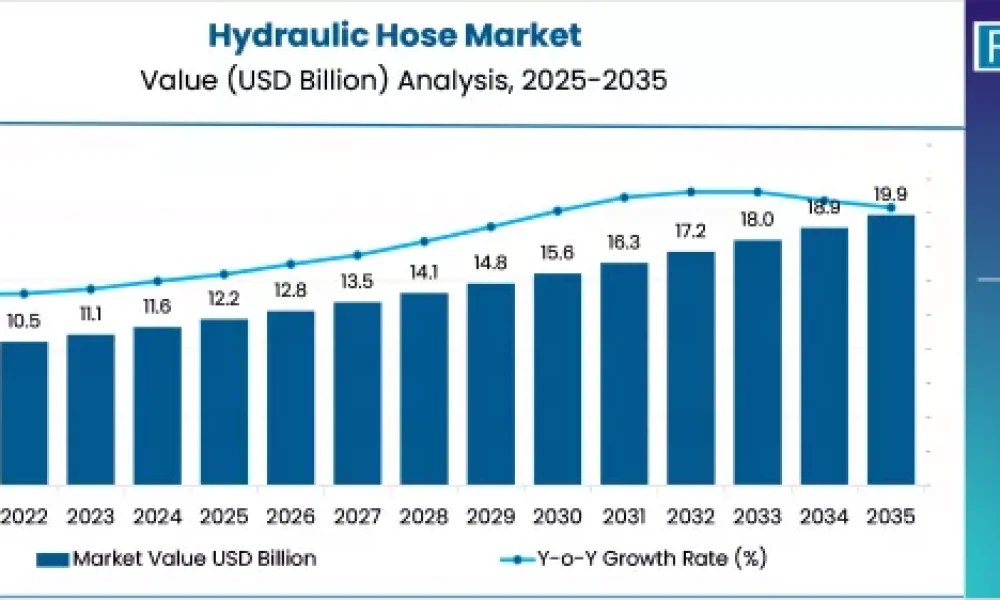
Global Hydraulic Hose Market to Surpass $12.8 Billion in 2026 as Industrial Automation and Infrastructure Projects Accelerate
Strategic shifts in material science and the integration of IoT-enabled “smart hoses” are reshaping fluid power systems across the construction, mining, and agricultural sectors.
The global hydraulic hose market is entering a high-growth phase, with its valuation projected to reach $12.86 billion in 2026. Driven by a surge in large-scale infrastructure projects and the rapid mechanization of agriculture in emerging economies, the industry is transitioning toward high-pressure, durable solutions designed for extreme operating environments.
According to latest industry data, the market is expanding at a compound annual growth rate (CAGR) of approximately 5.05%, fueled by the critical need for reliable fluid transfer in heavy-duty machinery. As of 2026, the sector is characterized by a move away from traditional rubber compounds toward advanced thermoplastics and wire-spiral reinforcements capable of withstanding pressures exceeding 6,000 PSI.
Request for Sample Report | Customize Report |purchase Full Report – https://www.factmr.com/connectus/sample?flag=S&rep_id=2538
Strategic Market Drivers: Infrastructure and Automation
The current market trajectory is defined by several key pillars of industrial growth:
- Construction Dominance: The construction and infrastructure segment remains the largest end-user, accounting for nearly 30% of global demand. Public and private investments in smart cities and transportation networks in the Asia-Pacific region are primary catalysts.
- Industrial Automation: The rise of Industry 4.0 has integrated hydraulic systems into robotic arms and automated assembly lines. This shift requires hoses with tighter bend radii and higher abrasion resistance to accommodate compact, high-speed machinery.
- Agricultural Modernization: To meet global food security demands, there is a marked increase in the adoption of hydraulic-driven tractors and harvesters, particularly in India and China, where the sector is seeing double-digit growth in specialized hose applications.
Technological Evolution: The Rise of “”Smart Hoses””
The year 2026 marks a turning point in hose technology. Manufacturers are increasingly embedding IoT sensors into hose assemblies to provide real-time data on pressure, temperature, and wear. These “”smart hoses”” allow for predictive maintenance, significantly reducing the risk of catastrophic failures and unscheduled downtime, which can cost heavy-industry operators upwards of $5,000 per hour.
Furthermore, environmental regulations are pushing the industry toward sustainability. Innovations in bio-fluid compatibility and recyclable materials are becoming standard as global players like Parker Hannifin, Gates Corporation, and Danfoss align their product lines with ESG (Environmental, Social, and Governance) goals.
Regional Insights and Segment Analysis
- Asia-Pacific: Currently the fastest-growing region, APAC is expected to dominate the market share through 2034. This is attributed to rapid industrialization and the presence of low-cost manufacturing hubs that are now pivoting toward high-quality exports.
- North America: Maintains a strong position due to a high replacement rate in the automotive aftermarket and established mining operations.
- Material Trends: While rubber still holds a majority share due to its flexibility, thermoplastics (Nylon and Polyurethane) are growing at the fastest rate due to their superior chemical resistance and lightweight properties.
Market Challenges: Volatility and Competition
Despite the robust outlook, the industry faces headwinds from raw material price volatility. Fluctuations in the cost of synthetic rubber and high-tensile steel wire impact profit margins for manufacturers. Additionally, the market remains highly competitive, with established Western brands facing increased pressure from cost-effective manufacturers in emerging markets who are rapidly closing the technology gap.
“”The hydraulic hose is no longer a commodity; it is a mission-critical component of the modern industrial ecosystem,”” states a market analyst. “”Success in 2026 is defined by the ability to balance high-pressure performance with digital monitoring capabilities.””
About the Industry
The hydraulic hose industry encompasses the design, manufacture, and distribution of reinforced flexible tubes used to transmit fluid within hydraulic systems. These components are vital for the operation of excavators, cranes, agricultural machinery, and aerospace equipment, serving as the “”arteries”” of modern mechanical power.
Related Reports
Hydraulic Power Unit Market
“



