
Piezoresistive Pressure Sensor Market Share and Trends Analysis
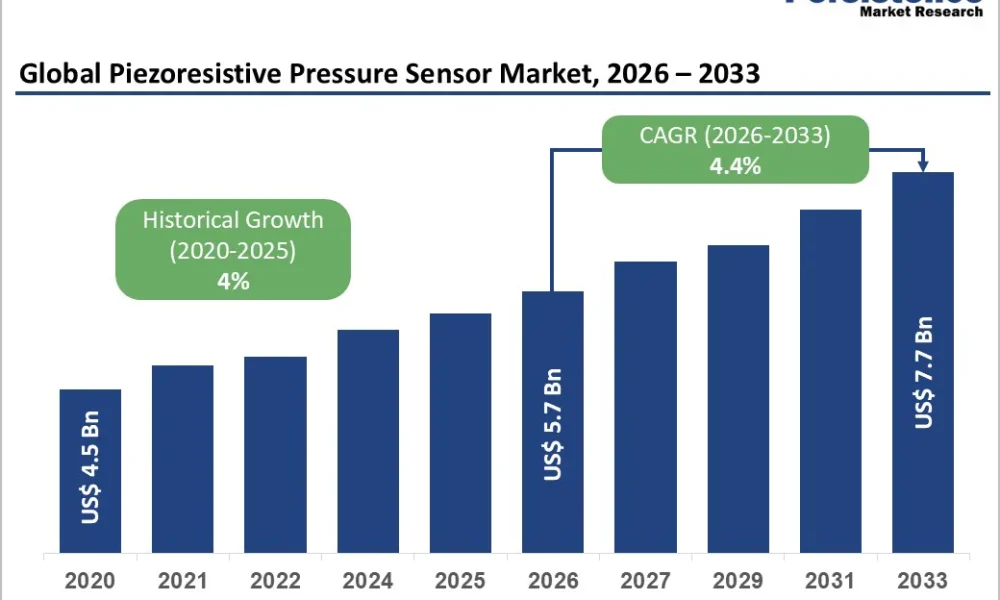
The global piezoresistive pressure sensor market is entering a phase of steady and technology-driven expansion. Valued at an estimated US$ 5.7 billion in 2026, the market is projected to reach US$ 7.7 billion by 2033, registering a CAGR of approximately 4.4% during 2026–2033. This growth reflects rising integration of pressure-sensing components across automotive systems, industrial automation, aerospace platforms, and medical devices.
Piezoresistive pressure sensors are increasingly becoming foundational components in next-generation intelligent systems. As regulatory frameworks tighten around emissions monitoring, industrial safety, and medical precision, manufacturers are prioritizing high-accuracy sensing technologies. In parallel, the expansion of MEMS-based semiconductor fabrication capacity is lowering unit costs and improving supply consistency, further accelerating global adoption.
From electric vehicles to ventilators and hydrogen fuel cells, piezoresistive MEMS sensors are quietly enabling smarter, safer, and more efficient systems worldwide.
Why Piezoresistive Pressure Sensors Matter in 2026 and Beyond
Pressure sensing is no longer a peripheral technology—it is a core enabler of automation, safety, and digital control. Piezoresistive sensors operate by detecting resistance changes in a semiconductor material when mechanical stress is applied. This enables highly accurate and stable pressure measurement across diverse environments.
Their compact size, high sensitivity, and compatibility with MEMS manufacturing processes make them ideal for integration into space-constrained systems. Automotive engine control units, industrial pumps, HVAC systems, and wearable medical monitors all rely on precise pressure feedback.
As industries shift toward electrification, predictive maintenance, and remote monitoring, demand for reliable pressure measurement continues to expand across both established and emerging applications.
Key Industry Highlights
- Leading Sensor Type (2026): Absolute pressure sensors (~48% market share)
- Dominant Pressure Range: Medium-pressure sensors (~52% share)
- Largest End-Use Industry: Automotive (~38% revenue share)
- Fastest-Growing Vertical: Healthcare (~10% CAGR through 2033)
- Regional Leader: Asia Pacific (~38% market share in 2026)
- Primary Growth Driver: Rising demand for advanced pressure monitoring across automotive, industrial, aerospace, and healthcare sectors
Market Drivers: Expanding Use of Advanced Pressure Monitoring
- Automotive Electrification and Safety Compliance
The automotive sector remains the single largest consumer of piezoresistive pressure sensors. These devices are critical for:
- Manifold air pressure monitoring
- Fuel injection systems
- Brake pressure sensing
- Tire pressure monitoring systems (TPMS)
- Exhaust after-treatment systems
With stricter global emissions norms and safety mandates, automakers must deploy increasingly precise sensors. Electric vehicles (EVs) introduce new requirements in battery thermal management, coolant monitoring, and brake-by-wire systems, further expanding sensor demand.
As autonomous and connected vehicles evolve, pressure data is becoming part of broader vehicle intelligence systems, supporting diagnostics and real-time optimization.
- Industrial Automation and Smart Manufacturing
Industry 4.0 transformation is fueling demand for real-time process monitoring. Industrial facilities are integrating pressure sensors into:
- Hydraulic systems
- Pneumatic lines
- Industrial pumps
- Filtration systems
- Energy management platforms
Accurate pressure measurement enhances operational efficiency and enables predictive maintenance strategies. By identifying anomalies early, facilities can reduce downtime and optimize performance.
Piezoresistive MEMS sensors, known for stability and compact design, are well suited for embedded industrial applications where space and durability are critical.
- Healthcare Device Digitalization
Healthcare is emerging as the fastest-growing vertical for piezoresistive pressure sensors. Applications include:
- Ventilators
- Infusion pumps
- Respiratory monitors
- Dialysis equipment
- Wearable health trackers
The shift toward portable and home-based care models demands miniaturized, energy-efficient, and highly accurate sensors. Flexible and low-power designs are enabling broader deployment in remote patient monitoring and chronic disease management.
As healthcare systems modernize globally, precision pressure measurement becomes central to patient safety and treatment accuracy.
Elevate your business strategy with comprehensive market data. Request a sample report now: https://www.persistencemarketresearch.com/samples/12694
Market Challenges: Supply Chain and Maintenance Constraints
Despite strong demand, the market faces structural challenges.
Semiconductor Supply Volatility
Piezoresistive sensors rely on semiconductor fabrication processes. Disruptions in wafer production, material sourcing, or logistics can impact availability and pricing. Regions with limited fabrication capacity may experience delivery delays, affecting OEM production cycles.
Supply chain diversification and regional manufacturing expansion remain critical priorities for sensor manufacturers.
Calibration and Environmental Sensitivity
These sensors require periodic recalibration to maintain accuracy, especially in environments exposed to:
- Temperature fluctuations
- Humidity
- Chemically aggressive media
Maintenance requirements increase total cost of ownership, particularly in cost-sensitive markets. In certain applications, alternative sensing technologies may be preferred if lower maintenance is prioritized over precision.
Category-Wise Analysis
Sensor Type Insights
Absolute pressure sensors are expected to command nearly 48% of market revenue in 2026. These sensors measure pressure relative to a perfect vacuum and are widely used in automotive engine control, vacuum systems, and environmental monitoring.
Their reliability and compatibility with MEMS fabrication enable scalable production and tight tolerance control.
Meanwhile, differential pressure sensors are projected to grow at the fastest rate through 2033. They are increasingly deployed in:
- HVAC systems
- Smart buildings
- Filtration equipment
- Medical respiratory devices
By measuring pressure differences between two points, these sensors enable energy optimization and early fault detection. Growth in smart infrastructure and indoor air quality monitoring supports this segment’s expansion.
Pressure Range Insights
Medium-pressure sensors (10–1,000 kPa) dominate with an estimated 52% share in 2026. Their versatility across automotive, industrial, and healthcare systems ensures steady demand.
High-pressure sensors (>1,000 kPa) are forecast to record the highest CAGR during 2026–2033. Growth is driven by:
- Aerospace turbine monitoring
- Hydrogen fuel-cell systems
- Electrolysis infrastructure
- Industrial reactors
As hydrogen mobility and renewable energy ecosystems expand, high-pressure measurement becomes mission-critical.
End-Use Industry Insights
Automotive – The Market Leader
Accounting for approximately 38% of market revenue in 2026, automotive applications continue to dominate. Emissions compliance, electrification, and connectivity trends are reinforcing demand.
Innovations such as Bluetooth-enabled TPMS sensors demonstrate how digital integration is reshaping traditional pressure monitoring systems.
Healthcare – The Fastest-Growing Segment
Projected to grow at nearly 10% CAGR through 2033, healthcare is experiencing rapid digital transformation. The demand for biocompatible, low-power, and miniaturized sensors is rising sharply.
As aging populations increase globally, remote diagnostics and wearable technologies are becoming mainstream, further accelerating adoption.
Regional Insights
Asia Pacific – The Global Leader
Asia Pacific is expected to secure roughly 38% of global revenue in 2026. China leads in automotive production, industrial automation, and semiconductor fabrication.
India and ASEAN countries are strengthening their positions through EV component manufacturing and medical electronics assembly. Expanding MEMS fabrication capacity enhances regional competitiveness.
Government initiatives supporting EVs, hydrogen mobility, and industrial modernization further propel market growth.
North America – Innovation-Driven Growth
North America is projected to hold around 32% market share in 2026. The United States anchors demand through:
- EV development
- Aerospace manufacturing
- Advanced medical device production
Regulatory frameworks such as EPA emissions mandates and FDA medical standards reinforce demand for precision sensing solutions.
Connected mobility and smart factory initiatives continue to deepen sensor penetration across sectors.
Europe – Hydrogen and Industrial Modernization
Europe is forecast to capture approximately 28% of revenues in 2026. Germany, the UK, and France lead adoption across automotive and aerospace supply chains.
Hydrogen fuel-cell vehicle adoption and renewable energy investments are boosting demand for high-pressure sensors. Industrial digitalization and smart factory upgrades further support steady regional expansion.
Competitive Landscape
The competitive environment in 2026 is led by major multinational players including:
- Honeywell International Inc.
- Bosch Sensortec GmbH
- TE Connectivity
- STMicroelectronics
- NXP Semiconductors
- Omron Corporation
- Sensata Technologies
- Infineon Technologies AG
- Amphenol Advanced Sensors
- TDK Corporation
These companies leverage advanced MEMS production, broad sensor portfolios, and deep OEM partnerships to maintain leadership.
Competition is intensifying as regional and MEMS-focused manufacturers introduce cost-effective and application-specific designs. Differentiation increasingly depends on:
- Miniaturization
- Digital communication interfaces
- Long-term stability
- Corrosion-resistant packaging
- Hydrogen-compatible designs
Continuous R&D investment remains central to maintaining global competitiveness.
Key Industry Developments
Recent innovations underscore the market’s technological momentum:
- TE Connectivity (2025): Introduced the 85UHP series with corrosion-resistant stainless steel housing for harsh industrial environments.
- Kistler (2025): Launched a hydrogen-ready absolute pressure sensor capable of operating up to 50 bar in fuel-cell systems.
- Omron (2025): Released the E8Y-L micropressure sensor series with integrated digital display for precise low-differential monitoring.
These developments highlight the shift toward specialized, application-optimized sensor platforms.
The Road Ahead: Strategic Outlook to 2033
Between 2026 and 2033, the piezoresistive pressure sensor market will experience moderate but resilient growth. Unlike high-volatility technology segments, this market benefits from diversified end-use applications and regulatory-driven demand.
Key long-term growth pillars include:
- Electric and hydrogen mobility
- Smart manufacturing and Industry 4.0
- Medical device miniaturization
- Aerospace system upgrades
- Renewable energy infrastructure
Manufacturers that prioritize supply chain resilience, application-specific customization, and digital connectivity will be best positioned to capture value.
As industries increasingly depend on precise real-time data to optimize performance and ensure safety, piezoresistive pressure sensors will remain indispensable components powering the next generation of intelligent systems.
Related Reports:




