
International law protects honorary consuls from being compelled to provide evidence about their official functions or to produce related official correspondence. However, the Protection has defined boundaries, may be waived by the sending state, and does not cover unrelated private activities.
WASHINGTON, DC, September 22, 2026
Honorary consuls generally have no obligation to testify about matters connected with their official consular functions or produce related official correspondence and documents, providing a specific safeguard for government work conducted through an otherwise locally based representative.
The Protection arises under Article 44(3) of the Vienna Convention on Consular Relations, which Article 58 applies to honorary consular officers, rather than through a general exemption from court attendance or every obligation associated with being a witness.
Describing the rule as an absolute prohibition against any judicial request would go too far, because the status of the evidence may require determination, the sending state can waive relevant Protection, and unrelated private information remains outside its scope.
The Treaty Protects Two Related Categories of Evidence
Article 44(3) of the Vienna Convention on Consular Relations addresses both evidence concerning the exercise of consular functions and production of official correspondence or documents relating to those functions, covering oral evidence and documentary requests.
The first Protection concerns what the honorary consul may be asked to explain, while the second concerns records the person may be asked to provide, allowing the provision to address different ways of obtaining information about official work.
A request for an officer’s account of a consular matter and a demand for the related mission correspondence may therefore engage the same paragraph. However, the character of the requested information still requires examination in each instance.
The provision also permits refusal to give expert evidence about the sending state’s law. Still, that separate entitlement should not be confused with protections specifically concerning official consular matters and related records arising during ordinary consular service.
Official Consular Work Is the Relevant Connection
The Protection concerns matters connected with consular functions, so the individual’s recognized responsibilities and the context in which information was obtained matter in deciding whether a particular question falls within the treaty provision’s scope in the receiving state.
An honorary consul may assist nationals, communicate with a supervising mission, or undertake other authorized activities. Still, the precise assignment varies, so the title alone does not establish that every interaction involving a foreign country is official.
In a hypothetical assistance case, questions about communications undertaken as part of an authorized consular service could engage Article 44(3), provided the connection with the officer’s functions is established under the applicable framework and no effective waiver changes the position.
By comparison, an ordinary conversation with the same individual during a private business transaction would require a separate assessment, because the participants’ identities do not automatically determine whether the subject belongs to official consular work.
Official Correspondence Is More Precise Than Diplomatic Correspondence
For an honorary consular post, the clearest description is official correspondence and documents relating to consular functions, which follows the treaty’s terminology and avoids suggesting that the officer necessarily possesses the status or responsibilities of a diplomatic agent.
Correspondence with an embassy can qualify when it relates to consular functions. Still, the destination alone should not be decisive, since an honorary consul might also communicate with embassy personnel about unrelated matters.
Similarly, official information may be exchanged with other authorized participants in consular work, making the purpose and character of the correspondence more informative than whether it was written on a particular letterhead or addressed to a specific official.
An accurate explanation therefore identifies the connection between the records and the consular assignment, rather than broadly applying the label “diplomatic” to every message involving an honorary consul, foreign official, or government-associated organization in the surrounding community.
Document Production Is Different From Archive Access
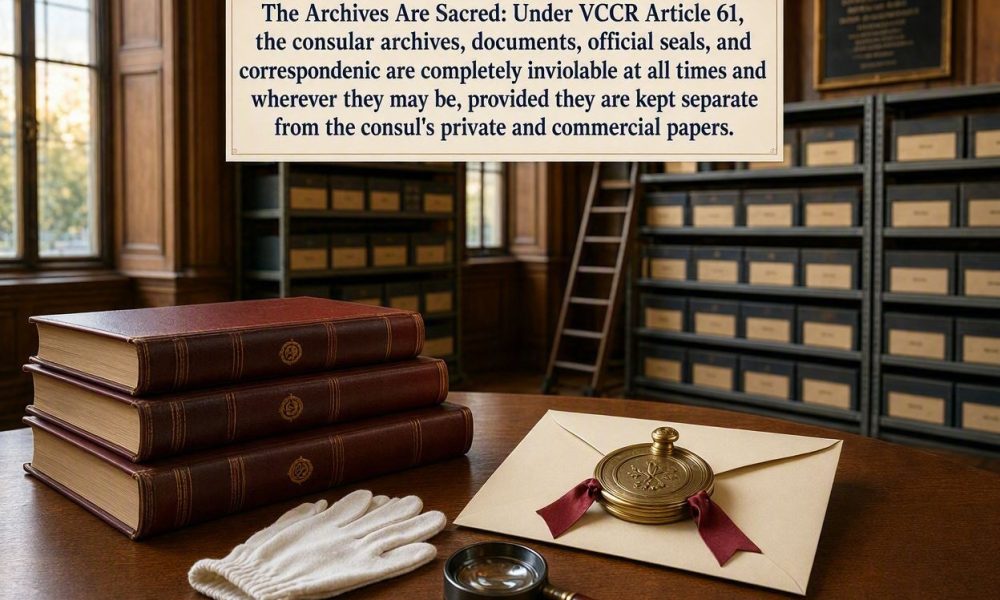
Article 44(3) addresses the obligation to produce official correspondence and documents. At the same time, Article 61 separately protects qualifying honorary consular archives, creating related safeguards that apply to different legal questions even when the same records are involved.
The testimonial provision does not require that documents be physically retrieved from a particular cabinet before the Protection applies, because its wording focuses on official correspondence and documents relating to the exercise of consular functions.
Archive inviolability has its own express separation condition, requiring the honorary post’s archives and documents to remain separate from private correspondence and professional or commercial materials, which must be considered when that additional Protection is invoked.
A demand for records can therefore require consideration of both provisions. Still, the requirements associated with one should not casually be substituted for the wording of the other when explaining the basis of a legal objection.
A Court Request Does Not Automatically Override the Protection
A judicial request does not, by itself, eliminate a treaty Protection, so a demand for qualifying official evidence must be assessed with the relevant international obligations and domestic procedures in mind before disclosure is compelled.
At the same time, a request directed to an honorary consul is not necessarily invalid merely because the recipient holds office, since the material sought may concern private conduct or require a determination of its official character.
The practical distinction is between receiving a request and being legally obliged to disclose the information, with the latter depending on the Protection’s scope, applicable law, and any relevant action by the sending state.
Where the issue is disputed, it should be raised through the appropriate legal process, allowing the competent authorities to assess the claim without assuming either that the title defeats every request or that the request defeats every Protection.
Private Records Do Not Acquire Protection Through Proximity
A private contract, personal bank statement, or commercial invoice does not become official consular correspondence merely because an honorary consul holds it or stores it in premises also used to conduct the post’s authorized activities.
In a hypothetical dispute concerning the officeholder’s private company, records of ordinary customer transactions would need to be distinguished from separate correspondence concerning an authorized consular matter, rather than treated as one protected collection because of their location.
The same principle applies to information held in memory, because knowledge acquired through private employment does not automatically become protected consular knowledge when the individual later discusses a related topic with someone connected to a foreign government.
The legal assessment should identify the actual relationship between the evidence and official functions, while any separate domestic privilege applicable to private professional communications must be examined on its own basis rather than attributed to honorary status.
Mixed Requests Require Attention to Their Individual Parts
A summons or document request may cover both official and private matters, so examine the categories sought rather than assuming that one protected item determines the treatment of every other item in the request.
For example, a hypothetical proceeding might seek information about a private lease alongside correspondence concerning a separate consular service, requiring evaluation of the relevant connection for each subject rather than inferring it from the broader dispute.
The presence of protected evidence does not automatically justify withholding unrelated information. At the same time, unprotected material does not necessarily remove Protection from distinct official communications that fall within Article 44(3) or another applicable provision.
A focused description of the claimed Protection can help identify the actual disagreement. However, the procedure for presenting and resolving that disagreement depends on the receiving country’s legal system and the circumstances of the particular proceeding.
Honorary Consuls Lack a General Right to Refuse All Testimony
Article 58 applies paragraph 3 of Article 44 to honorary consular officers, without incorporating paragraph 1’s broader restriction on coercive measures or penalties when a consular officer declines to give evidence, making the distinction legally significant.
An honorary consul therefore cannot rely on that omitted paragraph as a universal entitlement to refuse testimony about unrelated private events without consequences. However, other applicable agreements or domestic protections may affect a particular person’s position.
Likewise, Article 58 does not incorporate paragraph 2’s specific provisions concerning arrangements for taking evidence at a residence or consular post, so such accommodations should not be presented as automatic honorary-consular rights under that cross-reference.
A local court may nevertheless permit an appropriate accommodation under its own rules. Still, the source of that arrangement should be identified accurately rather than described as part of a general immunity arising from the appointment.
Waiver Comes From the Sending State
Article 45 allows the sending state to waive protections provided under Article 44, and Article 58 applies that waiver provision to honorary consular officers, meaning that the evidentiary safeguard is not necessarily permanent or incapable of being relinquished.
To waive the relevant testimonial Protection, the Convention requires an express waiver communicated in writing, making governmental authorization important rather than assuming that the honorary consul’s personal willingness to answer questions provides the necessary legal basis.
The scope of the waiver must also be considered, because permission for one subject or category of evidence should not automatically be treated as authorization to disclose every official communication associated with the post or the proceeding.
Separate archive and confidentiality questions may remain relevant even when testimonial Protection is addressed, so the effect of a waiver should be assessed against the particular records and legal provisions involved rather than assumed to resolve every issue simultaneously.
Being a Witness Is Different From Being a Defendant
The Protection against giving certain evidence is distinct from functional immunity under Article 43, which concerns jurisdiction over acts performed in the exercise of consular functions, even though both provisions can become relevant within the same broader dispute.
An honorary consul may be asked to testify in a case involving other people without facing any claim personally, making it unnecessary to establish that the officer is a defendant before considering whether official evidence is protected.
Conversely, an officer facing proceedings concerning private conduct does not gain general immunity merely because some requested evidence concerns official functions, although that specific evidence may still require separate consideration.
Keeping those questions distinct helps explain how legal accountability and Protection of consular work can coexist, with the court addressing the underlying dispute while respecting any valid limits on particular testimony or documentary material.
The Rules Protect the Function Without Resolving Every Factual Dispute
Article 71 expressly preserves the Article 44(3) privileges for consular officers who are nationals or permanent residents of the receiving state, showing that local nationality does not simply erase the relevant Protection for official evidence.
The ICIJ and ProPublica Shadow Diplomats investigation documented controversies involving honorary consuls and oversight weaknesses, underscoring why public descriptions should identify the Protection actually claimed rather than rely on broad assertions about diplomatic immunity.
Neither an allegation of wrongdoing nor the official’s assertion of Protection independently settles whether particular evidence falls within Article 44(3), because the relevant facts and legal requirements still need to be assessed through the appropriate process.
Reporting should therefore distinguish a claim of Protection, a pending dispute, and a confirmed ruling, allowing readers to understand whether the legal question has been resolved and exactly which testimony or documents were considered in that determination.
Accurate Descriptions Focus on the Evidence Requested
For Background, Amicus International Consulting’s honorary-consul overview discusses the role. At the same time, how a particular evidentiary request is handled depends on the Convention, the officer’s recognized functions, and the receiving country’s applicable procedures.
The company’s information about second-passport services concerns a separate citizenship-planning subject, and possession of nationality documentation does not, by itself, create a right to refuse testimony or withhold records from a court considering an otherwise lawful request.
The precise rule is that honorary consuls are generally under no obligation to give evidence about matters connected with their consular functions or produce related official correspondence and documents, subject to applicable law and effective waiver.
That Protection should be described through the character of the evidence and its official connection, preserving the distinction between protected consular work and unrelated private matters without suggesting that either a court request or an honorary title automatically decides everything.




