
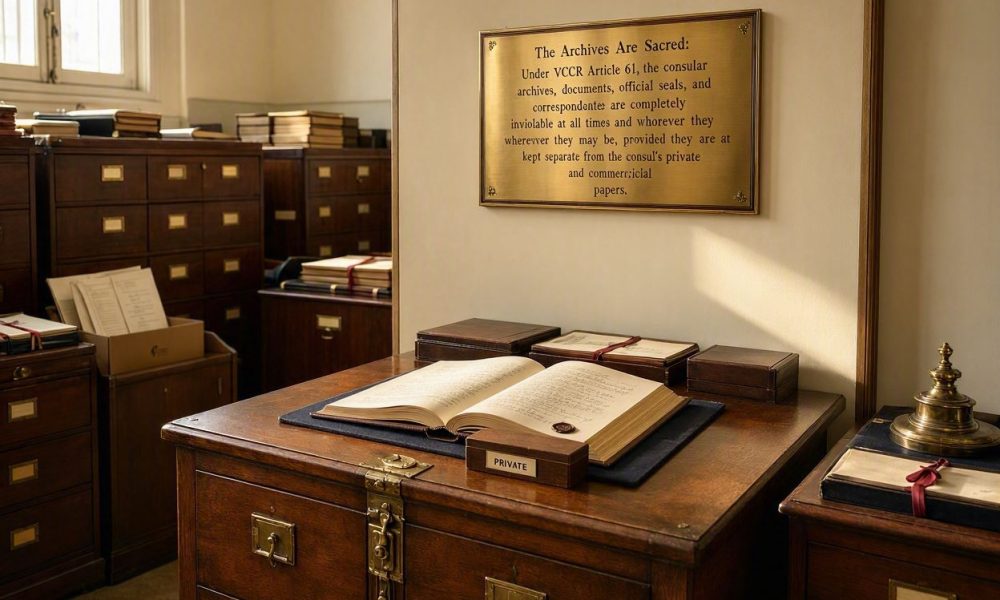
Qualifying honorary consular archives receive treaty protection when kept separate from private and business records. Still, a locked cabinet or designated room does not automatically shield everything inside it or prevent a lawful investigation of surrounding premises.
WASHINGTON, DC, September 22, 2026
Honorary consular archives receive a significant legal safeguard under international law. Still, Protection must be distinguished from claims that an officeholder can make any room or cabinet inaccessible to authorities simply by designating it as official storage.
The governing rule protects qualifying consular archives and documents subject to separation requirements. At the same time, searches of an honorary consul’s private home or business require an independent legal basis and must respect the protections that remain applicable.
That distinction corrects two potentially misleading assumptions: authorities do not acquire unrestricted power to raid premises because their occupant is an honorary consul, and the occupant cannot create blanket immunity through locks, signs or unilateral declarations.
Article 61 Establishes the Archive Protection
Article 61 of the Vienna Convention on Consular Relations makes the archives and documents of a post headed by an honorary consular officer inviolable, provided they remain separate from private correspondence and professional or commercial materials.
Its wording protects qualifying materials at all times and wherever they may be, making the official character of the records and compliance with the separation condition more important than whether they occupy a particular room.
Inviolability provides a substantive safeguard against interference with protected archives, including unauthorized examination or seizure, and should not be reduced to a courtesy that investigators may disregard merely because an inquiry concerns the person maintaining them.
However, the provision does not state that every locked room or container identified by an honorary consul automatically qualifies, so attention is required to the treaty’s definition of archives and the actual arrangements under which the materials are maintained.
The Treaty Protects More Than Loose Documents
Article 1 defines consular archives broadly, including the post’s papers, documents, correspondence, books, films, tapes and registers, together with codes, indexes and furniture, and their intended purpose, extending the category beyond individual sheets of paper.
A cabinet dedicated to safeguarding qualifying consular archives can therefore have legal significance under the definition, which means it would be inaccurate to suggest that authorities may always force it open simply because the surrounding building lacks premises inviolability.
The relevant assessment concerns the cabinet’s actual function and the protected materials associated with it, rather than its appearance, purchase price or the presence of an official emblem attached to its exterior by the officeholder.
A room raises a different question because the archive definition’s reference to protective furniture does not, by itself, transform an entire space into inviolable premises. However, authorities must still respect protected archives located within that space.
Designation Alone Does Not Establish Protection.
A label identifying consular archives may help communicate the intended purpose of a storage area. Still, it does not, by itself, establish that all contents are official or that every applicable condition for treaty protection has been satisfied.
In a hypothetical shared office, correspondence concerning authorized consular services could constitute official records. At the same time, the honorary consul’s unrelated company invoices remain commercial materials even if someone mistakenly places them in a folder carrying the same official designation.
Similarly, ownership by a foreign government does not automatically bring every item within Article 61, because the treaty separately addresses different categories of property and privileges rather than extending archive protection to everything associated with the sending state.
The proper inquiry therefore identifies the materials, their relationship to the consular post and their separation from private records, avoiding a rule under which an officeholder’s choice of wording would determine the receiving state’s legal obligations.
Searches of Private Premises Still Need Lawful Authority
The absence of general premises inviolability does not create a free-standing power to enter an honorary consul’s home or business, because police, tax officials and other authorities must act within the powers available under domestic law.
Whether a warrant, consent, statutory inspection authority, or another lawful basis is required depends on the jurisdiction and circumstances, so the statement that authorities “can raid” the property is too broad without explaining the legal basis involved.
A court’s role may also differ from that of an investigating agency, since authorizing a search, ordering production of records, and physically executing a search are distinct activities governed by the relevant legal system and procedural rules.
An accurate account should therefore identify what action has been authorized, who may carry it out and what limitations apply, rather than treating every form of official access as interchangeable or automatically permissible at a shared address.
Archive Inviolability Survives the Distinction Between Person and Records
An investigation into an honorary consul’s private business does not remove Protection from qualifying consular archives, because the individual’s potential liability and the receiving state’s obligations toward official records concern different aspects of the legal framework.
Conversely, archive protection does not create general immunity for the officer’s private conduct, so the existence of official records at the premises cannot by itself prevent proceedings concerning unrelated financial transactions, contractual obligations or alleged personal offenses.
The distinction allows Protection and Protection to operate together, with authorities pursuing matters within their lawful jurisdiction while respecting the separate status of records that genuinely belong to the consular post and satisfy the treaty’s conditions.
In a hypothetical investigation involving a company operated by an honorary consul, the company’s ordinary business records and the post’s separate official correspondence would therefore require distinct treatment rather than a single conclusion covering everything at the address.
Honorary Posts Do Not Receive Every Protection of Career Posts
Article 59 requires the receiving state to protect an honorary consular post’s premises against intrusion, damage, and disturbances affecting its peace or dignity, establishing an obligation that remains meaningful even without full premises inviolability.
Article 58 does not incorporate Article 31’s premises-inviolability regime for posts headed by career consular officers, so the honorary framework cannot be described as imposing the same restrictions on official entry.
The difference does not make archive protection optional, because Article 61 supplies its own safeguard independently of the broader status of the premises, preserving the distinction between access to a location and interference with protected records.
For a shared home or commercial office, that distinction matters because the legal treatment of ordinary living or working areas cannot be inferred solely from the presence of a protected archive elsewhere in the building.
Canadian Guidance Makes the Shared-Premises Distinction Explicit
Global Affairs Canada states that maintaining consular archives at a personal residence or business office does not permit the honorary consul to describe that property as a consulate or consular post in itself, emphasizing the narrower protected category.
The Canadian guidance also expressly conditions archive inviolability on keeping official materials separate from private and business or professional documents, reinforcing the importance of identifying the records rather than relying on the general description of the location.
Its appointment process requires the archive address, and changes must be reported through the relevant arrangements, showing that official knowledge of a location serves administrative purposes without automatically converting every part of that property into protected space.
These Canadian provisions illustrate a national application of the distinction. At the same time, searches and disputes elsewhere must be evaluated through the relevant host country’s laws, treaty obligations, and any additional arrangements affecting the particular honorary consular post.
Separation Requires More Than Installing a Lock
A lock can support physical security, but Article 61’s condition concerns separation from private and professional materials, so access controls and document classification address related but different questions when an honorary consul maintains archives inside an existing business.
An office with secure storage could still present problems if commercial files and consular correspondence are routinely mixed. At the same time, the precise consequences of a disputed arrangement would require legal assessment rather than an automatic conclusion based on one observation.
The treaty does not specify a universal standard for safe or cabinet construction or room layout, so it is important to distinguish the legal separation requirement from practical security measures established through governmental instructions or local operational arrangements.
A responsible records system should make the categories clear during routine administration, helping the supervising mission maintain continuity and accountability without relying on a last-minute assertion about the status of materials when a dispute arises.
Disputed Claims Require a Lawful Resolution
Authorities may be uncertain whether particular materials constitute protected archives, especially in a shared workplace. Still, that uncertainty does not itself supply a universal entitlement to read everything first and determine the legal position afterward.
Equally, an unsupported assertion by the officeholder should not be treated as conclusively establishing that every item falls within the treaty, because the characterization and the separation condition may require examination through appropriate legal and diplomatic channels.
The Convention does not prescribe one complete operational procedure for every contested search. Hence, statements about mandatory inspection sequences, automatic access or a particular official’s exclusive decision-making authority require support from the relevant jurisdiction’s rules.
Depending on the legal system, clarification may involve the competent authorities, the foreign ministry, the sending state’s mission or judicial proceedings, with the appropriate route determined by the nature of the dispute and the powers being exercised.
Electronic Records Raise Similar Distinctions
Official records may exist electronically, but the Convention does not prescribe a modern technical procedure for examining shared computers or cloud accounts, so contemporary application depends on relevant legal interpretation and instructions governing the post.
A device containing consular correspondence may also contain personal or commercial information, which means neither complete access nor complete immunity should be inferred solely from the presence of some material described as official by its user.
Practical arrangements for separating accounts, access and storage can help identify the different categories, but no particular folder name or software setting independently resolves the legal status of every record stored on a device or service.
When electronic material becomes relevant to proceedings, the inquiry must account for both applicable investigative authority and any protected official records, avoiding the assumption that a physical cabinet analogy provides a complete answer to every digital question.
Oversight Reporting Should Distinguish Allegations From Legal Findings
The ICIJ and ProPublica Shadow Diplomats investigation documented controversies involving honorary consuls and weaknesses in oversight, showing why claims about official privileges deserve scrutiny without establishing that every disputed archive claim is valid or every search is lawful.
Reporting on an individual incident should identify the status of the post, the action taken by authorities, and any confirmed ruling about the materials, rather than inferring the legal outcome from the presence of flags or official signage.
An allegation that a privilege was misused remains distinct from a finding that particular records lacked Protection; the Protection of surrounding commercial premises does not establish that investigators lawfully examined every document discovered there.
Precise language helps readers understand what has been confirmed and what remains contested, preserving the distinction between enforcement action, assertions of consular Protection, and the relevant legal questions.
The Protected Category Must Be Described Accurately
In the introductory Background, Amicus International Consulting’s honorary-consul overview describes the role. At the same time, the legal treatment of archives depends on the Convention, the recognized post’s circumstances, and the rules governing the particular search or request for records.
The company’s information about second-passport services concerns a separate citizenship-planning subject, and personal nationality documentation should not be assumed to constitute protected consular archives merely because its holder has an honorary appointment or stores it near official materials.
The defensible principle is that authorities must respect qualifying, separately maintained consular archives even when they possess lawful authority to search surrounding private premises, with archive furniture potentially included under the treaty’s definition and rooms requiring separate analysis.
A locked cabinet or designated room therefore cannot be assessed by its label alone, because the decisive questions concern the protected materials, the storage arrangement, the authority for the proposed action and the legal rules applicable to that situation.




