
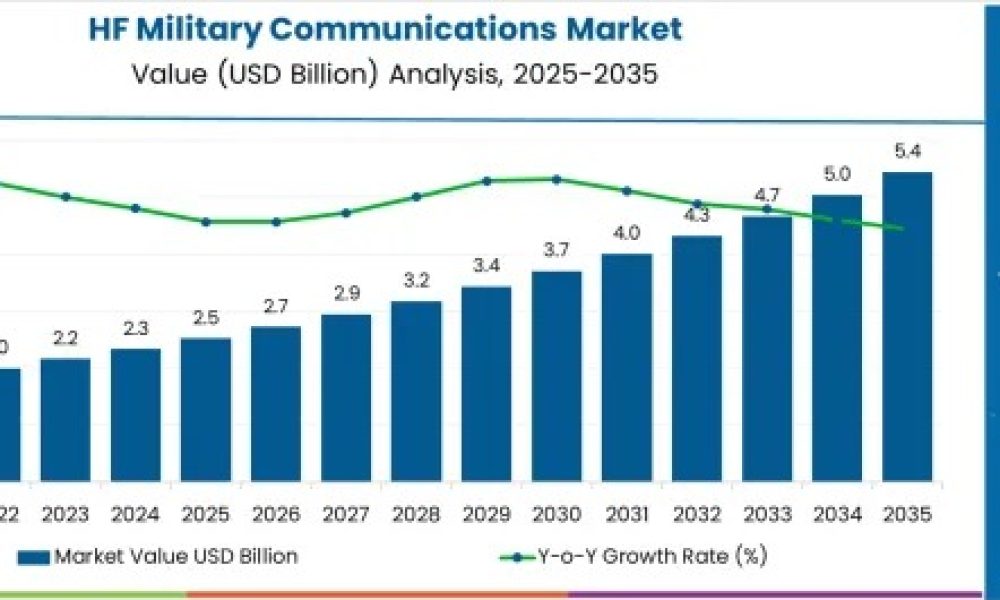
The global High Frequency Military Communications Market is entering a period of accelerated growth, supported by rising defense modernization efforts and increasing demand for secure, long-range communication networks. According to recent market projections, the sector—valued at USD 2.5 billion in 2025—is expected to reach USD 5.4 billion by 2035, reflecting a strong CAGR of 8.0%.
Growing geopolitical complexities, cross-border surveillance requirements, and joint-force operations are reinforcing the need for robust, resilient, and encrypted communication technologies. High-frequency (HF) systems, capable of providing dependable beyond-line-of-sight communication without reliance on satellite networks, are quickly becoming essential assets across global military operations.
By mid-forecast, between 2028 and 2030, the market is expected to experience an acceleration in adoption—driven by defense budget expansions in North America, Europe, and Asia Pacific. Countries such as China and India are leading global momentum, recording forecast CAGRs of 10.8% and 10.0%, respectively, with investments directed toward advanced HF radios, software-defined systems, and anti-jamming technologies. Germany (9.2%), France (8.4%), the UK (7.6%), and the United States (6.8%) continue to prioritize modernization and interoperability to support multinational missions.
Subscribe for Year-Round Insights → Stay ahead with quarterly and annual data updates:
https://www.futuremarketinsights.com/reports/sample/rep-gb-25879
Market Growth Foundation: What’s Fueling Demand?
- Expansion of Secure Long-Range Communication Capabilities
Modern conflict environments demand secure and uninterrupted communication in remote, contested, and infrastructure-limited zones. HF systems remain unmatched in delivering long-range connectivity with minimal dependency on satellites, making them vital for land, naval, and airborne operations.
- Rapid Defense Modernization and Rising Military Budgets
Nations across Asia Pacific, Europe, and the Middle East are accelerating modernization initiatives to strengthen command-and-control efficiency. HF communication upgrades—including frequency-agile radios, encrypted voice/data channels, and advanced antenna systems—are integral components of these programs.
- Integration with Satellite and Tactical Networks
The market is increasingly defined by hybrid communication models that combine HF with SATCOM and VHF/UHF systems. This integration strengthens redundancy and improves operational resilience, ensuring high-availability communication for mission-critical operations.
- Advancements in Encryption and Software-Defined Technologies
Next-generation HF systems prioritizing cybersecurity, adaptive waveform management, and AI-enabled signal processing are reshaping the defense communications landscape. These developments enable improved threat detection, lower interception risk, and enhanced situational awareness.
Key Segmental Insights
- Frequency Range:
The 18–20 MHz band remains the leading segment, expected to contribute 34.6% of total revenue in 2025, primarily due to its superior long-distance signal stability.
- Platform:
Land platforms dominate with 41.2% share, supported by increasing adoption of rugged mobile HF units for border security, tactical deployments, and mission coordination.
- Component:
The hardware segment leads with 57.8% share, as militaries continue to invest in field-proven transceivers, antennas, and manpack systems to modernize tactical communications.
Regional Growth Highlights
- China: HF adoption strengthens across naval, air, and border operations as part of large-scale modernization programs.
- India: Mountain and maritime defense needs drive demand for long-range, encrypted HF radios with anti-jamming features.
- Germany: NATO integration mandates secure, interoperable HF networks with enhanced encryption layers.
- United Kingdom: Upgrades across naval and air fleets support growing maritime surveillance and Arctic operations.
- United States: AI-backed HF systems and cyber-secure communication frameworks position the US as a global technology leader.
Competitive Landscape
The market remains highly competitive, led by L3Harris Technologies, Thales Group, Collins Aerospace, Elbit Systems, and Leonardo DRS. Strategic focus areas include frequency agility, anti-jamming protocols, software-defined architectures, and ruggedized systems designed for extreme operational environments. Interoperability, NATO-standard compliance, and advanced encryption capabilities continue to guide product innovation.
Get data that aligns with your strategic priorities — ask for report customization today:
https://www.futuremarketinsights.com/customization-available/rep-gb-25879
Have a specific Requirements and Need Assistant on Report Pricing or Limited Budget please contact us – [email protected]
About Future Market Insights (FMI)
Future Market Insights, Inc. (FMI) is an ESOMAR-certified, ISO 9001:2015 market research and consulting organization, trusted by Fortune 500 clients and global enterprises. With operations in the U.S., UK, India, and Dubai, FMI provides data-backed insights and strategic intelligence across 30+ industries and 1200 markets worldwide.
Contact Us:
Future Market Insights Inc.
Christiana Corporate, 200 Continental Drive,
Suite 401, Newark, Delaware – 19713, USA
T: +1-347-918-3531



