
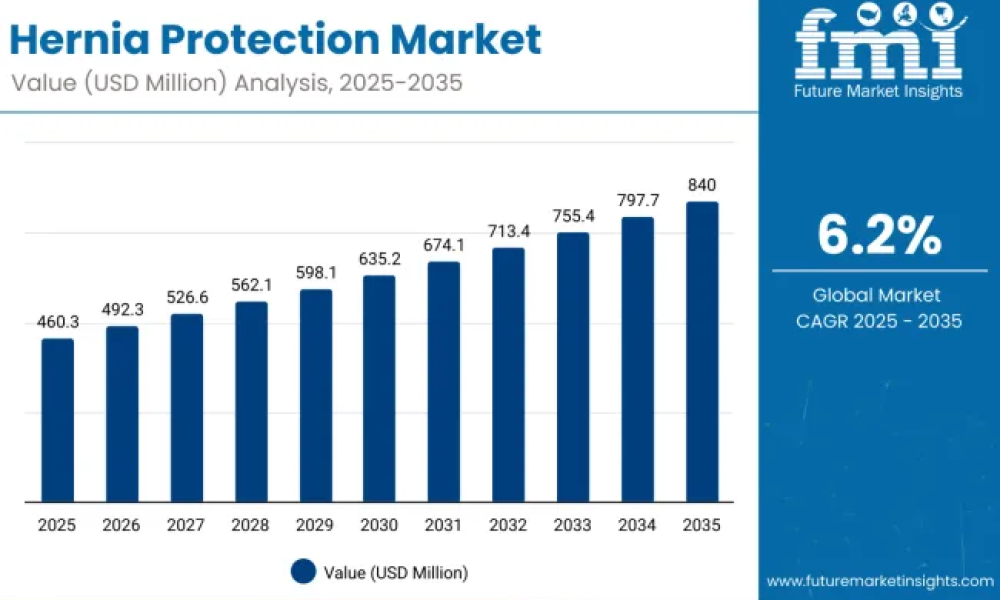
Future Market Insights (FMI), a leading provider of market intelligence and consulting services, today released its latest in-depth report on the global hernia protection market is emerging as a cornerstone of innovative medical device solutions. According to a comprehensive new report from Future Market Insights (FMI), the market is set to expand from USD 460.3 million in 2025 to USD 840.0 million by 2035, achieving a steady compound annual growth rate (CAGR) of 6.2%. This growth trajectory underscores a shift toward patient-centered care, where comfort, efficacy, and accessibility drive adoption across diverse demographics and regions.
The FMI report highlights how hernia protection products—ranging from specialized support belts to advanced garments—are not just reactive tools but proactive guardians of health. As hernia incidences rise globally due to aging populations, increased surgical procedures, and lifestyle factors, these devices are pivotal in preventing complications, managing conditions, and supporting post-surgical recovery. “The hernia protection market represents a fusion of medical innovation and everyday wellness,” notes the report’s analysis. “By emphasizing preventive measures, we’re seeing a reduction in recurrence rates and healthcare costs, empowering patients to lead active lives without compromise.”
Market Dynamics: Drivers Fueling Expansion
Several key drivers are propelling this market forward. Foremost is the surging demand for preventive healthcare, amplified by technological advancements in materials like bioabsorbable meshes and biocompatible fabrics. These innovations enhance comfort and durability, making products more appealing for long-term use. The rise in minimally invasive and laparoscopic surgeries has also heightened the need for reliable post-operative support, as patients seek solutions that minimize risks and promote faster healing.
An aging global population plays a significant role, with older adults more susceptible to hernias and prioritizing quality-of-life improvements. Increased healthcare awareness, coupled with rising expenditures, further accelerates adoption. The report points to patient safety as a core focus: devices that offer compression, support, and skin compatibility are reducing hospital readmissions and improving overall outcomes. However, challenges such as competition from alternative treatments, budget constraints in healthcare systems, and varying patient compliance rates could temper growth if not addressed through targeted education and affordability initiatives.
Segmentation Insights: Tailored Solutions Driving Adoption
The market’s segmentation reveals targeted opportunities for industry leaders. By product type, ostomy support belts lead with a 24.5% share in 2025, prized for their specialized design and effective compression. Other categories, including support girdles/wraps, support underwear, custom-fit/adjustable wear, and barrier rings & strips, cater to diverse needs, with Japan showing ostomy belts at 27.0% dominance.
In terms of clinical use, hernia prevention commands the largest slice at 36.0%, reflecting a proactive healthcare mindset. Hernia management follows at 25.0%, with everyday protection (15.0%), post-surgical recovery (14.0%), and sports & active lifestyle (8.0%) rounding out the segments. South Korea mirrors this trend, with prevention at 39.0% in 2025, projected to hold steady.
Sales channels are evolving rapidly, with e-commerce marketplaces capturing 32.0% in 2025 due to convenience, privacy, and broad accessibility. Hospital pharmacies (28.0%), retail pharmacies (25.0%), and drug stores (15.0%) remain vital, but the digital shift offers a pathway for expanded reach.
Regionally, Asia Pacific emerges as the growth engine, led by India (8.2% CAGR) and China (7.8% CAGR), fueled by improving healthcare infrastructure, demographics, and rising awareness. Brazil follows at 7.5%, while North America (USA and Canada at 6.0%) and Europe (overall 5.7%) provide stable bases. In Europe, Germany holds 25.8% in 2025, declining slightly to 24.2% by 2035, with France at 20.6% (to 19.2%). The report covers over 40 countries, emphasizing tailored strategies for high-potential markets like the USA, UK, France, and Germany.
Opportunities and Strategic Pathways
FMI identifies eight strategic pathways for capturing market value, each with substantial revenue pools. Pathway A, focusing on ostomy support belt technology leadership, could unlock USD 180-220 million. Hernia prevention emphasis (Pathway B) offers USD 280-340 million, while e-commerce expansion (Pathway C) promises USD 120-180 million in uplift. Geographic pushes in India and China (Pathway D) target USD 150-220 million, and material innovations for comfort (Pathway E) add USD 80-130 million.
Partnerships with healthcare professionals (Pathway F) could yield USD 70-110 million, post-surgical specialization (Pathway G) USD 60-100 million, and premium lifestyle integration (Pathway H) USD 50-80 million. These opportunities hinge on trends like advanced material tech, patient education programs, and integration into preventive medicine frameworks.
Competitive Landscape: Innovation at the Forefront
The market is consolidated among 8-12 key players, with the top five controlling 60-65% share. Coloplast A/S leads at 28.3%, excelling in postoperative solutions. Hollister Incorporated, Convatec Group plc, and B. Braun Melsungen AG follow, innovating with skin-friendly, durable products. Challengers like Salts Healthcare Ltd., Nu-Hope Laboratories Inc., Stealth Belt Inc., and Welland Medical Ltd. differentiate through customization and discreet designs.
Competition centers on comfort, ease of use, clinical efficacy, and skin compatibility. Recent developments include bioabsorbable mesh advancements, lightweight adjustable garments, and e-commerce expansions. From 2020-2024, steady growth stemmed from investments in product development and minimally invasive surgery trends.
Subscribe for Year-Round Insights → Stay ahead with quarterly and annual data updates: https://www.futuremarketinsights.com/reports/brochure/rep-gb-26816
Request for Discount: https://www.futuremarketinsights.com/reports/sample/rep-gb-26816
Looking Ahead: A Patient-Centric Future
As the hernia protection market evolves, industry leaders must prioritize innovation and accessibility to meet rising demands. The projected growth—adding USD 174.9 million from 2025-2030 and USD 204.8 million from 2030-2035—signals a vibrant sector ripe for investment. Europe alone is expected to grow from USD 133.5 million in 2025 to USD 232.4 million by 2035 at 5.7% CAGR, with Japan at USD 19.8 million and South Korea at USD 10.6 million in 2025.
This report equips decision-makers with actionable insights to navigate opportunities, mitigate restraints, and capitalize on trends. By fostering preventive care and technological progress, the hernia protection market is not only addressing current needs but also paving the way for healthier futures.
About Future Market Insights (FMI)
Future Market Insights, Inc. (FMI) is an ESOMAR-certified, ISO 9001:2015 market research and consulting organization, trusted by Fortune 500 clients and global enterprises. With operations in the U.S., UK, India, and Dubai, FMI provides data-backed insights and strategic intelligence across 30+ industries and 1200 markets worldwide.
Why FMI: Decisions that Change Outcomes- https://www.futuremarketinsights.com/why-fmi
Contact Us:
Future Market Insights Inc.
Christiana Corporate, 200 Continental Drive,
Suite 401, Newark, Delaware – 19713, USA
T: +1-347-918-3531
Website: https://www.futuremarketinsights.com
LinkedIn| Twitter| Blogs | YouTube
Have a specific Requirements and Need Assistant on Report Pricing or Limited Budget please contact us – [email protected]



