
The global helicopter blades market is demonstrating steady and dependable expansion, underpinned by defense fleet modernization, rising civil helicopter utilization, and ongoing advances in composite materials and rotor aerodynamics. Market value is projected to increase from USD 670.3 million in 2025 to USD 900.8 million by 2035, registering a compound annual growth rate (CAGR) of 3.0% over the forecast period. This growth reflects the essential role of rotor blades in ensuring lift efficiency, maneuverability, safety, and lifecycle performance across military and civilian rotorcraft operations.
Between 2025 and 2030, the market is expected to expand from USD 670.3 million to USD 777.0 million, representing an increase of more than USD 100 million within the first five-year block. This period highlights stable demand driven by replacement of aging helicopter fleets, rising defense procurement, and increased deployment of helicopters for emergency medical services, offshore operations, and logistics support. The predictable year-on-year rise—from USD 690.4 million in 2026 to USD 732.4 million by 2028—underscores the market’s structural stability rather than cyclical volatility.
Rotor Blade Innovation Anchors Market Momentum
The helicopter blades market occupies a specialized yet critical position within the broader aerospace ecosystem. While blades account for approximately 6% of the aerospace components market, their importance is magnified within rotorcraft systems, where they represent nearly 25% of total value. This dominance reflects the centrality of rotor blades in defining helicopter performance parameters such as lift, vibration control, noise levels, and payload capacity.
In the military and defense aviation equipment segment, helicopter blades contribute close to 8%, highlighting the emphasis placed on durability, survivability, and extended service life in demanding operational environments. Within the aviation parts and spares market, blades account for nearly 7%, driven by high wear rates, fatigue cycles, and strict maintenance requirements. Although their share in the broader commercial aviation equipment market is more modest at around 4%, steady demand persists due to ongoing investment in civil rotorcraft fleets.
Get access to comprehensive data tables and detailed market insights — request your sample report today!
Defense Applications Continue to Dominate Demand
By application, the military segment leads the market with a 58.4% share in 2025, supported by elevated defense spending, fleet replacement programs, and the increasing use of helicopters in combat, surveillance, transport, and humanitarian missions. Armed forces across the United States, India, China, and NATO countries are upgrading rotor systems to improve agility, payload efficiency, and operational readiness.
Advanced blade technologies—including extended-life composite materials, erosion-resistant leading edges, and vibration-reduction designs—are being increasingly adopted to reduce maintenance cycles and enhance mission availability. The focus on stealth, maneuverability, and performance in diverse climatic conditions further reinforces the military segment’s leadership position.
Main Rotor Blades and OEM Channels Shape Market Structure
By blade location, main rotor blades account for approximately 67.9% of total market share in 2025, reflecting their fundamental role in lift generation and flight control. Continuous innovation in aerodynamic shaping, lightweight composites, and active blade technologies has kept this segment at the center of product development. High mechanical stress and aerodynamic loading also result in consistent replacement demand, supporting both OEM and aftermarket revenues.
From a distribution perspective, the OEM channel dominates with a 61.2% market share, benefiting from direct integration into new helicopter production programs. Early-stage collaboration between blade manufacturers and helicopter OEMs ensures optimized performance, structural compatibility, and regulatory compliance. Long-term procurement and maintenance agreements, particularly in defense programs, further strengthen OEM dominance, while ensuring traceability and quality assurance.
Composite Materials and Lifecycle Services Drive Differentiation
The helicopter blades market is evolving around composite and lightweight material innovation, as manufacturers seek to balance durability with efficiency. Carbon fiber and advanced alloy blades are increasingly favored for their ability to reduce weight, improve fuel efficiency, and extend service intervals. These benefits are particularly valuable for civil operators focused on lowering operating costs and improving fleet availability.
In parallel, the market is witnessing a growing emphasis on aftermarket services, including blade refurbishment, repair, and lifecycle management solutions. Modular blade designs and service packages that minimize downtime are gaining traction, signaling a shift from purely product-based sales toward long-term performance assurance and cost optimization.
Drive Your Business Growth Strategy: Checkout the Report for Key Insights
Regional Growth Led by Asia, Supported by Mature Markets
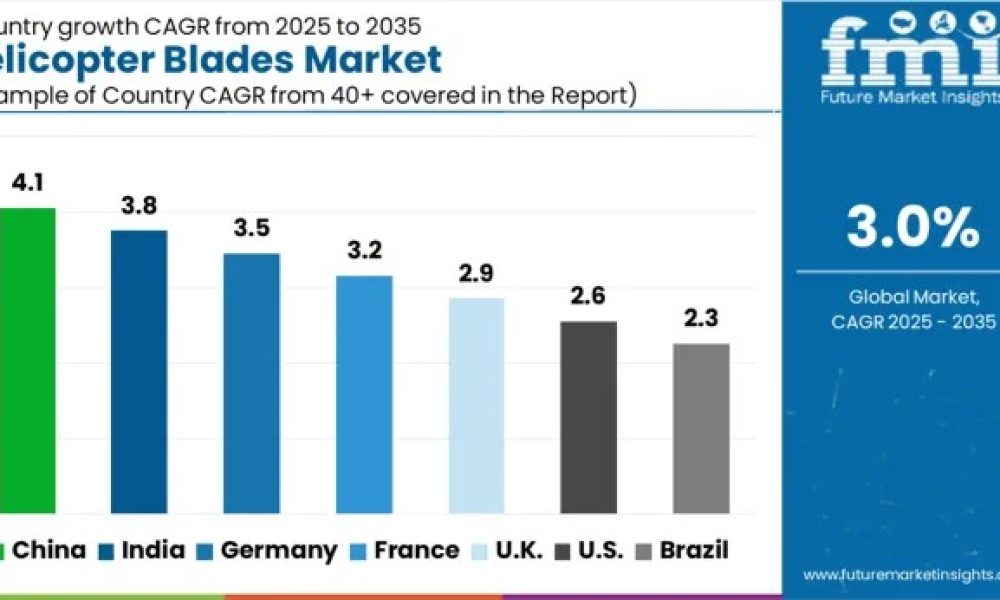
Geographically, China leads growth with a projected CAGR of 4.1%, followed by India at 3.8% and Germany at 3.5%. Rapid defense procurement, civil helicopter expansion, and government-backed manufacturing initiatives are accelerating demand in Asia. China’s focus on composite blade production and India’s “Make in India” initiative are strengthening domestic capabilities and reducing reliance on imports.
Mature markets such as the United States (2.6% CAGR), United Kingdom (2.9%), and France (3.2%) continue to generate steady demand through fleet upgrades, aftermarket replacements, and investments in advanced materials and noise-reduction technologies. While growth rates are lower, these markets remain critical due to large installed bases and strong regulatory frameworks.
Competitive Landscape Focused on Performance and Compliance
The competitive landscape is defined by a mix of global aerospace leaders and specialized component manufacturers, including Airbus S.A.S., Bell Helicopter Textron, Boeing, Lockheed Martin Corporation, Hindustan Aeronautics Limited, and Van Horn Aviation, LLC. Competition centers on composite innovation, weight reduction, vibration control, and regulatory certification.
OEM-backed players leverage integrated helicopter programs, while niche suppliers differentiate through aftermarket upgrades, STC-certified blades, and performance-enhancing retrofits. Across the market, success is increasingly determined by the ability to deliver reliable, compliant, and service-oriented blade solutions.
Outlook
With helicopters remaining indispensable across defense, emergency response, offshore, and commercial missions, rotor blades will continue to represent a stable, innovation-driven market segment. Gradual yet dependable growth, coupled with opportunities in composites, aftermarket services, and regional fleet expansion, positions the helicopter blades market for sustained relevance through 2035.
Why Choose FMI: Empowering Decisions that Drive Real-World Outcomes: https://www.futuremarketinsights.com/why-fmi
About Future Market Insights (FMI)
Future Market Insights, Inc. (FMI) is an ESOMAR-certified, ISO 9001:2015 market research and consulting organization, trusted by Fortune 500 clients and global enterprises. With operations in the U.S., UK, India, and Dubai, FMI provides data-backed insights and strategic intelligence across 30+ industries and 1200 markets worldwide.



