

Overview
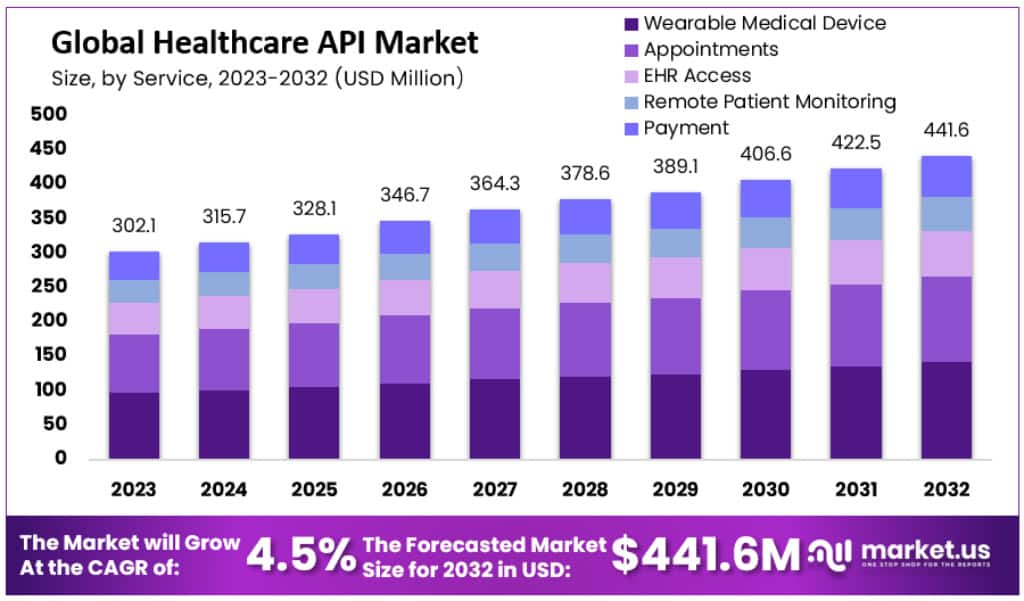
The Global Healthcare Api Market is experiencing steady growth, driven by the rising need for efficient digital communication in healthcare systems. In 2023, the market was valued at USD 302.1 million and is projected to reach approximately USD 441.6 million by 2032, expanding at a compound annual growth rate (CAGR) of 4.5% during the forecast period from 2023 to 2033. This growth reflects the increasing adoption of APIs to streamline medical workflows, improve data access, and support digital health transformation.
Healthcare APIs are software tools that enable secure data exchange between healthcare applications and systems. These APIs help hospitals, clinics, and physicians share electronic health information more efficiently. They also play a key role in enhancing communication among care teams, improving the speed and accuracy of clinical decisions. By replacing outdated, manual systems, healthcare APIs offer a modernized way of managing patient information and coordinating care across departments.
APIs in healthcare simplify various services such as appointment scheduling, access to lab results, and payment processing. Patients benefit from having a single interface for multiple services, reducing the need for physical paperwork or long phone calls. Healthcare providers can also retrieve patient records instantly, which is crucial in emergency situations. Faster access to data supports better diagnostics and enables timely interventions, ultimately improving patient outcomes.
One of the significant advantages of healthcare APIs is their ability to reduce operational costs. They automate data entry, billing, and claims processing, helping to eliminate manual errors and administrative delays. For example, API-enabled billing systems allow hospitals to generate and send invoices without needing staff to handle repetitive tasks. This automation increases productivity and reduces human error, which leads to higher efficiency across healthcare facilities.
The healthcare API market is being further driven by innovation from EHR vendors and tech firms. Leading companies are increasingly integrating APIs into their platforms to enhance interoperability. Apple Health, for instance, launched an API in 2018 that provides users access to their electronic health records from over 500 U.S. hospitals. Such initiatives highlight the growing emphasis on patient-centered care and seamless health data exchange.
In conclusion, healthcare APIs are reshaping the future of healthcare by enabling better access, communication, and integration. Their implementation benefits all stakeholders — patients, providers, and payers — by enhancing transparency, reducing costs, and supporting informed decision-making. As digital health continues to evolve, APIs will remain essential to building connected, efficient, and patient-friendly healthcare ecosystems. The market outlook remains positive, with sustained adoption expected across both developed and emerging healthcare infrastructures.
Key Takeaways
- The global healthcare API market is expected to grow from USD 302.1 million in 2023 to around USD 441.6 million by 2032.
- This projected growth reflects a compound annual growth rate (CAGR) of 4.5% over the forecast period from 2023 to 2033.
- Electronic Health Records (EHR) access accounted for over 32% of the total market share within the healthcare API space in 2023.
- Cloud-based deployment models emerged as the dominant segment, capturing more than 71% of the market share during the year 2023.
- North America led the global healthcare API market in 2023, accounting for 36.4% share, valued at approximately USD 109.9 million.
- Among all end users, healthcare providers held the largest share in 2023, contributing over 47% to the total healthcare API market.
Get Sample: https://market.us/report/healthcare-api-market/request-sample/
Regional Analysis
North America continues to dominate the global healthcare API market, accounting for a 36.4% share and valued at USD 109.9 million in 2023. This dominance is attributed to high digital literacy and a well-established healthcare infrastructure. Integrated electronic health records (EHRs) and widespread adoption of digital health tools further support growth. Favorable government policies and large healthcare organizations are also driving API integration. The region’s early adoption of advanced health IT solutions gives it a competitive edge in the healthcare API landscape.
Europe is projected to register the highest CAGR in the healthcare API market during the forecast period. The region’s growth is supported by its robust healthcare systems and strict data protection laws, such as the General Data Protection Regulation (GDPR). These regulations enhance patient trust and encourage digital health innovations. Countries in Europe benefit from favorable government initiatives promoting interoperability. The presence of numerous healthcare providers and IT vendors accelerates the integration of APIs into clinical and administrative systems.
Germany is anticipated to hold nearly 7.0% of the global healthcare API market share in 2023. Growth is driven by increasing adoption of EHRs enhanced with API functionality. Healthcare IT companies and EHR vendors are investing in system improvements that allow for seamless data exchange. Additionally, policy support and the demand for patient-centric healthcare models contribute to API adoption. These efforts are streamlining workflows and improving patient data accessibility across German healthcare facilities.
Segmentation Analysis
In 2023, the healthcare API market saw strong segmentation across key service areas. Electronic Health Records (EHR) access led the market, holding over 32% share. This was due to the growing need for digital record accessibility and data interoperability. Wearable medical devices also contributed significantly, supporting real-time health monitoring through API integration. Additionally, appointment scheduling APIs simplified healthcare access and reduced administrative workload. These services align with the rising demand for digital solutions that improve patient engagement, real-time data management, and overall operational efficiency in modern healthcare systems.
Remote patient monitoring (RPM) emerged as another essential segment in the healthcare API market. RPM APIs allowed for continuous health tracking, especially for chronic diseases and elderly care. This segment gained momentum due to the growing emphasis on telehealth and remote care, particularly during and after the COVID-19 pandemic. Furthermore, the payment segment also expanded, driven by the need for secure digital transactions. APIs in this area support billing, reduce errors, and streamline payment processes. These solutions reflect the healthcare industry’s broader shift toward financial digitization and efficiency.
Deployment-wise, the cloud-based segment dominated with over 71% market share. Cloud APIs offered scalability, real-time access, and cost-efficiency, making them ideal for large data handling. However, on-premise deployment still held value, especially for organizations prioritizing control and data security. In terms of end-use, healthcare providers led with a 47% share, using APIs to manage records, schedule care, and support telehealth. Payers and other stakeholders like pharma companies and startups also adopted APIs for claims processing, research, and innovation. The overall market reflected a growing digital transformation across the healthcare ecosystem.
Service
- Wearable Medical Device
- Appointments
- EHR Access
- Remote Patient Monitoring
- Payment
Deployment Model
- Cloud-based
- On-Premise
End-use
- Healthcare Payers
- Providers
- Others
Key Players Analysis
The Healthcare API market is witnessing rapid growth, led by dominant technology providers. Apple holds the leading position with a 20% market share. Its HealthKit platform allows seamless integration of health and fitness data across multiple devices and applications. Greenway Health follows with a 15% share. The company offers APIs that connect its electronic health records (EHR) systems with external health software. These tools help providers and developers enhance data interoperability and streamline healthcare workflows across platforms.
Microsoft ranks third in the market with a 12% share. Through its Azure cloud platform, it provides APIs for patient engagement, clinical data exchange, and decision support systems. Cerner Corporation holds 10% of the market, offering API solutions that integrate its health IT products with third-party healthcare tools. These solutions improve clinical operations and ensure smoother data sharing among health systems. General Electric also plays a notable role with its APIs for imaging, monitoring, and diagnostics.
Other influential players include Athenahealth, Practo Technologies, MuleSoft, Epic Systems Corporation, and Practice Fusion. These companies offer a wide range of API-based solutions that support EHR integration, scheduling, billing, and real-time data sharing. Collectively, the top ten players account for over 80% of the global Healthcare API market. Their innovations are shaping the digital transformation of healthcare by enabling better connectivity and care coordination.
Conclusion
In conclusion, the healthcare API market is transforming how healthcare systems operate by enabling faster, safer, and more efficient data exchange. These APIs help hospitals, clinics, and other providers connect systems, share patient information, and deliver better care. With rising adoption of digital health tools, cloud-based platforms, and remote monitoring solutions, the demand for healthcare APIs is expected to continue growing. The market is supported by strong contributions from leading tech companies and increased use across developed and emerging regions. As digital healthcare becomes more common, APIs will remain central to improving care coordination, reducing administrative work, and enhancing patient experiences. This makes healthcare APIs a key part of the industry’s digital future.
Get in Touch with Us:
Market.us (Powered By Prudour Pvt. Ltd.)
Address: 420 Lexington Avenue, Suite 300, New York City, NY 10170, United States.
Contact No: +1 718 874 1545 (International), +91 78878 22626 (Asia).
Email: [email protected]
View More
Veterinary Software Market
Healthcare Information Systems Market



