
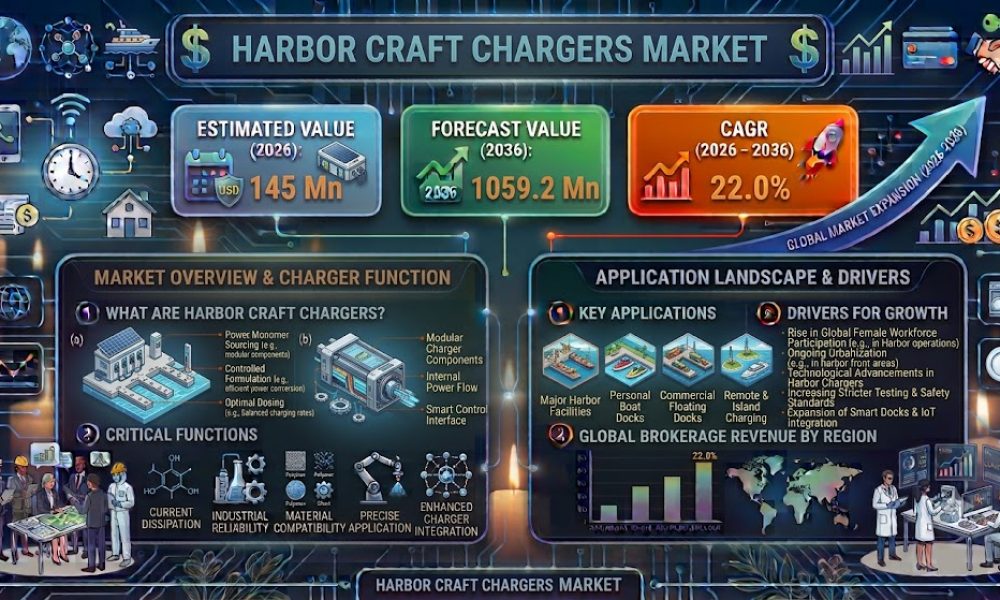
Harbor Craft Chargers Market is projected to expand from USD 145 million in 2026 to USD 1,059.2 million by 2036, registering a 22.0% CAGR during the forecast period. The market reached USD 118.9 million in 2025 and is expected to create an absolute opportunity of USD 914.2 million through 2036.
The market is gaining traction as commercial ports replace diesel-powered harbor craft with battery-powered vessels. Electric tugboats, ferries, patrol craft, service vessels, and pilot boats require dependable charging infrastructure to maintain operating schedules. Government support for cleaner marine transport and investment in waterfront electrification are also supporting demand.
Get Detailed Market Forecasts, Competitive Benchmarking, and Pricing Trends: https://www.factmr.com/connectus/sample?flag=S&rep_id=15465
Global Segment Leaders
- DC fast charging is expected to hold 39.0% share in 2026. Commercial harbor fleets require shorter charging cycles to keep vessels available throughout the day.
- Ferries account for 29.0% share, supported by frequent passenger services that depend on reliable charging between scheduled trips.
- Dockside chargers represent 37.0% share, as permanent installations integrate with existing harbor infrastructure and provide consistent charging access.
- Load management leads the grid integration segment with 34.0% share, helping ports balance electricity demand across multiple charging points.
- Port authorities capture 35.0% share among buyer types because they continue to direct investment in harbor electrification projects.
Harbor Fleet Electrification Drives Market Expansion
The strongest market driver is the electrification of harbor fleets. Ports are adding battery-powered vessels to reduce dependence on diesel-powered craft, making charging infrastructure a necessary part of fleet modernization.
Harbor operators are also looking at charging speed, equipment reliability, and energy management. Smart charging platforms can help control electricity demand across multiple charging locations, while battery buffer systems can reduce pressure on local grids.
Government funding for cleaner ports is another important factor. Fact.MR estimates that harbor fleet electrification contributes approximately 1.3 percentage points to market CAGR, while government funding for clean ports contributes 1.1 percentage points. Growth in electric ferry services adds another 0.9 percentage points.
Megawatt and Floating Charging Create New Opportunities
Larger electric harbor craft are creating demand for higher-capacity charging systems. Fact.MR identifies megawatt charging deployment as a major opportunity, with an estimated 0.9 percentage point impact on CAGR.
Floating charging stations also offer a way to extend charging access across busy waterfronts without requiring major civil construction. Renewable-powered charging and battery-supported charging hubs provide additional opportunities, particularly where ports face electricity capacity constraints.
The market also faces practical barriers. Grid upgrade requirements have an estimated negative 0.8 percentage point impact on CAGR. High infrastructure costs, slow replacement of existing diesel fleets, and limited charging standards can delay new installations.
Country-Level Performance
- United States: The market is projected to expand at a 22.4% CAGR through 2036, the highest among the countries covered. Commercial ports are increasing charging infrastructure for electric harbor craft, while tug operators and ferry services invest in battery-powered vessels.
- Norway: Expected to register a 22.0% CAGR, supported by established use of electric ferries and harbor vessels and continued expansion of charging capacity.
- China: Forecast to grow at 21.5% CAGR as major ports strengthen electric vessel infrastructure and incorporate charging facilities into harbor modernization projects.
- Germany: Expected to record a 21.1% CAGR, supported by clean port investment, energy-efficiency initiatives, and demand for smart energy management.
- India: Projected to achieve a 20.5% CAGR as commercial ports begin expanding infrastructure for electric harbor craft and pilot projects demonstrate battery-powered marine transport.
Europe holds a 42.0% share of the market in 2026, reflecting continued development of electric maritime transport projects across commercial ports.
Industry Developments and Competitive Landscape
The competitive landscape includes electrical equipment manufacturers, marine engineering companies, and charging infrastructure specialists. Key companies profiled by Fact.MR include ABB, Cavotec, Kempower, Wärtsilä, Damen, Crowley, Shell, and Aqua superPower.
Recent developments show how charging infrastructure is becoming part of wider port electrification programs. The Maritime and Port Authority of Singapore launched a pilot electric harbour craft charging point at Marina South Pier in April 2024 using a 150 kW DC fast charger. In March 2025, Singapore introduced TR 136, its first technical standard for electric harbour craft charging infrastructure.
Crowley also accepted delivery of the eWolf, described by Fact.MR as the first fully electric tugboat in the United States, in January 2024. Such projects demonstrate how vessel deployment and charging infrastructure are developing together.
Competition is shifting beyond charging hardware. Buyers increasingly assess charging speed, software capabilities, energy management, installation requirements, and lifecycle support when selecting charging systems.
Analyst Perspective
Shambhu Nath Jha, Senior Analyst at Fact.MR, states:
“Harbor craft charging is becoming a core element of modern port infrastructure. Operators now focus on charging speed, equipment reliability and energy management as electric fleets expand across commercial waterways.”
For equipment suppliers, the report points toward modular charging platforms that can support mixed vessel fleets. Port authorities also need to align charging capacity with planned fleet electrification rather than treating infrastructure as a later-stage investment.
Report Coverage
The Fact.MR study covers harbor craft charging systems across AC depot charging, DC fast charging, megawatt charging, and opportunity charging. It analyzes dockside, containerized, floating, and depot chargers, along with load management, battery buffers, shore power integration, and renewables-linked charging.
The assessment covers tugboats, ferries, patrol craft, service vessels, and pilot boats. The study draws on 112+ sources, 44+ company portfolios, 31+ countries, and 26+ interviews.
Read the complete [Harbor Craft Chargers Market report by Fact.MR] for detailed market forecasts, segment analysis, country-level outlook, competitive assessment, and technology trends.
Explore More Related Studies Published by Fact.MR Research:
Aircraft Galley Waste Compaction Systems Market
EV Battery Current-Interrupt Devices Market
About Fact.MR
Fact.MR is a global market research and consulting firm, trusted by Fortune 500 companies and emerging businesses for reliable insights and strategic intelligence. With a presence across the U.S., UK, India, and Dubai, we deliver data-driven research and tailored consulting solutions across 30+ industries and 1,000+ markets. Backed by deep expertise and advanced analytics, Fact.MR helps organizations uncover opportunities, reduce risks, and make informed decisions for sustainable growth.



