
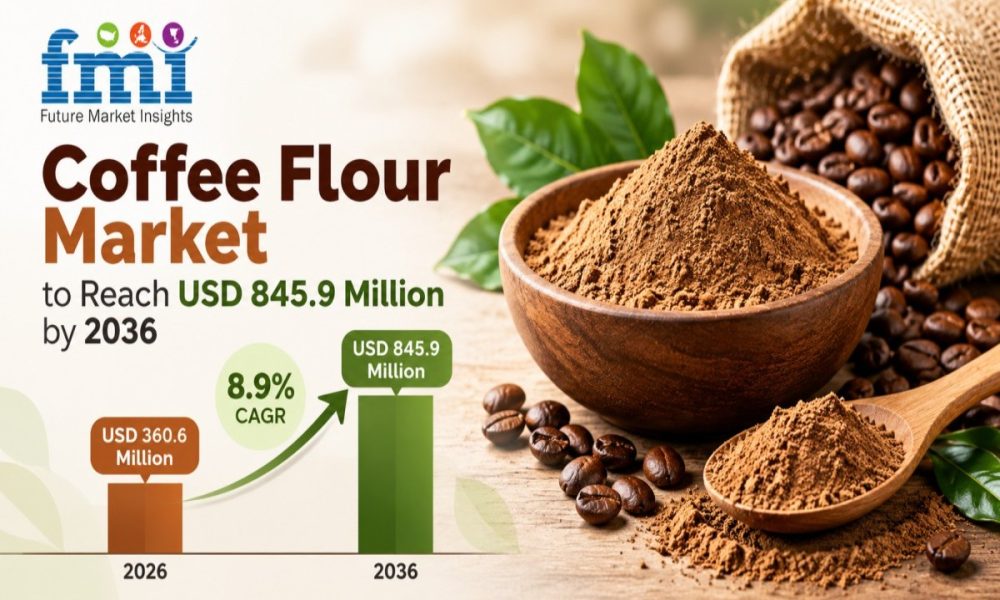
The global Coffee Flour Market is projected to reach USD 845.9 million by 2036, up from approximately USD 360.6 million in 2026, expanding at an 8.9% CAGR during the forecast period, according to the latest analysis by Future Market Insights (FMI).
The market is being supported by growing efforts to convert coffee-processing side streams into qualified food ingredients. Increasing recovery of coffee pulp, cascara and spent coffee grounds is creating opportunities for food manufacturers seeking functional ingredients while reducing waste from coffee processing.
Get Detailed Market Forecasts, Competitive Benchmarking, and Pricing Trends:
https://www.futuremarketinsights.com/reports/sample/rep-gb-34583
Coffee Cherry Pulp and Cascara Lead Source Demand
Coffee cherry pulp and cascara are estimated to account for 44.0% of source demand in 2026, making them the leading source category.
Coffee cherry pulp reaches the flour-production process immediately after depulping, making rapid stabilization important for retaining food-grade material. Drying and contamination controls help processors maintain suitable specifications for coffee-pulp flour across repeated manufacturer qualification cycles.
Conventional Supply Leads Nature Demand
Conventional coffee flour is projected to account for 58.0% of nature demand in 2026.
Conventional supply benefits from broader feedstock access as processors qualify coffee-derived materials for initial commercial applications.
Bakery Represents the Leading Application
Bakery is projected to account for 32.0% of application demand in 2026.
Bakery provides manufacturers with a controlled environment for comparing coffee-derived flour against dough handling, product volume, texture and sensory performance.
The Antioquia project documented in April 2025 that bakery recipes used 8 to 12 grams of coffee-pulp flour per serving, providing a tested starting point for commercial recipe development.
Food Manufacturers Lead End-Use Demand
Food manufacturers are expected to account for 38.0% of end-use demand in 2026.
Food manufacturers can spread ingredient qualification costs across larger production runs and multiple product lines. Their technical teams can evaluate microbiological limits, flavor effects and labeling requirements before approving recurring purchases.
Coffee Side-Stream Recovery Supports Market Expansion
Coffee processors can create additional value by converting stabilized coffee pulp and spent grounds into qualified food ingredients rather than directing them toward lower-value disposal routes.
The Antioquia project measured 44% dietary-fiber content in coffee-pulp flour in April 2025, giving formulation teams a measurable reason to evaluate the material beyond waste-management objectives.
Caffeine and Sensory Variation Can Extend Qualification
Caffeine levels and flavor intensity can vary according to feedstock and processing conditions, increasing formulation requirements for coffee-derived flour.
Manufacturers need composition data before establishing inclusion limits that protect taste and intended caffeine intake in finished products.
The Antioquia project measured 1.76 grams of caffeine per 100 grams of coffee-pulp flour in April 2025, providing a practical basis for formulation and dose guidance.
Vietnam Leads Country Growth
Vietnam’s coffee flour market is projected to expand at a 9.8% CAGR through 2036.
Robusta processing and established drying infrastructure provide shorter recovery routes for coffee side streams. Vietnam’s Department of Information and Statistics reported in May 2025 that cascara exceeds 60% of fresh coffee-fruit mass and can enter a bottled food product.
Brazil Benefits from Large Origin-Side Coffee Volumes
Brazil is projected to record a 9.6% CAGR through 2036.
Large coffee-processing volumes close to wet-processing facilities create opportunities for rapid separation and drying of coffee side streams. Seasonal moisture and mixed residues can nevertheless affect food-grade consistency.
USDA projected Brazil’s 2026/27 coffee crop at a record 71.9 million 60-kilogram bags in July 2026, reinforcing the scale of coffee side streams potentially available for recovery.
United States Expands Through Spent-Ground Collection Networks
The United States coffee flour market is forecast to rise at an 8.0% CAGR through 2036.
Dense commercial brewing networks provide opportunities to collect spent coffee grounds, although dispersed pickup points require controlled storage and predictable collection schedules.
The Center for Circular Economy in Coffee reported in April 2025 that The Kawa Project Inc. conducted pilots with large confectionery companies, providing an application route for recovered coffee powders.
Competitive Landscape
The Coffee Flour Market includes coffee-fruit powder developers, spent-ground processors, coffee-biorefinery companies and specialized food-ingredient developers.
Key companies profiled by FMI include Kaffe Bueno ApS, FOODTEMPLUM Scientific & Production Company, Coffee Resurrect Inc., Groundup Eco-Ventures Ltd., ofi (Olam Food Ingredients), Connecting Grounds ApS, The Kawa Project Inc. and PectCof B.V.
Competitive positioning is influenced by coffee feedstock coverage, food-grade flour and powder commercialization, formulation and scale-up support, food-safety records, milling consistency and geographic reach.
Key Industry Developments
The market continues to see advancements in coffee-side-stream recovery, food-ingredient commercialization and processing technologies.
In June 2026, ofi (Olam Food Ingredients) documented KOFEFRUT soluble cascara powder sourcing across six origins and a standardized route into food and beverage applications.
In January 2026, PectCof B.V. reported a positive EFSA scientific opinion for coffee-fruit-pulp Dutch Gum and advanced its European food-access pathway without completing authorization.
In November 2025, The Kawa Project Inc. won Bühler’s New Chocolate Challenge with a cocoa alternative made from upcycled coffee grounds and entered industry-led scale-up work.
Analyst Perspective
“Coffee flour earns repeat orders once food manufacturers can compare feedstock identity, microbiological controls and workable inclusion rates across batches. Strong offers pair a powder specification with bakery or formulation data that reduces repeated trials without hiding caffeine and sensory limits.” — Nandini Roy Choudhury, Principal Consultant, Future Market Insights
Exclusive Discounts on Full Report
https://www.futuremarketinsights.com/reports/coffee-flour-market
Report Scope
The FMI study covers the Coffee Flour Market by source, form, nature, application, end use and region.
Source categories include coffee cherry pulp/cascara, coffee grounds, green coffee beans and defatted coffee residue. Form categories include fine flour, coarse powder, instant/soluble powder and blended flour mixes. Nature categories include conventional, organic and upcycled/sustainability-certified supply.
Applications include bakery, snacks and bars, beverages, chocolate and confectionery, and nutritional products. End uses include food manufacturers, bakery/foodservice, retail consumers and ingredient blenders.
The research covers North America, Latin America, Europe, East Asia, South Asia and Pacific, and the Middle East and Africa, with Vietnam, Brazil, Colombia, the United States, the United Kingdom and 20+ additional countries included in the full report.
Key Executive Benefits
- Decision-Ready Insights
- Reduced Strategic Risk
- Market Entry Confidence
- Competitive Advantage
- Faster Growth Decisions
- Primary Market Validation
To explore how FMI Custom Research can support your strategic priorities, connect with our team at [email protected].
About Future Market Insights (FMI)
Future Market Insights, Inc. is an ESOMAR-certified, ISO 9001:2015 market research and consulting organization trusted by Fortune 500 companies. With a global presence across the U.S., UK, India and Dubai, FMI delivers data-driven insights across 30+ industries and 1,200 markets worldwide.



