
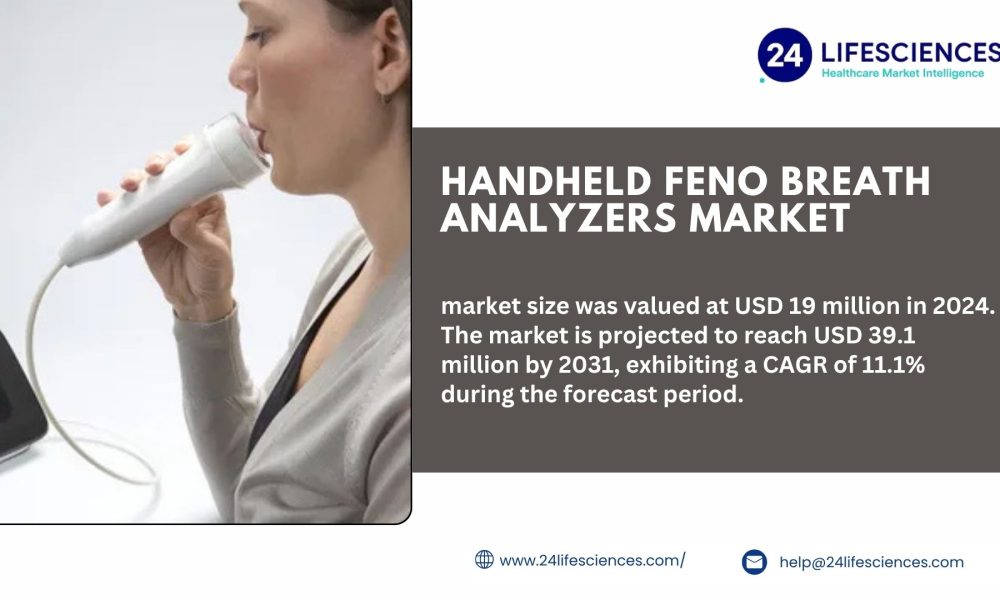
Global Handheld FeNO Breath Analyzers market size was valued at USD 19 million in 2024. The market is projected to reach USD 39.1 million by 2031, exhibiting a CAGR of 11.1% during the forecast period.
Get free sample of this report at : https://www.24lifesciences.com/download-sample/2497/handheld-feno-breath-analyzers-market-market
The handheld FeNO (fractional exhaled nitric oxide) breath analyzer is a portable medical device designed for non-invasive assessment of airway inflammation, particularly for the diagnosis and management of asthma and chronic obstructive pulmonary disease (COPD). This compact and lightweight instrument measures nitric oxide concentration in exhaled breath to help clinicians gauge inflammation levels and refine treatment strategies. Patients simply inhale deeply and exhale steadily as guided, allowing the built-in sensor to deliver quick, precise FeNO readings on the spot.
Recent developments (2019–mid-2024)
- Miniaturization & portability: Advances in electrochemical and optical sensor design have reduced size, power consumption, and warm-up time — enabling truly handheld, clinic-to-home devices.
- Improved sensor lifetime & calibration: Newer sensors and on-device auto-calibration methods reduced drift and service needs, lowering total cost of ownership for clinics.
- Connectivity & digital integration: Many devices added Bluetooth/USB connectivity and companion apps for trend visualization, EHR integration, remote monitoring, and telemedicine workflows.
- Expanded guideline acceptance: Clinical guidelines increasingly recognize FeNO as a useful biomarker to guide inhaled corticosteroid (ICS) decisions in certain asthma phenotypes, boosting clinician adoption.
- Point-of-care adoption in primary care & pharmacies: Simpler handheld units made screening and monitoring feasible outside pulmonology clinics—accelerating demand from primary-care networks and community health settings.
- Diversified use cases: Beyond asthma management, exploratory use in monitoring airway inflammation in COPD exacerbations, eosinophilic respiratory conditions, and as a biomarker in some research settings.
- Competitive pricing & OEM entrants: New entrants and contract manufacturers introduced lower-cost devices targeted at emerging markets and high-volume primary-care use.
- Regulatory approvals & reimbursement variability: Devices secured regulatory clearances in major markets; reimbursement policies remain patchy (positive in some countries, limited/no coverage in others), affecting uptake.
The market is expanding swiftly because of the growing global burden of respiratory conditions like asthma and COPD, which heightens the need for accessible diagnostic tools. Advancements in device portability and user-friendliness further propel this growth, enabling home-based testing that empowers better patient self-management. Key players such as NIOX Group (Circassia AB), CAIRE, ECO PHYSICS AG, Bosch Healthcare Solutions, and Bedfont Scientific dominate, with the top five holding about 95% market share. Europe leads regionally with 55% share, followed by North America at 38% and Asia Pacific at 12%, while adults represent 70% of applications.
Executive summary
Handheld fractional exhaled nitric oxide (FeNO) breath analyzers—used to monitor airway inflammation and guide asthma management—are seeing steady adoption driven by guideline endorsement, portability for point-of-care and home use, and improvements in sensor technology. Growth is strongest in North America and Asia-Pacific (driven by rising asthma prevalence and primary-care decentralization), with expanding traction in Europe and select emerging markets. Key themes for 2025–2032: miniaturization and sensor robustness, integration with digital health platforms, increased use in primary care and telehealth, and competitive pressure on price and reimbursement.
MARKET DRIVERS
Rising Prevalence of Respiratory Diseases to Drive Market Growth
The global incidence of respiratory conditions such as asthma and chronic obstructive pulmonary disease (COPD) continues to surge, creating a strong demand for effective diagnostic tools like handheld FeNO breath analyzers. These devices measure fractional exhaled nitric oxide levels, providing a non-invasive way to assess airway inflammation and guide treatment decisions. With asthma affecting over 260 million people worldwide and COPD impacting around 384 million, the need for accessible monitoring solutions has never been greater. This rising burden is particularly evident in regions with high pollution and aging populations, where early detection can significantly improve patient outcomes. Handheld analyzers offer portability and ease of use, allowing for frequent testing that helps clinicians adjust therapies more precisely. Furthermore, the integration of these devices into routine care protocols is accelerating adoption, as they enable better management of symptoms and reduce healthcare costs associated with severe exacerbations. As awareness grows about the benefits of proactive respiratory health monitoring, the market for these analyzers is poised for substantial expansion, supported by ongoing public health initiatives aimed at controlling chronic diseases.
Advancements in Portable and Smart Technology to Boost Adoption
Technological innovations in sensor accuracy and device miniaturization are transforming the handheld FeNO breath analyzer landscape, making them more reliable and user-friendly for both clinical and home settings. Modern devices feature electrochemical sensors that deliver results in seconds with high precision, often within a range of 5 to 300 parts per billion, aligning with clinical guidelines for asthma management. The shift toward smart connectivity, including Bluetooth integration with mobile apps and cloud data storage, empowers patients to track their FeNO levels over time and share insights with healthcare providers remotely. This is especially valuable in telemedicine scenarios, which have expanded post-pandemic. For example, recent models incorporate user-friendly interfaces with guided breathing instructions, reducing errors in self-testing and enhancing compliance among patients. These advancements not only lower the barrier to entry for non-specialists but also support personalized treatment plans by providing longitudinal data trends. As a result, healthcare systems are increasingly recommending these tools for ongoing monitoring, driving market penetration in primary care and outpatient facilities.
MARKET OPPORTUNITIES
Strategic Partnerships and Technological Integrations to Unlock Growth Potential
Increasing collaborations between device manufacturers and digital health platforms are opening new avenues for handheld FeNO breath analyzers, particularly through enhanced data analytics and AI-driven insights. With the market’s projected growth to $39.1 million by 2031, key players are pursuing acquisitions and joint ventures to integrate FeNO monitoring with wearable ecosystems, enabling comprehensive respiratory health profiles. For example, partnerships focusing on app-based result interpretation can improve user engagement, especially among the 70% adult demographic managing chronic conditions at home. These initiatives not only expand market reach but also align with the rising demand for telehealth solutions, potentially increasing adoption rates by facilitating remote consultations.
Additionally, supportive policies from health authorities for non-invasive diagnostics are fostering opportunities in underserved regions, where rising respiratory disease burdens demand affordable innovations.
Expansion into Emerging Markets and Pediatric Applications
The untapped potential in emerging markets, particularly in Asia Pacific with its 12% current share but growing urbanization and pollution-related asthma cases, presents lucrative prospects for handheld FeNO analyzers. Tailoring devices for cost-sensitive consumers, such as models with irreplaceable mouthpieces to reduce ongoing expenses, could capture this segment. In pediatric care, representing 30% of applications, opportunities lie in child-friendly designs that simplify testing, addressing the unique challenges of younger patients and supporting early intervention strategies.
Segment Analysis:
By Type
Replaceable Mouthpiece Segment Dominates the Market Due to Enhanced Hygiene Standards and User Convenience
The market is segmented based on type into:
- Replaceable Mouthpiece
- Irreplaceable Mouthpiece
Replaceable mouthpieces are preferred in clinical and home settings for their ability to maintain strict hygiene protocols, reducing the risk of cross-contamination between users. This segment benefits from widespread adoption in healthcare facilities where infection control is paramount, driving its leadership position. Irreplaceable mouthpieces, while simpler in design, are gaining traction in disposable or single-use applications to further minimize infection risks.
By Application
Adults Segment Leads Due to Higher Prevalence of Respiratory Conditions and Broader Diagnostic Needs
The market is segmented based on application into:
- Adults
- Children
The adults segment accounts for the majority of the market, reflecting the higher incidence of chronic respiratory diseases like asthma and COPD in this demographic. Devices tailored for adults support ongoing monitoring and treatment adjustments in primary care and specialist settings. The children segment is growing steadily, driven by increasing awareness of pediatric asthma management and the need for child-friendly, non-invasive testing options to improve early diagnosis and intervention.
HANDHELD FENO BREATH ANALYZERS MARKET TRENDS
Increasing Prevalence of Respiratory Diseases to Emerge as a Key Trend in the Market
The global incidence of respiratory conditions such as asthma and chronic obstructive pulmonary disease (COPD) is on a steady rise, fueling significant demand for non-invasive diagnostic tools like handheld FeNO breath analyzers. These devices measure fractional exhaled nitric oxide levels to assess airway inflammation, enabling quicker and more accurate management of symptoms. With the market valued at $19 million in 2024 and projected to reach $39.1 million by 2031, growing at a compound annual growth rate (CAGR) of 11.1%, this trend underscores the urgent need for accessible monitoring solutions. Furthermore, as urbanization and environmental factors exacerbate respiratory issues worldwide, healthcare providers are increasingly relying on portable analyzers to support early intervention and personalized treatment strategies. However, while this expansion offers opportunities, it also highlights challenges like varying regulatory standards across regions that could influence adoption rates.
Other Trends
Shift Toward Home-Based and Patient-Centric Care
The growing emphasis on home-based healthcare has accelerated the adoption of handheld FeNO breath analyzers, allowing patients to monitor their conditions independently without frequent clinic visits. This shift is particularly beneficial for chronic patients, where adults account for about 70% of applications, enabling better self-management and adherence to therapy plans. Devices with user-friendly designs and instant result displays empower individuals to track inflammation levels in real-time, reducing healthcare burdens and improving outcomes. While children represent a smaller segment, innovations in child-friendly interfaces are broadening accessibility, fostering a more proactive approach to respiratory health management.
Get free sample of this report at : https://www.24lifesciences.com/handheld-feno-breath-analyzers-market-market-2497
About 24lifesciences
Founded in 2017, 24LifeScience has emerged as a trusted research and analytics partner for organizations operating within the global life sciences and chemical industries. Our core mission is to provide intelligent, future-ready insights that help clients stay ahead in an increasingly complex and innovation-driven market
International: +1(332) 2424 294 | Asia: +91 9425150513 (Asia)
Website: http://www.24lifesciences.com
Follow us on LinkedIn: http://www.linkedin.com/company/lifesciences24




