
The global hand blender market is gaining steady traction as modern consumers increasingly seek compact, efficient, and multifunctional kitchen appliances. Hand blenders, also known as immersion blenders, have become essential tools for quick food preparation, offering convenience for blending, mixing, and pureeing directly in containers. Their lightweight design, ease of use, and space-saving nature make them particularly popular in urban households where kitchen space is limited. The growing preference for home-cooked meals and the rising trend of quick meal preparation are further contributing to the adoption of hand blenders worldwide.
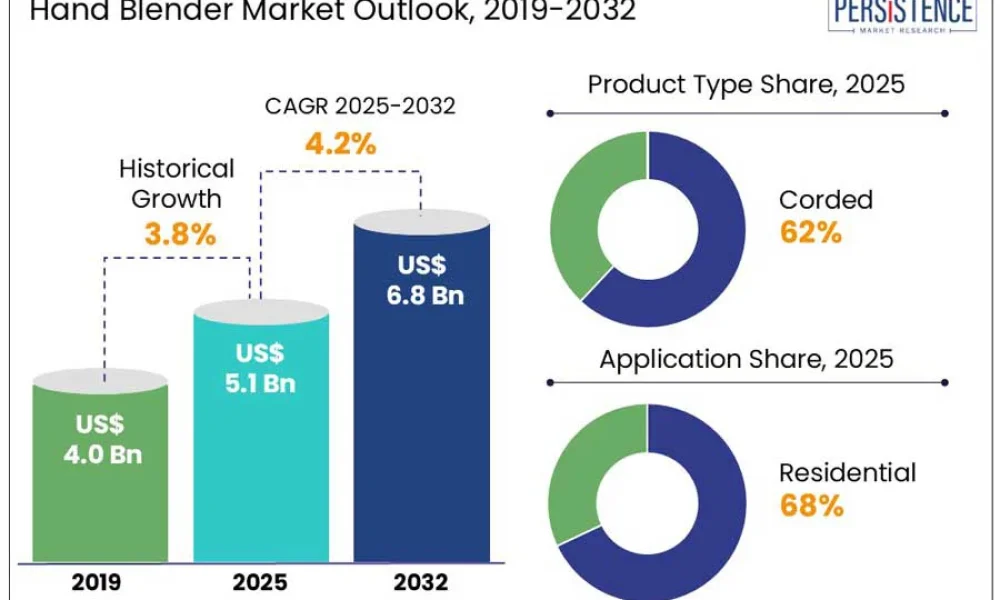
According to Persistence Market Research, the global hand blender market size is projected to increase from US$ 5.1 billion in 2025 to US$ 6.8 billion by 2032, exhibiting a CAGR of 4.2% from 2025 to 2032. The industry’s growth is driving innovation in kitchens worldwide, fueled by increasing demand for compact and versatile appliances. The household segment remains the leading end-user category due to frequent usage in daily cooking, while Europe is emerging as a leading regional market owing to high adoption of modern kitchen appliances and strong culinary culture.
Download Your Free Sample & Explore Key Insights : https://www.persistencemarketresearch.com/samples/35393
Key Highlights from the Report
➤ The hand blender market is expected to grow from US$ 5.1 billion in 2025 to US$ 6.8 billion by 2032.
➤ Rising demand for compact and multifunctional kitchen appliances is driving market growth globally.
➤ Increasing trend of home cooking and meal customization is boosting product adoption.
➤ Technological advancements such as variable speed settings and ergonomic designs are enhancing product appeal.
➤ Expansion of online retail channels is improving accessibility and product visibility.
➤ Growing interest in time-saving cooking solutions is supporting steady demand across households.
Market Segmentation
The hand blender market can be segmented based on product type, application, and distribution channel. Product types primarily include corded and cordless hand blenders, with corded variants dominating the market due to their consistent power output and affordability. However, cordless hand blenders are gaining popularity as they offer greater flexibility and portability, making them suitable for modern kitchens. Manufacturers are also focusing on adding attachments such as whiskers, choppers, and frothers to enhance product functionality and attract a wider consumer base.
From an application perspective, the market is divided into household and commercial segments. The household segment leads due to the increasing use of hand blenders for daily cooking activities such as preparing soups, smoothies, sauces, and baby food. In terms of distribution channels, supermarkets and hypermarkets remain key sales points, while e-commerce platforms are rapidly expanding. Online channels allow consumers to compare features, read reviews, and access a wide range of products, making them an increasingly preferred purchasing option.
Customize This Report for Your Exact Requirements : https://www.persistencemarketresearch.com/request-customization/35393
Regional Insights
Europe holds a significant share in the hand blender market due to high consumer awareness and strong demand for advanced kitchen appliances. Countries such as Germany, France, and the United Kingdom are leading markets where consumers prioritize convenience and efficiency in cooking. The region’s established food culture and preference for homemade meals contribute to sustained demand for hand blenders. Additionally, the presence of well-known appliance manufacturers supports continuous product innovation.
North America is another prominent market driven by the growing trend of healthy eating and home meal preparation. Consumers in the region are increasingly investing in kitchen gadgets that simplify cooking processes. Meanwhile, the Asia-Pacific region is witnessing rapid growth due to urbanization, rising disposable incomes, and changing lifestyles. The increasing adoption of modern kitchen appliances in countries like India and China is creating significant opportunities for market expansion.
Market Drivers
The increasing demand for compact and multifunctional kitchen appliances is a major driver of the hand blender market. Consumers today prefer appliances that offer multiple functionalities while occupying minimal space. Hand blenders fulfill this requirement by combining blending, mixing, and whisking capabilities in a single device. This versatility makes them a preferred choice among busy households looking for efficient cooking solutions.
Another key driver is the rising trend of home cooking and healthy eating habits. Consumers are increasingly preparing meals at home to ensure better quality and nutrition. Hand blenders enable quick preparation of fresh soups, smoothies, and sauces, aligning with health-conscious lifestyles. The growing influence of cooking shows, social media recipes, and food blogs is also encouraging consumers to experiment with new dishes, further boosting the demand for hand blenders.
Market Restraints
Despite steady growth, the hand blender market faces challenges such as limited durability and performance issues in low-cost products. Budget-friendly hand blenders may lack the power and longevity required for heavy usage, leading to consumer dissatisfaction. This can impact brand reputation and reduce repeat purchases, particularly in price-sensitive markets.
Another restraint is the availability of alternative kitchen appliances such as countertop blenders and food processors. These appliances often offer higher power and additional features, making them suitable for more complex food preparation tasks. As a result, some consumers may prefer investing in multifunctional appliances instead of hand blenders, which can limit market growth to some extent.
Market Opportunities
The growing demand for innovative and feature-rich hand blenders presents significant opportunities for manufacturers. Introducing advanced features such as smart controls, noise reduction technology, and energy-efficient motors can enhance product differentiation. Additionally, the development of cordless and rechargeable models is expected to attract consumers seeking convenience and portability.
Another promising opportunity lies in the expansion of emerging markets. Rapid urbanization, increasing disposable incomes, and changing consumer lifestyles in regions such as Asia-Pacific and Latin America are driving the adoption of modern kitchen appliances. Companies can capitalize on this trend by offering affordable and durable products tailored to local preferences, thereby expanding their market presence.
Get Instant Access – Complete Your Purchase : https://www.persistencemarketresearch.com/checkout/35393
Company Insights
Key players operating in the hand blender market include:
- Whirlpool Corporation
- Panasonic Corporation
- Koninklijke Philips N.V.
- BSH Hausgeräte GmbH
- Groupe SEB
- Electrolux AB
- Conair Corporation
- Vorwerk SE & Co. KG
- De’Longhi S.p.A.
- Hamilton Beach Brands Holding Company
- Breville Group Ltd.
- Braun GmbH
- KitchenAid
- Russell Hobbs
- Cuisinart
Recent Developments
- June 2024: Philips launched a new range of ergonomic hand blenders with advanced speed control features to enhance user convenience.
- October 2023: Breville introduced a high-performance cordless hand blender designed for improved portability and efficiency.
Future Opportunities and Growth Prospects
The future of the hand blender market appears promising as consumers continue to prioritize convenience, efficiency, and versatility in kitchen appliances. Technological advancements and product innovation are expected to play a crucial role in shaping market dynamics. Manufacturers focusing on user-friendly designs and enhanced functionality will likely gain a competitive edge in the coming years.
Additionally, the increasing adoption of modern kitchen solutions in emerging economies will further drive market expansion. With rising awareness of healthy eating and home cooking trends, the demand for hand blenders is expected to remain strong. Strategic product launches, expansion into new markets, and continuous innovation will define the long-term growth trajectory of the hand blender market.




