
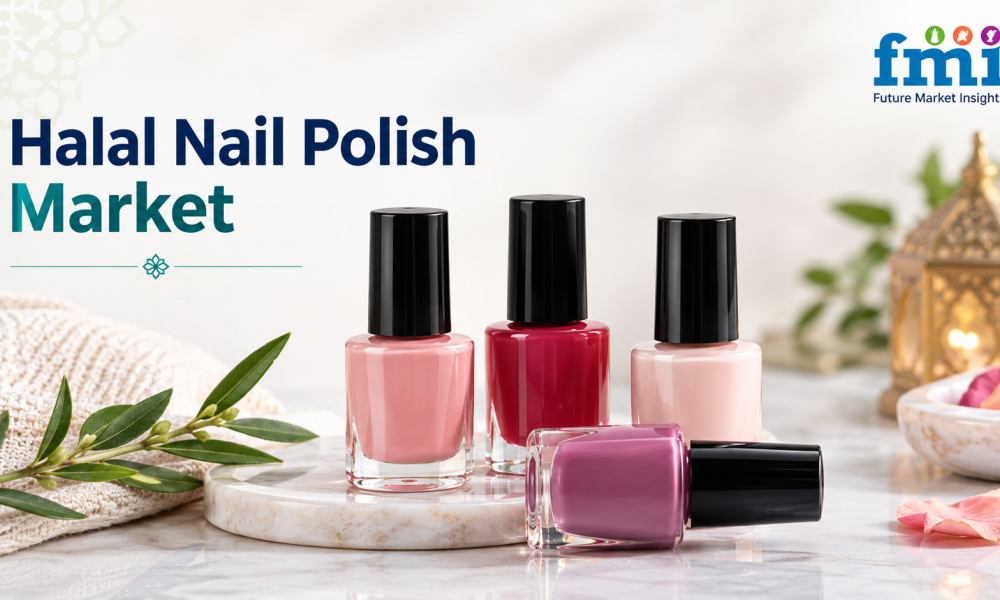
The global Halal Nail Polish Market is projected to grow from USD 316.5 million in 2026 to USD 535.5 million by 2036, expanding at a 5.4% CAGR, according to Future Market Insights (FMI). The market is being shaped by changes in halal certification requirements, continued demand for routine nail-color purchases and the need for brands to maintain separate evidence for halal assurance and ordinary cosmetic safety compliance.
Indonesia is an important market in this shift. Its mandatory halal certification requirement for cosmetics is scheduled to take effect on October 18, 2026, moving certification planning further into the product development and import process. For manufacturers and overseas brands, the change means formula documentation, certification and certified inventory planning need to be considered before packaging and shipment decisions are finalized.
The market is also influenced by differences in regulatory approaches across countries. In Great Britain, halal nail polish remains an ordinary cosmetic category with voluntary faith assurance. At the same time, the UK-India trade agreement is changing the tariff environment for qualifying nail-polish trade. Cosmetic notification and Responsible Person requirements continue to apply before retail sale.
Core Nail-Color Lines Remain Important
FMI estimates that core-classic lines will account for 35.0% of the product-type category in 2026. Familiar shades and routine replacement support demand for established nail-color products, reducing the purchase complexity associated with specialist treatments.
The conventional category is projected to represent 54.0% of the market by nature in 2026. Halal certification addresses permitted inputs and handling requirements, which are separate from vegan or natural positioning. This allows mainstream formulation capacity to serve halal-conscious consumers when the required ingredient and process evidence is available.
By format, cream & balm is projected to hold 39.0% in 2026 under the supplied market taxonomy. Controlled application and familiar usage cues support its position within the format category.
Price and distribution also remain relevant to market development. Mass products are projected to account for 33.0% of the price-positioning category in 2026, reflecting the importance of visible price differences in repeat color purchases. Meanwhile, e-commerce & DTC is expected to represent 27.0% of the sales-channel category, allowing brands to place certification information alongside shade, wear and usage details.
Get detailed market forecasts, competitive benchmarking, and pricing trends: https://www.futuremarketinsights.com/reports/sample/rep-gb-35287
Compliance Creates Both Pressure and Opportunity
The expansion of formal halal requirements is moving certification work earlier in the launch process. However, halal certification does not replace ordinary cosmetic safety assessments. Nail products continue to face safety and product-notification requirements, creating an additional documentation burden for manufacturers and brands.
This distinction is becoming increasingly important as regulatory scrutiny develops. FMI notes that separate halal and safety evidence can increase compliance work and costs. At the same time, clearer cosmetics-specific halal guidance could help companies reduce avoidable rework by preparing ingredient, formulation and manufacturing records before artwork and packaging approval.
Rahul Pandita, Principal Consultant at Future Market Insights, said:
“A halal claim earns repeat purchase only after the formula and handling evidence survive the same scrutiny as shade and wear. Retailers therefore need certification scope to be clear before promotional language turns a faith claim into a reason to list another color line.”
Access the Complete Report in PDF Format: https://www.futuremarketinsights.com/reports/brochure/rep-gb-35287
Regional Growth Outlook
FMI’s country-level analysis covers several markets where certification requirements and cosmetic regulations are developing at different speeds.
Saudi Arabia is projected to expand at a 7.2% CAGR through 2036, while Indonesia is forecast at 6.9%. The UAE follows at 6.5%, Turkey at 6.2%, Malaysia at 5.9%, and the UK at 5.6%.
The differences reflect distinct market-entry conditions. Indonesia is bringing halal certification into import and launch planning. Saudi Arabia places emphasis on cosmetic safety documentation and disciplined claims. The UAE continues to provide an optional halal assurance route, while Turkey requires responsible technical oversight before cosmetics enter the local market. Malaysia benefits from domestic cosmetics manufacturing capacity, and the UK combines established beauty retail infrastructure with changing trade conditions.
Competitive Landscape
The competitive environment includes direct nail-color companies, manicure specialists and diversified beauty groups. Key companies profiled by FMI include The Estée Lauder Companies, e.l.f. Beauty, Glamnetic, Church & Dwight, Coty, L’Oréal Groupe, Wella Company, KISS Products, Olive & June, and Unilever.
Coty, L’Oréal Groupe, Wella Company and Olive & June have documented direct nail-color or nail-care participation. Glamnetic and KISS Products participate through adjacent press-on manicure formats, while diversified beauty companies bring broader retail and distribution capabilities.
Report Scope
The FMI study analyzes the Halal Nail Polish Market by product type, nature, format, price positioning, sales channel and region. The research covers North America, Latin America, Western Europe, Eastern Europe, East Asia, South Asia and Pacific, and the Middle East and Africa.
The market definition covers commercial sales of halal-positioned nail polish and nail-color products within the stated taxonomy. Press-on nails, adhesives, removers and salon-service revenue remain outside the market boundary.
The report uses primary and secondary research with market triangulation, combining industry interviews, regulatory sources, trade information, company disclosures and other public evidence. The forecast period extends from 2026 to 2036.
Business Impact
FMI helps organizations transform market complexity into strategic clarity, enabling leadership teams to identify growth opportunities faster, optimize resource allocation, strengthen competitive positioning, and make high-stakes business decisions with confidence.
To explore how FMI Custom Research can support your strategic priorities, please connect with our team at – [email protected]
About Future Market Insights (FMI)
Future Market Insights, Inc. (FMI) is an ESOMAR-certified, ISO 9001:2015 market research and consulting organization, trusted by Fortune 500 clients and global enterprises. With operations in the U.S., UK, India, and Dubai, FMI provides data-backed insights and strategic intelligence across 30+ industries and 1200 markets worldwide.



