
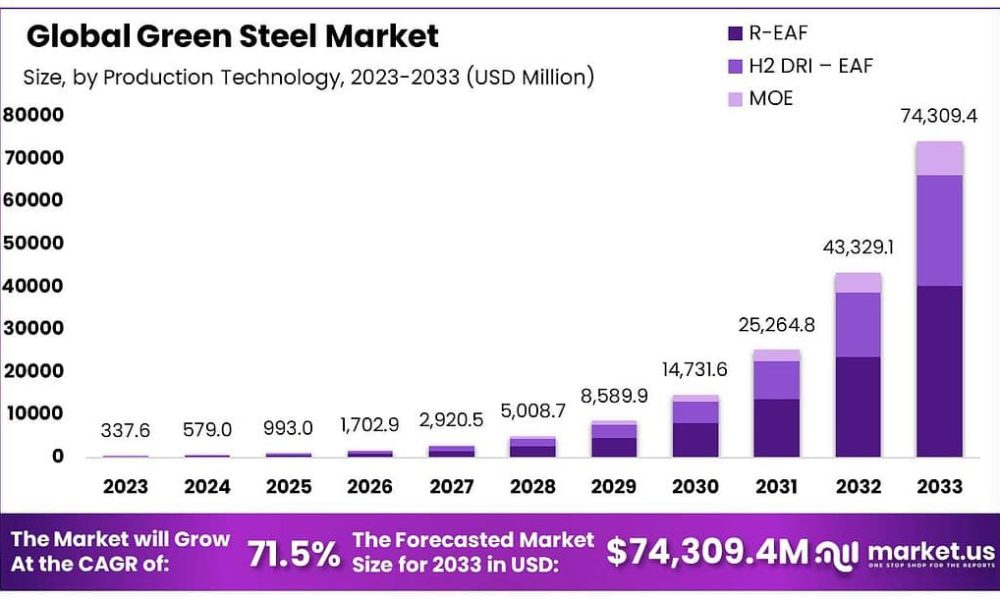
According to market.us, the global green steel market is projected to reach approximately USD 74,309.4 million by 2033, rising sharply from USD 337.6 million in 2023, at a remarkable CAGR of 71.5% between 2024 and 2033. Green steel refers to steel produced through environmentally responsible methods that significantly lower carbon emissions compared to conventional processes. These methods include electric arc furnace (EAF) technology, hydrogen-based steelmaking, and carbon capture, utilization, and storage (CCUS).
The market is gaining momentum as industries and governments intensify efforts to combat climate change, reduce greenhouse gas emissions, and adopt cleaner industrial practices. Green steel maintains the same physical and chemical properties as traditionally produced steel but with a substantially lower environmental footprint. Its growing adoption is driven by mounting regulatory pressure on carbon emissions, heightened awareness of environmental degradation, and strong demand from sectors like construction, automotive, and manufacturing.
Moreover, escalating climate-related challenges—such as global warming and environmental pollution—have prompted several national governments to implement stricter emission standards and incentivize sustainable production technologies. The surge in eco-conscious investments, coupled with technological innovations in decarbonization, is expected to propel the green steel market forward throughout the forecast period.
Key Takeaways
- In 2023, the global green steel market generated a revenue of USD 337.6 million, with a CAGR of 71.5%, and is expected to reach USD 74,309.4 million by the year 2033.
- The production technology held a major share of the market, with renewable-electric arc furnaces (R-EAF): taking the lead in 2023 with a market share of 54.3%.
- By energy source, the solar accounted for a significant share of 44.5%.
- By end-use, the building & construction segment among the other sub-segments held a significant revenue share of the market with 38.5% of the global green steel market.
- Asia Pacific led the market by securing a market share of 43.4% in 2023.
Access a Complimentary Sample of This Premium Report: https://market.us/report/green-steel-market/request-sample/
Factors Affecting the Growth of the Green Steel Market
Government Regulations and Environmental Policies: Stricter environmental laws and carbon emission targets are encouraging steel manufacturers to adopt cleaner production technologies. Supportive policy frameworks, including tax benefits, emission trading systems, and decarbonization incentives, are playing a vital role in accelerating the shift toward green steel.
Technological Advancements in Steel Production: The development and adoption of alternative steelmaking processes, such as hydrogen-based direct reduced iron (DRI), electric arc furnaces (EAF), and carbon capture technologies, are transforming traditional manufacturing. These innovations reduce reliance on fossil fuels and enhance production efficiency, thereby boosting market growth.
Rising Demand for Sustainable Construction and Automotive Materials: Increasing awareness among consumers and industries about the environmental impact of construction and mobility is driving the demand for low-carbon steel. Sectors such as automotive, infrastructure, and industrial equipment are seeking greener alternatives to align with sustainability goals.
Corporate Sustainability Goals and ESG Commitments: Many global companies are integrating sustainability into their supply chains, committing to net-zero emissions, and demanding low-carbon materials from their suppliers. This growing focus on environmental, social, and governance (ESG) standards is prompting higher adoption of green steel across industries.
Investment and Infrastructure for Green Steel Technologies: Substantial investments in renewable energy sources, hydrogen production, and infrastructure development are essential for scaling green steel production. Public-private collaborations, funding for pilot projects, and investments in green hydrogen plants are critical to making green steel economically viable and widely accessible.
Key Market Segmentation
By Production Technology Analysis
In 2023, the renewable-electric arc furnace (R-EAF) segment led the green steel market, accounting for a dominant 54.3% share. This leadership is attributed to its capacity to drastically lower greenhouse gas emissions by up to 80% compared to conventional steel production methods. R-EAF technology, when powered by renewable sources such as solar, wind, or tidal energy, offers a sustainable and efficient alternative for steelmaking.
The rising cost of carbon emissions and tightening government regulations are key drivers encouraging steel producers to shift toward cleaner production methods. Additionally, the growing affordability and accessibility of renewable energy infrastructure, such as industrial-scale solar grids, is expected to support the adoption of R-EAF technology.
According to the International Energy Agency (IEA), global renewable energy capacity increased by approximately 510 GW in 2023, marking a 50% annual growth—the fastest in 22 years—further reinforcing the shift toward renewable-powered steel manufacturing.
By Energy Source Analysis
The solar energy segment accounted for a notable 44.5% share of the green steel market, driven by declining solar power costs and rising adoption of renewable energy in industrial applications. Solar energy is becoming increasingly competitive with fossil fuels, making it a preferred option for powering electric furnaces in steel production. Government incentives and tax benefits are further encouraging its use in industrial sectors.
Technological advancements such as bi-facial solar panels and improved energy storage systems have enhanced efficiency and reduced operational costs, strengthening the segment’s position. As steel manufacturers aim to lower emissions and align with sustainability targets, solar energy is emerging as a reliable and widely available solution.
According to the International Renewable Energy Agency (IRENA), global solar PV capacity reached approximately 710 GW in 2020. The ability of solar power to reduce grid dependency and protect against energy price fluctuations further supports its growing adoption in green steel production.
By End-use Analysis
The building and construction segment accounted for the largest share of the global green steel market at 38.5%, primarily due to the rising demand for sustainable and energy-efficient infrastructure. Green steel, known for its lower carbon footprint and high recycled content, aligns with the construction industry’s shift toward environmentally responsible practices.
Tools like Building Information Modeling (BIM) and Life Cycle Assessment (LCA) are further supporting adoption by enabling stakeholders to evaluate and reduce environmental impacts during project planning.
In addition, green steel’s inherent properties—such as durability and corrosion resistance—help lower maintenance costs and extend the lifespan of buildings. With ongoing global urbanization, infrastructure expansion, and renovation activities, the demand for green steel in construction is expected to grow steadily.
Key Market Segments
By Production Technology
- Renewable – Electric Arc Furnace
- Hydrogen Direct Reduced Iron – Electric Arc Furnace
- Molten Oxide Electrolysis
By Energy Source
- Solar
- Wind
- Others
By End-use
- Building & Construction
- Automotive
- Renewable Energy Infrastructure
- Home Appliances
- Others
Geopolitical Impact Analysis
Geopolitical factors play a crucial role in shaping the global green steel market, influencing trade dynamics, investment, and policy direction. Trade tensions, such as the China–US trade war, can raise production costs and restrict international supply chains, posing challenges to market expansion. However, supportive government policies are counterbalancing these effects by promoting sustainable steel production.
Notably, the European Union’s Green Deal, launched in 2020, and the carbon border adjustment mechanism aim to make Europe climate-neutral by 2050, offering significant growth opportunities for green steel manufacturers in the region. Similarly, the United States is advancing its green steel agenda through legislative support. The Inflation Reduction Act (IRA) and the Infrastructure and Jobs Act (IJA) provide funding and policy backing for low-carbon technologies like hydrogen-based steelmaking and carbon capture and storage (CCS).
Global cooperation on clean technology, political stability, and investment in green infrastructure further supports market development. Conversely, ongoing geopolitical tensions may cause supply chain disruptions, affecting raw material availability. Nonetheless, these challenges also encourage innovation and a push toward energy independence, which is expected to accelerate the adoption of green steel globally.
Top Key Players
- Arcelor Mittal
- Baowu Steel Group
- Emirates Steel Arkan
- Green Steel Group Inc.
- H2 Green Steel
- Other Key Players
Get in Touch with Us:
Market.us (Powered By Prudour Pvt. Ltd.)
Address: 420 Lexington Avenue, Suite 300 New York City, NY 10170, United States
Send Email: [email protected]
Refer More Related Reports:



