

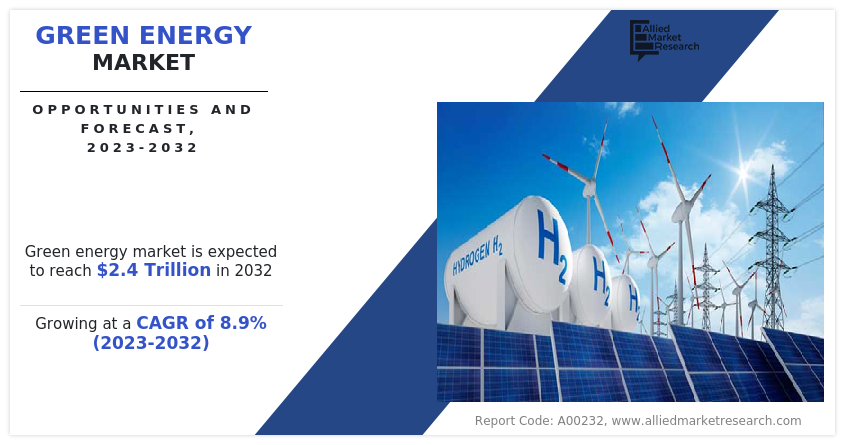
According to a new report published by Allied Market Research, titled, “Green Energy Market,” The green energy market was valued at $1.0 trillion in 2022, and is estimated to reach $2.4 trillion by 2032, growing at a CAGR of 8.9% from 2023 to 2032.
The green energy market encompasses the generation and use of energy from renewable, environmentally friendly sources such as solar, wind, hydro, biomass, and geothermal. These energy sources are considered sustainable alternatives to conventional fossil fuels, as they produce little to no greenhouse gas emissions and help combat climate change. The rising global awareness regarding environmental degradation, combined with international commitments to reduce carbon emissions, is propelling the demand for green energy solutions across residential, commercial, and industrial sectors.
Governments worldwide are implementing policies, subsidies, and regulatory frameworks to accelerate the adoption of green energy technologies. Technological advancements, declining installation costs, and increased investments in renewable infrastructure have further fueled market expansion. As the world transitions toward a low-carbon economy, the green energy market is positioned as a critical component of the global energy mix, offering both environmental and economic benefits.
Download PDF Brochure: https://www.alliedmarketresearch.com/request-sample/322
Green Energy Market Dynamics
- Market Drivers
The green energy market is primarily driven by the growing global emphasis on sustainability and reducing carbon emissions. International climate agreements, such as the Paris Agreement, have prompted countries to adopt ambitious renewable energy targets. Supportive government policies, including subsidies, tax incentives, and renewable energy mandates, have further accelerated the deployment of green technologies. In addition, the declining cost of renewable energy sources, particularly solar and wind power, has made them more accessible and competitive with conventional energy sources. - Market Restraints
Despite its positive growth trajectory, the green energy market faces challenges that could hinder its expansion. One significant barrier is the intermittency of renewable energy sources like solar and wind, which can lead to grid reliability concerns without adequate energy storage solutions. Furthermore, the high initial capital investment required for setting up renewable infrastructure can be a deterrent in developing regions. Regulatory complexities and lack of standardization across countries also pose difficulties in seamless integration and implementation. - Market Opportunities
The ongoing energy transition offers immense opportunities for innovation and investment in the green energy sector. Advancements in smart grid systems, battery storage technologies, and digital energy management tools are enhancing the efficiency and reliability of renewable power systems. Emerging economies, in particular, present untapped markets for green energy development due to their growing energy demand and limited fossil fuel resources. Additionally, the integration of green energy with electric vehicles and green hydrogen production opens new avenues for cross-sectoral growth. - Market Trends
Key trends shaping the green energy market include increased decentralization of power generation through rooftop solar panels, community wind projects, and microgrids. There is also a noticeable shift toward corporate power purchase agreements (PPAs) as businesses strive to meet sustainability targets. The rise of energy-as-a-service (EaaS) models and the application of AI and IoT in renewable energy systems are further transforming the market landscape. As stakeholders prioritize ESG (Environmental, Social, and Governance) goals, green energy continues to be at the forefront of investment strategies and public policy agendas.
For Purchase Inquiry: https://www.alliedmarketresearch.com/purchase-enquiry/322
Green Energy Market Segment Overview:
The green energy market forecast is segmented based on energy type, end use, and region. By energy type, the market includes solar, wind, hydro, geothermal, and bioenergy. Among these, solar and wind energy dominate due to widespread adoption and declining costs. In terms of end use, the market is classified into residential, commercial, industrial, and utility-scale sectors, with the utility segment accounting for the largest share owing to large-scale renewable power installations. Regionally, the market is analyzed across North America, Europe, Asia-Pacific, and LAMEA, with Asia-Pacific leading due to rapid industrialization and strong government support for clean energy.
Regional Analysis
Regionally, the green energy market is experiencing robust growth across Asia-Pacific, which held a significant share and is expected to maintain its dominance during the forecast period. Countries such as China, India, and Japan are making substantial investments in renewable energy infrastructure to meet rising energy demands and reduce dependence on fossil fuels. China, in particular, is leading global installations of solar and wind capacity, backed by favorable policies and strong manufacturing capabilities. India’s government initiatives like “National Solar Mission” and focus on grid modernization are further boosting the region’s market expansion.
In North America and Europe, the green energy market is also witnessing steady growth driven by environmental regulations, carbon neutrality targets, and financial incentives for renewable energy adoption. In Europe, countries such as Germany, France, and the Netherlands are aggressively transitioning to clean energy through ambitious decarbonization strategies. Meanwhile, the U.S. is investing in utility-scale solar and wind projects, along with advancements in green hydrogen and energy storage systems. These developments are helping to accelerate the shift toward a more sustainable and resilient energy infrastructure across these mature markets.
Competitive Analysis
The green energy market is highly competitive, with key players focusing on strategic partnerships, acquisitions, and technological innovations to strengthen their market presence. Major companies such as Siemens Gamesa, Vestas, Ørsted, Enel Green Power, and NextEra Energy are actively investing in wind and solar power projects across multiple regions. These companies are also exploring advancements in green hydrogen, battery storage, and smart grid solutions to enhance energy efficiency and ensure a stable supply of renewable energy. Their emphasis on research and development is aimed at increasing the efficiency and scalability of green energy technologies to meet growing global demand.
In addition to established energy giants, the market also features a growing number of regional and emerging players, especially in Asia-Pacific and Latin America, who are capitalizing on local government incentives and expanding infrastructure. These players contribute to increased competition and diversification in the market. The rapid entry of new firms in sectors like bioenergy, geothermal, and floating solar technologies is pushing the boundaries of innovation and helping reduce the overall cost of green energy. As competition intensifies, companies are increasingly prioritizing sustainability goals, digital transformation, and grid integration to remain relevant and competitive in a dynamic energy landscape.
Key findings of the Green Energy Market study:
- Market Growth: The green energy market is experiencing robust growth, driven by rising environmental concerns, policy support, and increasing demand for cleaner power alternatives.
- Solar and Wind Dominate: Among various green energy sources, solar and wind energy continue to dominate due to falling technology costs and widespread adoption in residential, commercial, and utility-scale projects.
- Asia-Pacific Leads: The Asia-Pacific region holds the largest market share, fueled by aggressive renewable energy targets, government subsidies, and expanding infrastructure in countries like China and India.
- Technological Innovation: Advancements in energy storage, grid integration, and smart technologies are enhancing the efficiency and reliability of green energy systems, supporting broader adoption.
- Policy Support Matters: Government incentives, renewable energy mandates, and global climate agreements are crucial in accelerating the transition from fossil fuels to renewable sources worldwide.




