
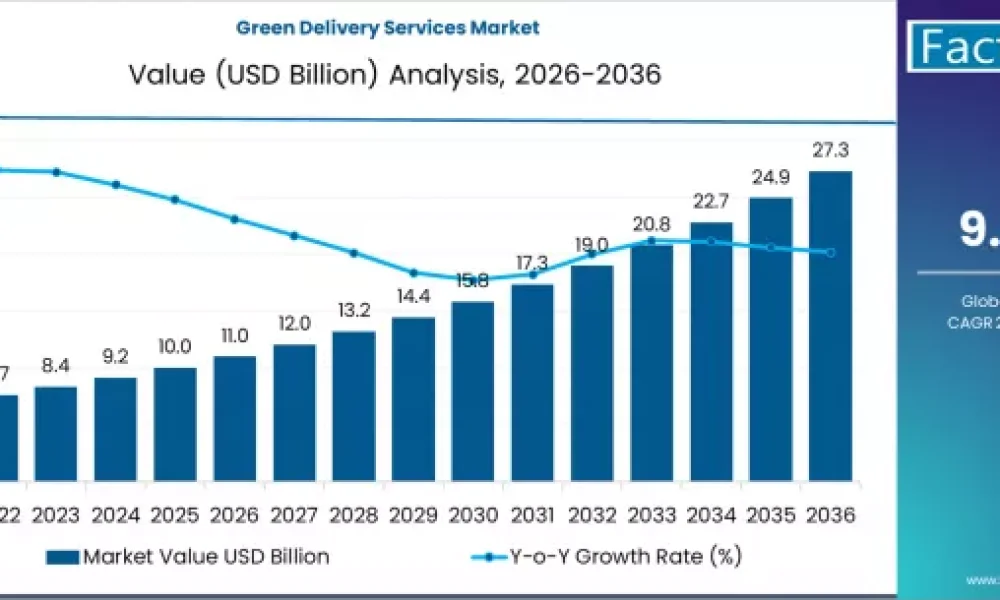
The global Green Delivery Services Market is projected to grow significantly through 2036 as environmental concerns, regulatory pressure, and consumer expectations steer the logistics industry toward low-emission, energy-efficient delivery solutions. Green delivery services emphasize reduced carbon footprints in last-mile and urban logistics by deploying electric vehicles (EVs), cargo bikes, optimized routing systems, shared mobility solutions, and other sustainable transportation modalities. These services support broader corporate sustainability commitments and help businesses deliver on environmental, social, and governance (ESG) goals.
As e-commerce volumes surge and urban populations expand, emissions from delivery fleets have become a major focus for policymakers, brands, and logistics providers. Green delivery services enable retailers, carriers, and third-party logistics (3PL) providers to cut emissions without compromising delivery speed or service quality, aligning operational performance with environmental responsibility.
Market Outlook (2026–2036)
Market Value in 2026: Estimated at USD 11.0 Billion
Market Value in 2036: Projected to exceed USD 25.0 Billion
Forecast CAGR (2026–2036): Approximately 9.5%
Leading Service Mode: Electric Vehicle (EV) Fleets
Primary Application: Parcel and Small-Package Delivery
Top End Users: E-Commerce Retailers, Consumer Brands, Logistics Providers
The market’s optimistic growth forecast reflects rising investment in sustainable mobility, emissions reduction initiatives, and integration of smart delivery technologies across global logistics networks.
To Access the Complete Data Tables & in-depth Insights, Request a Discount on this report: https://www.factmr.com/connectus/sample?flag=S&rep_id=13415
Market Overview
Green delivery services are logistics solutions designed to minimize environmental impact through low-emission vehicles, optimized route planning, multimodal transportation, and digital platforms that reduce fuel consumption and congestion. Last-mile delivery — the final step between warehouse and customer — accounts for a disproportionate share of urban delivery emissions, making it a prime target for sustainable innovations.
Core elements of the green delivery ecosystem include electric and hybrid delivery vehicles, cargo bikes and pedestrian delivery for dense urban zones, consolidated delivery hubs, micro-fulfillment centers, and advanced software that optimizes routing to reduce distance and idle times. These solutions help lower carbon emissions, improve air quality, and reduce operational costs while meeting customer expectations for fast and reliable delivery.
Key Market Drivers
1. Rapid Growth of E-Commerce
The exponential rise in online shopping has significantly increased delivery volumes, intensifying emissions from traditional fossil-fuel-based logistics. Green delivery services help balance convenience with environmental responsibility.
2. Regulatory Pressure and Environmental Mandates
Governments and city authorities increasingly enforce emissions standards, low-emission zones, and incentives for clean transportation. These policies drive logistics providers to adopt greener fleets and sustainable delivery models.
3. Consumer Demand for Sustainable Practices
Consumers are more environmentally conscious and often prefer brands that demonstrate sustainability in their operations, including green delivery options. Retailers increasingly promote eco-friendly delivery choices as a competitive differentiator.
4. Advances in Electric Mobility and Routing Technology
Improvements in battery technology, EV charging infrastructure, telematics, route planning software, and shared logistics platforms enhance the feasibility and performance of green delivery services for operators of all sizes.
Market Segmentation Insights
By Delivery Approach:
Electric Vehicle (EV) Fleets
Cargo Bikes and Micro-Mobility Solutions
Hybrid and Low-Emission Vehicles
Route Optimization and Consolidation Services
Shared or Collaborative Delivery Networks
By Service Type:
Parcel and Small-Package Delivery
Grocery and Quick Commerce Delivery
Business-to-Business (B2B) Logistics
Specialty and On-Demand Delivery Services
By End User:
E-Commerce Platforms
Retail and Consumer Goods Companies
Third-Party Logistics (3PL) Providers
Brand-Owned Delivery Networks
Urban Goods Distribution Services
Regional Demand Dynamics
North America is expected to hold a substantial share of the green delivery services market due to high e-commerce penetration, strong sustainability commitments among corporations, and supportive regulations promoting electric mobility and clean air initiatives.
Europe stands out as a major regional market, backed by stringent emission reduction targets, widespread adoption of electric delivery fleets, and city-scale policies favoring cargo bikes and low-emission solutions in dense urban areas.
Asia Pacific is projected to register rapid growth due to expanding online retail activity, increasing logistics infrastructure investments, and proactive measures by governments to reduce carbon footprints in fast-growing metropolitan regions.
Emerging regions in Latin America and Middle East & Africa are gradually expanding adoption of green delivery practices as environmental awareness grows and logistics ecosystems evolve to support cleaner transportation alternatives.
Competitive Landscape
The green delivery services market is marked by participation from traditional logistics carriers, specialized green logistics startups, e-commerce platform integrators, and fleet electrification partners. Competitive strategies revolve around fleet modernization, digital route optimization, customer-facing sustainability features, and partnerships with clean technology providers.
Leaders in the space emphasize data-driven fleet management, low-emission vehicle rollout plans, investment in charging and infrastructure support, and service offerings that help customers track and offset carbon emissions.
Future Outlook
The Green Delivery Services Market is expected to sustain strong growth through 2036 as sustainable logistics becomes embedded in global supply chains and customer expectations evolve. Continued innovation in electrification, delivery automation, urban logistics design, and carbon tracking will further propel market adoption.
Green delivery services are increasingly central to smart city initiatives, corporate ESG strategies, and long-term planning for carbon neutrality. As environmental responsibility and delivery performance converge, green delivery solutions will continue to transform the logistics landscape, offering efficient, customer-centric, and eco-conscious transport alternatives worldwide.
Have specific requirements or need assistance on report pricing or have a limited budget? Please contact [email protected]
About Fact.MR:
Fact.MR is a global market research and consulting firm, trusted by Fortune 500 companies and emerging businesses for reliable insights and strategic intelligence. With a presence across the U.S., UK, India, and Dubai, we deliver data-driven research and tailored consulting solutions across 30+ industries and 1,000+ markets. Backed by deep expertise and advanced analytics, Fact.MR helps organizations uncover opportunities, reduce risks, and make informed decisions for sustainable growth



