
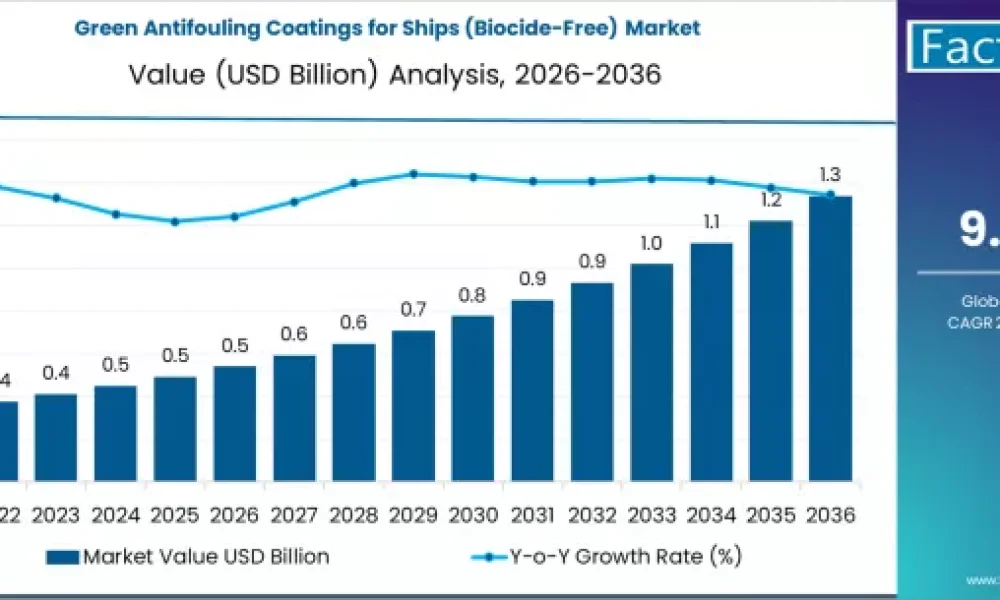
The green antifouling coatings for ships (Sustainable) market is expected to witness robust growth over the next decade as shipping operators, shipbuilders, and regulatory bodies intensify efforts to reduce marine environmental impact and comply with stricter anti-pollution standards. Biocide-free antifouling coatings are specialized marine surface treatments that prevent biofouling — the accumulation of marine organisms such as barnacles and algae — without releasing harmful biocidal compounds into ocean waters. These coatings improve vessel performance while supporting environmentally responsible shipping practices.
Driven by global decarbonization goals, tightening international maritime regulations, and expanding adoption of eco-friendly technologies, the market for green antifouling coatings is projected to gain traction across commercial shipping, offshore platforms, naval fleets, and recreational vessels.
Market Outlook (2026–2036)
Market Value (2026): USD 489.2 million
Market Forecast Value (2036): USD 1,251.4 million
Forecast CAGR (2026–2036): Approximately 9.7%
Leading Vessel Types: Commercial cargo ships and container vessels
Top Coating Technology: Biocide-free polymeric and silicone-based antifouling systems
Key Growth Regions: Asia Pacific, Europe, North America
To Access the Complete Data Tables & in-depth Insights, Request a Discount on this report: https://www.factmr.com/connectus/sample?flag=S&rep_id=13080
Market Overview
Antifouling coatings are applied to the submerged hulls of ships to prevent the settlement and growth of marine organisms, which can dramatically increase drag, reduce fuel efficiency, and elevate greenhouse gas emissions. However, these substances can leach into marine environments and cause ecological damage.
In response, biocide-free antifouling coatings have been developed using innovative polymer formulations, physical surface structuring, fouling release technologies, and environmentally benign materials. These green coatings employ mechanisms such as low surface energy, microtexture, and hydrophobicity to prevent organisms from firmly attaching to hull surfaces, enabling easier removal during normal vessel operation.
Key Market Drivers
1. Environmental Regulations and Compliance
International maritime regulations are progressively discouraging the use of toxic biocides in antifouling coatings. Regulatory frameworks aimed at protecting marine ecosystems and reducing water pollution have encouraged the development and adoption of biocide-free alternatives. As countries tighten environmental regulations for ships operating in sensitive marine zones, greener antifouling systems are increasingly specified.
2. Fuel Efficiency and Emission Reduction Goals
Biofouling increases hull roughness and hydrodynamic drag, leading to higher fuel consumption and greater emissions. Green antifouling coatings help maintain smoother hull surfaces over time, contributing to reduced fuel costs and lower greenhouse gas emissions. With maritime operators under pressure to improve operational efficiency and meet decarbonization targets, demand for effective fouling control technologies is rising.
3. Expansion of Global Maritime Trade
The continuous growth of global trade has expanded the world merchant fleet, driving demand for effective hull protection solutions across a wide range of vessel types. Commercial cargo ships, container carriers, bulk carriers, and tankers require reliable antifouling systems that minimize maintenance costs and downtime, particularly on long voyages between dry-docking intervals.
4. Advanced Material Technologies and Innovation
Technological advancements in coating chemistries, surface engineering, and polymer science have accelerated the performance capabilities of biocide-free antifouling coatings. Emerging solutions combine low surface energy polymers with controlled surface roughness and enhanced mechanical durability, enabling extended service life and effective biofouling control without toxic biocides.
Market Segmentation Insights
By Coating Technology
Polymeric Sustainable Coatings: Lead the market due to balanced performance, ease of application, and compatibility with multiple hull substrates.
Silicone and Fouling-Release Coatings: Provide low surface energy and smooth finish, facilitating organism removal at operational speeds.
Nanostructured Surface Systems: Emerging technologies that use engineered surface textures to inhibit organism adhesion at the microscopic level.
Hybrid and Multifunctional Biofouling Solutions: Combine physical and chemical deterrent mechanisms for enhanced protection.
By Vessel Type
Commercial Cargo and Container Ships: Represent the largest share due to high annual operating hours and extensive ocean routes.
Tankers and Bulk Carriers: Use green coatings to maintain fuel efficiency and reduce fouling in warm waters.
Cruise and Passenger Ships: Require high-performance coatings for both environmental and aesthetic considerations.
Offshore and Support Vessels: Demand durable antifouling performance under varied marine conditions.
Naval and Defense Craft: Growing adoption driven by mission requirements and environmental priorities.
Recreational Boats and Yachts: Increasing use of eco-friendly coatings in leisure markets.
By Application Technique
Shipyards and New Builds: Significant segment as green coatings are increasingly specified during initial vessel fabrication.
Dry-Dock and Maintenance Recoats: Repeat application market supporting ongoing maintenance schedules.
Retrofit Market: Growing as existing vessels upgrade to biocide-free solutions to meet sustainability goals.
Regional Market Dynamics
Asia Pacific is anticipated to dominate the global market, driven by large maritime fleets, extensive shipbuilding activity, and increased environmental compliance in major economies. Countries with major ports and shipping hubs are prioritizing the use of green marine coatings.
Europe continues to be a strong market, underpinned by regional environmental regulations, advanced maritime infrastructure, and high adoption of sustainable shipping technologies. Northern European countries with stringent marine ecosystem protection measures are notable adopters.
North America shows steady growth, supported by domestic shipping routes, coastal trade, and growing awareness of environmental impacts in marine operations.
Emerging markets in Latin America, the Middle East, and Africa are gradually increasing adoption as trade volumes expand and local regulations evolve to support environmental protection in marine environments.
Competitive Landscape
The green antifouling coatings market features competition among global chemical manufacturers, specialty marine coatings producers, and innovation-focused material technology firms. Key players are investing in research and development to enhance coating performance, extend service life, and reduce total lifecycle costs.
Strategic initiatives include partnerships with shipbuilders, technical support services for application and maintenance, and development of region- specific solutions tailored to local water conditions and regulatory requirements. Companies are also focusing on certification, testing, and performance validation to support adoption in demanding marine environments.
Future Outlook
The green antifouling coatings for ships (biocide-free) market is expected to sustain strong growth through 2036 as environmental sustainability becomes central to maritime operations. Continued innovation in coating technologies, expansion of global shipping activities, and heightened regulatory emphasis on marine pollution control will drive further adoption of eco-friendly antifouling solutions.
As the maritime industry pursues decarbonization and emission reduction strategies, biocide-free antifouling coatings will play a key role in enhancing vessel performance, protecting marine ecosystems, and supporting long-term operational efficiencies across global shipping fleets.
Have specific requirements or need assistance on report pricing or have a limited budget? Please contact [email protected]
About Fact.MR:
Fact.MR is a global market research and consulting firm, trusted by Fortune 500 companies and emerging businesses for reliable insights and strategic intelligence. With a presence across the U.S., UK, India, and Dubai, we deliver data-driven research and tailored consulting solutions across 30+ industries and 1,000+ markets. Backed by deep expertise and advanced analytics, Fact.MR helps organizations uncover opportunities, reduce risks, and make informed decisions for sustainable growth



