
Definition
The Graphene RF Device Market represents one of the most dynamic segments of the semiconductor and advanced materials industries. These devices are engineered using graphene, a single layer of carbon atoms arranged in a two-dimensional honeycomb lattice, renowned for its exceptional electrical conductivity, mechanical strength, and thermal stability. Graphene-based radio frequency (RF) components include low-noise amplifiers, frequency multipliers, mixers, and high-speed radiometers, all of which are essential for modern wireless communication systems, radar technologies, and high-frequency applications.
Graphene’s extraordinary electron mobility (exceeding 200,000 cm²/V·s) enables faster signal transmission compared to traditional materials such as silicon or gallium arsenide. This property allows graphene RF devices to operate at terahertz frequencies, drastically reducing signal degradation and improving power efficiency. Moreover, its excellent heat dissipation supports high-performance operation without thermal instability, which is critical for communication systems running at extremely high data rates.
The integration of graphene in RF components is driving innovation in 5G and upcoming 6G networks, defense radar systems, aerospace communication modules, and advanced medical imaging equipment. These applications demand components that can deliver ultra-high frequency operation, minimal signal loss, and superior linearity, making graphene a cornerstone material for next-generation RF technologies. As telecommunication networks transition toward sub-terahertz and millimeter-wave frequencies, graphene RF devices are positioned to play a transformative role in shaping the future of global connectivity.
Read Full Report: https://semiconductorinsight.com/report/graphene-rf-device-market/
Market Size
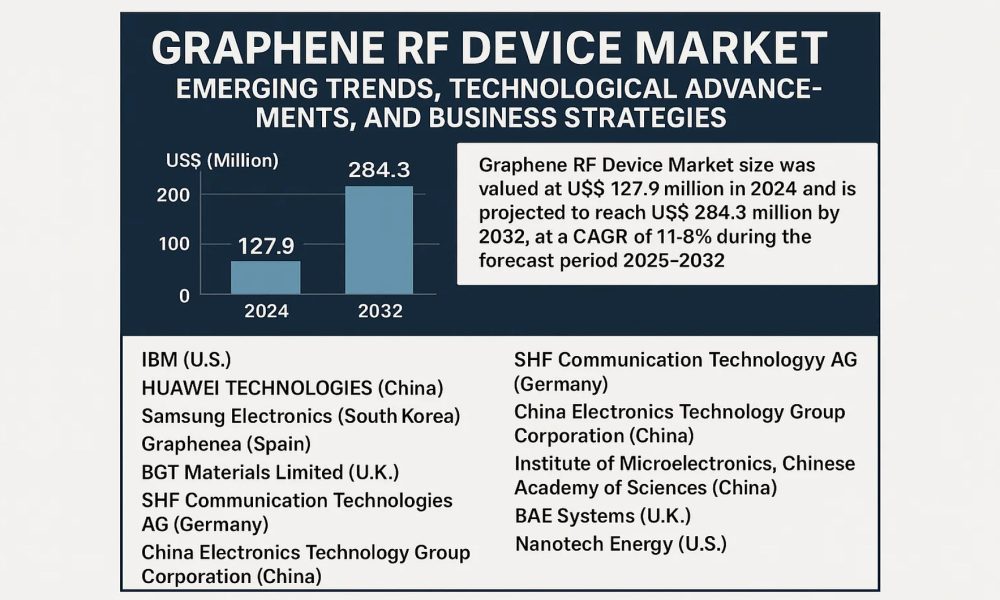
The global Graphene RF Device Market, valued at US$ 127.9 million in 2024, is projected to reach US$ 284.3 million by 2032, expanding at a compound annual growth rate (CAGR) of 11.8%. This significant growth trajectory underscores the increasing demand for high-speed, low-power electronic systems that can support evolving communication standards and high-frequency data transmission.
Historically, RF components have relied on compound semiconductors like GaAs (Gallium Arsenide) and InP (Indium Phosphide); however, the performance plateau of these materials has led to growing adoption of graphene due to its faster carrier transport and tunable electronic bandgap. The surge in 5G infrastructure development, coupled with ongoing research investments in graphene material synthesis, has accelerated commercialization in this space.
By 2026, as the global 5G infrastructure market surpasses US$ 100 billion annually, the reliance on graphene-enabled RF components is expected to intensify. Furthermore, ongoing defense modernization programs, satellite communication upgrades, and the emergence of the Internet of Things (IoT) ecosystem are additional contributors to market growth. Analysts predict that North America and Asia-Pacific will collectively account for more than 75% of the total consumption, driven by high investment levels in communication technology development and manufacturing capacity expansion.
Regional Analysis
North America
North America dominates the global Graphene RF Device Market, holding a significant share due to the region’s advanced semiconductor infrastructure and high investment in 5G and defense technologies. The presence of key players such as IBM and BAE Systems strengthens the region’s leadership position. The U.S. government’s increasing emphasis on secure, high-frequency communication for military and aerospace applications further accelerates graphene RF adoption.
Asia-Pacific
The Asia-Pacific region is experiencing rapid growth, driven by major contributors like China, Japan, and South Korea. Companies such as Huawei Technologies, Samsung Electronics, and the Chinese Academy of Sciences are heavily investing in graphene-based device research to support the exponential demand for 5G and 6G network infrastructure. China’s national initiatives in graphene material production and application innovation are positioning it as a global hub for advanced RF device manufacturing.
Europe
Europe’s market growth is supported by research-oriented organizations such as Graphenea (Spain) and BGT Materials Limited (U.K.), which are pioneering efforts in high-quality graphene synthesis and device integration. The European Union’s funding programs, including Graphene Flagship, have provided a significant boost to technological advancements, particularly in the telecommunication and aerospace sectors.
Rest of the World
Regions like the Middle East and Latin America are gradually adopting graphene RF technology, primarily through collaboration with global research institutes and semiconductor manufacturers. As regional telecommunication providers upgrade their infrastructure, the adoption of graphene-based RF components is expected to grow steadily, albeit from a smaller base compared to major markets.
Download Sample Report: https://semiconductorinsight.com/download-sample-report/?product_id=97952
Competitor Analysis (in brief)
The Graphene RF Device Market is moderately consolidated, featuring a blend of established semiconductor corporations and specialized material innovators.
- IBM (U.S.) leads with extensive R&D in graphene-based transistors and RF amplifiers.
- Huawei Technologies (China) focuses on integrating graphene RF components into its 5G and future 6G communication modules.
- Samsung Electronics (South Korea) invests in graphene-based chip design to enhance device performance and energy efficiency.
- Graphenea (Spain) supplies high-purity graphene materials critical for large-scale manufacturing.
- BGT Materials Limited (U.K.) and SHF Communication Technologies AG (Germany) contribute to the ecosystem with innovations in substrate materials and high-speed testing equipment.
Collaborations between academic institutions and industry players have become a defining feature of this market, propelling the commercialization of next-generation RF devices. These partnerships ensure that graphene transitions from laboratory research into scalable, high-yield production for industrial applications.
Global Graphene RF Device Market: Market Segmentation Analysis
This report provides a deep insight into the global Graphene RF Device Market, covering all its essential aspects. This ranges from a macro overview of the market to micro details of the market size, competitive landscape, development trend, niche market, key market drivers and challenges, SWOT analysis, value chain analysis, etc.
The analysis helps the reader to shape the competition within the industries and strategies for the competitive environment to enhance the potential profit. Furthermore, it provides a simple framework for evaluating and assessing the position of the business organization. The report structure also focuses on the competitive landscape of the Global Graphene RF Device Market. This report introduces in detail the market share, market performance, product situation, operation situation, etc., of the main players, which helps the readers in the industry to identify the main competitors and deeply understand the competition pattern of the market.
In a word, this report is a must-read for industry players, investors, researchers, consultants, business strategists, and all those who have any kind of stake or are planning to foray into the Graphene RF Device Market in any manner.
Market Segmentation (by Application)
- Computers
- Communication
- Automation
Market Segmentation (by Type)
- Low-Noise Amplifiers
- Frequency Multipliers
- Mixers
- High-Speed Radiometers
Download Sample Report: https://semiconductorinsight.com/download-sample-report/?product_id=97952
Key Company
- IBM (U.S.)
- HUAWEI TECHNOLOGIES (China)
- Samsung Electronics (South Korea)
- Graphenea (Spain)
- BGT Materials Limited (U.K.)
- SHF Communication Technologies AG (Germany)
- China Electronics Technology Group Corporation (China)
- Institute of Microelectronics, Chinese Academy of Sciences (China)
- BAE Systems (U.K.)
- Nanotech Energy (U.S.)
- Graphene Engineering and Innovation Centre (U.K.)
Geographic Segmentation
- North America
- Europe
- Asia-Pacific
- Middle East & Africa
- Latin America
Download Sample Report: https://semiconductorinsight.com/download-sample-report/?product_id=97952
FAQ Section
Q1. What is the current market size of the Graphene RF Device Market?
The global Graphene RF Device Market was valued at US$ 127.9 million in 2024 and is projected to reach US$ 284.3 million by 2032, growing at a CAGR of 11.8%.
Q2. Which are the key companies operating in the Graphene RF Device Market?
Key companies include IBM, Huawei Technologies, Samsung Electronics, Graphenea, BAE Systems, and Nanotech Energy, among others.
Q3. What are the key growth drivers in the Graphene RF Device Market?
Major growth drivers include 5G infrastructure expansion, rising demand for terahertz-frequency communication, defense modernization, and graphene’s superior electrical and thermal properties.
Q4. Which regions dominate the Graphene RF Device Market?
North America and Asia-Pacific dominate the market, jointly accounting for over 75% of total demand, fueled by heavy investments in telecom and semiconductor R&D.
Q5. What are the emerging trends in the Graphene RF Device Market?
Key trends include integration of graphene in 6G and satellite systems, miniaturization of RF components, improvements in graphene material scalability, and collaborative research between academia and industry.




