
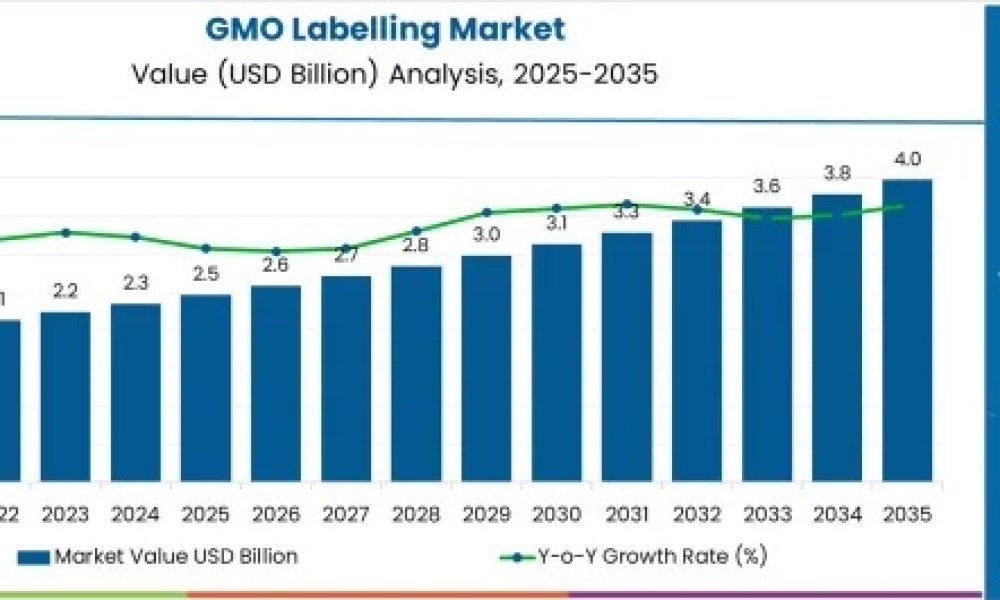
The global GMO labelling market is on a strong upward trajectory, driven by accelerating demand for ingredient transparency and heightened consumer awareness of genetically modified organisms in the global food supply. Valued at USD 2.5 billion in 2025, the market is projected to reach USD 4.0 billion by 2035, expanding at a CAGR of 4.9%. The shift toward transparent labelling is pushing food manufacturers, retailers, and technology providers toward advanced traceability and compliant packaging practices.
Growing regulatory mandates across North America, Asia-Pacific, and Europe are reinforcing the need for clear GMO disclosure, positioning the market for sustained expansion. As governments strengthen compliance frameworks, consumer expectations for fully transparent food labels continue to reshape product development and sourcing strategies.
Subscribe for Year-Round Insights → Stay ahead with quarterly and annual data updates. https://www.futuremarketinsights.com/reports/sample/rep-gb-1363
Key Market Highlights
- Market Value 2025: USD 2.5 billion
- Market Forecast 2035: USD 4.0 billion
- Forecast CAGR: 4.9%
- Leading Sales Channel (2025): Online (58.3%)
- High-Growth Regions: North America, Asia-Pacific, Europe
- Key Players: Campbell Soup, Conagra Foods, Earthbound Farms, General Mills, Danone, Nature Path Foods, Ingredion Incorporated, Organic Valley, Kerry Ingredients
Why the GMO Labelling Market Is Accelerating
The market’s expansion is rooted in intensifying consumer demand for safe, ethically sourced, and transparently labelled food products. Consumers across developed and emerging markets are increasingly scrutinizing ingredient lists, prompting food manufacturers to adopt clear GMO identification practices.
Regulatory bodies are playing a central role in accelerating adoption. Stringent global standards—supported by frameworks from the European Union, FDA, Codex Alimentarius, and regional authorities—are compelling companies to invest in compliant labelling processes, digital printing technologies, and traceability systems.
Technological innovation is also reshaping visibility across the supply chain. QR-enabled packaging, blockchain-based traceability, and cloud-integrated compliance systems are making GMO identification more precise, dynamic, and consumer friendly. Together, these factors are creating new opportunities for compliance solution providers, packaging companies, and food manufacturers.
Segmental Insights: Online Sales Channel Continues to Dominate
In 2025, online channels accounted for 58.3% of total GMO labelling market revenue, making it the most influential segment. The dominance of e-commerce is supported by:
- Consumer preference for detailed digital product information
- Greater transparency on ingredient sourcing
- Direct-to-consumer brand models prioritizing clean-label communication
- Rapid adoption of tech-enabled product tracking
As consumers increasingly rely on digital platforms, brands are leveraging transparent labelling to differentiate products and reinforce trust. Integration of blockchain, batch-level tracking, and smart labels is accelerating uptake across online marketplaces globally.
Market Overview: Historical Trends vs Future Outlook
The GMO labelling market has demonstrated consistent expansion, underpinned by evolving consumer attitudes and regulatory clarity. Rising demand for non-GMO ingredients and clean-label food products continues to influence reformulation strategies among major food brands.
Consumer behavior shifts—driven by health consciousness, sustainability concerns, and trust-building packaging—are expected to strengthen industry momentum through 2035.
Country-Wise Highlights
United States
The U.S. market is expanding rapidly following national regulations mandating GMO disclosure. The market is expected to grow from USD 907.8 million in 2025 to USD 1.4 billion by 2035, supported by a CAGR of 4.2%. Rising consumer awareness and reformulation by major brands are strengthening demand.
Europe
Europe remains the global pioneer in GMO labelling. Countries follow strict thresholds, with the EU, Turkey, Australia, and Saudi Arabia enforcing a 0.9% GMO inclusion limit. Compliance-led demand continues to unlock opportunities for labelling, packaging, and traceability solution providers.
Asia-Pacific
China and India are among the fastest-growing markets with CAGRs of 6.6% and 6.1%, respectively. Increasing regulatory clarity and rising consumer interest in food safety are accelerating adoption.
Competitive Landscape
Leading companies such as Campbell Soup, Conagra Foods, Earthbound Farms, General Mills, Danone, Nature Path Foods, Ingredion Incorporated, Organic Valley, and Kerry Ingredients are focusing on:
- Transparent labelling innovation
- Compliance-driven product reformulation
- Expansion of non-GMO product lines
- Stronger distribution networks across emerging regions
The competitive environment is expected to intensify as brands increasingly adopt clean-label strategies and digital packaging technologies.
About Future Market Insights (FMI)
Future Market Insights, Inc. (FMI) is an ESOMAR-certified, ISO 9001:2015 market research and consulting organization, trusted by Fortune 500 clients and global enterprises. With operations in the U.S., UK, India, and Dubai, FMI provides data-backed insights and strategic intelligence across 30+ industries and 1200 markets worldwide.



