
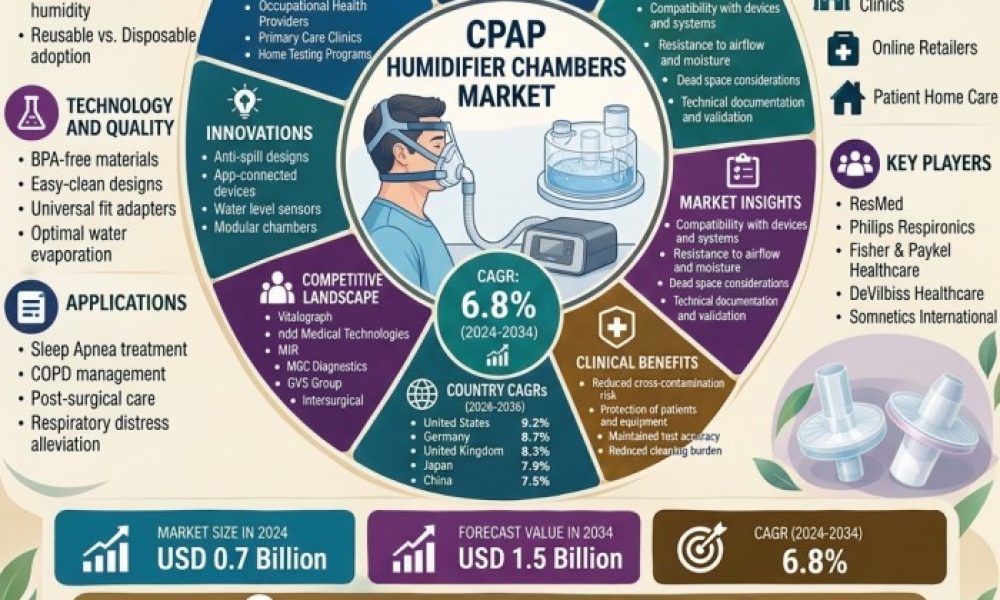
Rockville, Maryland — October 6, 2026: The CPAP humidifier chambers market is expanding from USD 0.5 billion in 2026 to USD 1.1 billion by 2036, advancing at 8.2% CAGR over the forecast period. Demand is being reinforced by the growing role of humidification in home positive airway pressure therapy, where removable water chambers help reduce dryness and irritation during nightly treatment.
Get detailed market forecasts, competitive benchmarking, and pricing trends:
Therapy comfort is a central growth catalyst. PAP users experiencing nasal or mouth dryness increasingly rely on humidification, while DME providers require recurring chamber supplies for patients enrolled in resupply programs. Device manufacturers are also emphasizing easy-fill, easy-clean chamber designs and compatibility with established CPAP, APAP, and BiPAP platforms. Online accessory channels add another route to replacement purchases as users seek model-specific chambers between scheduled provider resupply cycles.
Integrated Heated Humidifier Chambers remain the leading chamber type, accounting for 52.0% of market share in 2026. Their lead reflects the widespread use of modern PAP systems with built-in humidification, allowing users to add moisture within the established device workflow. By device compatibility, CPAP and APAP Device Chambers command an even larger 61.0% share, reflecting their role across the main installed base of home PAP therapy.
The United States is projected to register the fastest growth among the countries covered, reaching 9.7% CAGR through 2036 as PAP installed bases, DME resupply programs, and connected platforms support recurring chamber demand. Germany follows at 9.1% CAGR, supported by home sleep therapy adoption and humidification systems supplied through clinical and homecare channels. Australia is expected to grow at 8.7% CAGR, with established ResMed and Fisher & Paykel Healthcare ecosystems supporting humidified PAP use and replacement demand. China is forecast to advance at 8.2% CAGR as local PAP manufacturers expand integrated heated humidification, while Japan is projected to post 7.8% CAGR as older sleep apnea patients increasingly use compact home PAP systems.
Competition is centered on installed device ecosystems, chamber compatibility, cleaning convenience, and replacement availability. ResMed and Fisher & Paykel Healthcare are prominent providers, while React Health, BMC Medical, Löwenstein Medical, and Sunset Healthcare Solutions also participate across humidification platforms and replacement chamber categories. Suppliers that combine leak resistance, easy maintenance, clear compatibility information, and dependable replacement access are positioned to address evolving DME and online accessory requirements.
The report also identifies DME and Resupply Programs as the leading sales channel, with a 41.0% share in 2026, while Six-Month Replacement Chambers account for 39.0%. These patterns highlight the recurring nature of chamber demand and the importance of replacement schedules in the market. Cleanable Polymer Chambers hold 44.0% share, reflecting users’ need for water tubs that can withstand repeated filling and washing.
As PAP therapy becomes increasingly integrated into long-term home respiratory care, CPAP humidifier chambers are shifting from optional comfort accessories toward routine resupply components. Manufacturers and distributors can strengthen market access by improving device fit, cleaning ease, chamber durability, and model-specific availability. Fact.MR’s CPAP Humidifier Chambers Market report provides detailed forecasts, segment analysis, country-level outlooks, competitive assessment, and strategic insights for stakeholders through 2036.
A notable opportunity lies in aligning chamber replacement with patient use patterns. DME providers can improve continuity through replacement reminders, while online retailers can reduce wrong-fit purchases through clearer model identifiers. Suppliers also have scope to simplify removal, refilling, washing, and inspection without compromising sealing performance. These improvements can address the market’s principal operational restraint: the cleaning burden associated with repeated chamber handling.
The geographic outlook points to differentiated priorities. In the United States, automated replenishment and compatibility with major PAP platforms remain significant. Germany offers opportunities tied to durable chamber designs and homecare distribution, while Australia benefits from established sleep-therapy ecosystems. China’s opportunity is linked to expanding local manufacturing and affordable compatible components, whereas Japan presents demand for compact, user-friendly chamber formats.
The Fact.MR assessment covers chamber types, materials, device compatibility, replacement cycles, sales channels, and regional markets. It profiles leading participants and evaluates the market through 2036, helping manufacturers, distributors, healthcare procurement teams, investors, and product strategists assess demand, competitive positioning, and emerging opportunities across major sleep-therapy markets globally.
Explore More Related Studies Published by Fact.MR Research
Acute Coronary Syndrome Market
Acute Respiratory Disease Diagnostics Market
About Fact.MR
Fact.MR is a global market research and consulting firm, trusted by Fortune 500 companies and emerging businesses for reliable insights and strategic intelligence. With a presence across the U.S., UK, India, and Dubai, we deliver data-driven research and tailored consulting solutions across 30+ industries and 1,000+ markets. Backed by deep expertise and advanced analytics, Fact.MR helps organizations uncover opportunities, reduce risks, and make informed decisions for sustainable growth.
– Contact Us –
11140 Rockville Pike, Suite 400, Rockville,
MD 20852, United States
Tel: +1 (628) 251-1583 | [email protected]



