
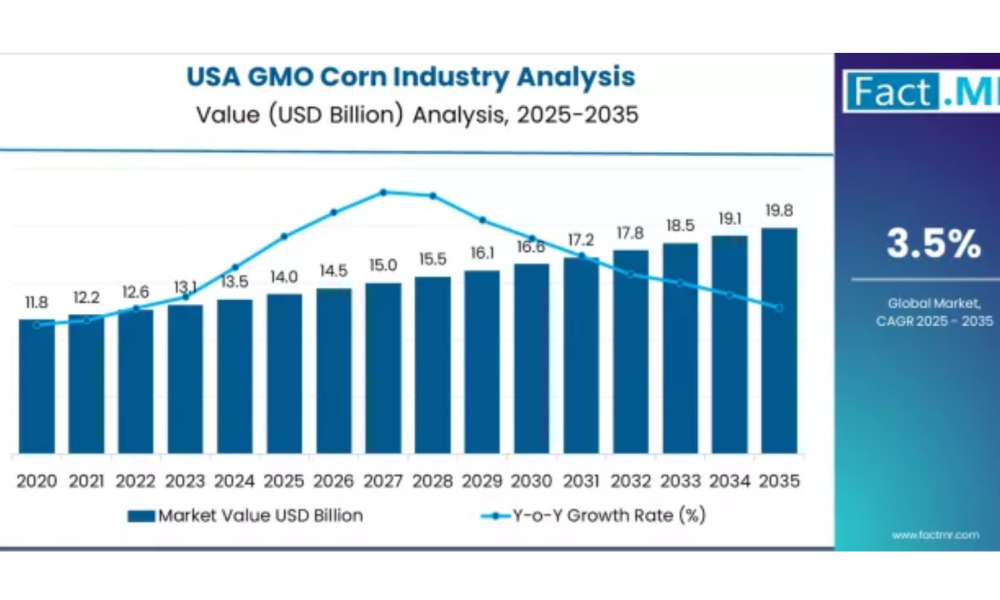
The USA GMO corn market is set for stable and sustained growth as advancements in biotechnology, rising feedstock requirements, and expanding industrial applications drive nationwide demand. According to the latest analysis, the market is projected to grow from USD 14.0 billion in 2025 to USD 19.8 billion by 2035, marking an absolute increase of USD 5.8 billion over the forecast period. This reflects a total growth of 41.4%, with demand expected to rise at a CAGR of 3.5% from 2025 to 2035.
GMO corn—engineered for high yield, pest resistance, and herbicide tolerance—remains a cornerstone of American agriculture, strongly supported by technological innovation, sustainability initiatives, and large-scale feed and industrial demand.
Key Market Drivers
Biotech Advancements Strengthen Yield and Crop Efficiency
Ongoing improvements in genetic engineering, including traits for drought tolerance, pest resistance, and optimized nutrient utilization, are enhancing farm productivity. Farmers are increasingly adopting GMO corn hybrids to reduce crop loss, improve grain quality, and maintain consistent production amid climate variability.
To access the complete data tables and in-depth insights, request a Discount On The Report here: https://www.factmr.com/connectus/sample?flag=S&rep_id=11388
Expanding Demand from Feed and Livestock Industry
Corn-based feed remains critical to the U.S. livestock and poultry sectors. GMO corn’s high starch concentration and predictable supply chain reinforce its dominance in feed formulations. Rising meat and dairy consumption further strengthens demand for biotech-enhanced corn.
Industrial and Biofuel Applications Drive Consumption
Corn is a vital feedstock for ethanol, biochemicals, and sustainable packaging. Rapid growth in the biofuel industry, coupled with government incentives for renewable energy, continues to boost demand for GMO corn varieties optimized for starch extraction and conversion efficiency.
Sustainability and Resource Efficiency Supports GMO Adoption
GMO corn reduces the need for pesticides and enables conservation tillage, lowering greenhouse gas emissions and improving soil health. As sustainability becomes central to U.S. agriculture policy, GMO traits aligned with reduced environmental impact are gaining traction.
Regional Landscape
Midwest: Core Production Hub
States like Iowa, Illinois, Nebraska, and Minnesota dominate U.S. GMO corn production. Strong infrastructure, large-scale farms, and early biotech adoption ensure the Midwest maintains its leading role.
South & Plains: Rapid Adoption and Acreage Expansion
Warmer climates and increasing drought-resilient GMO varieties are facilitating acreage growth across Kansas, Texas, and Missouri, supporting broader national supply.
West & Northeast: Moderate but Stable Growth
Despite smaller acreage, GMO corn adoption in these regions is rising due to demand from ethanol plants, livestock operations, and food processors.
Market Segmentation Insights
By Trait Type
- Herbicide-Tolerant Corn (HT) – Widely used for managing large-scale weed pressure.
- Insect-Resistant Corn (Bt) – Effective for reducing pest-related losses.
- Stacked Trait Varieties – Fastest-growing segment, combining multiple agronomic advantages.
By Application
- Animal Feed – Largest market share due to heavy livestock demand.
- Food & Beverage – Used in sweeteners, starch, cornmeal, cereals, and processed foods.
- Biofuels & Industrial Use – Growing importance in ethanol, bioplastics, and chemical intermediates.
Market Challenges
Despite its strong trajectory, the USA GMO corn market faces a few structural constraints:
- Regulatory and Consumer Perception Challenges – Ongoing debates around GMO labeling and consumer transparency influence food industry decisions.
- Trade-Related Uncertainties – Export regulations and restrictions from non-GMO-preferred markets can affect global competitiveness.
- Environmental Concerns – Issues related to herbicide resistance and biodiversity require continuous innovation and stewardship.
Competitive Landscape
The market is moderately consolidated, featuring major agritech and seed companies focused on advanced biotech development, precision farming tools, and strong dealer networks.
Key Market Participants:
- Monsanto/Bayer Crop Science
- Corteva Agriscience
- Syngenta
- BASF
- Land O’Lakes
- AgReliant Genetics
- WinField United
These companies are strengthening seed trait portfolios, expanding precision agriculture platforms, and partnering with growers to optimize yields.
Future Outlook: Toward High-Efficiency, Climate-Ready GMO Corn
The next decade will witness significant advancements in climate-resilient, high-starch, and multifunctional GMO corn hybrids. As food security, renewable energy, and sustainable agriculture become national priorities, GMO corn will remain pivotal to achieving productivity and environmental goals.
Companies that invest in biotech innovation, farmer support programs, and value-chain integration will be best positioned to benefit from the steady expansion of the U.S. GMO corn market.
Have a specific Requirements and Need Assistant on Report Pricing or Limited Budget please contact us – [email protected]
About Fact.MR
Fact.MR is a global market research and consulting firm, trusted by Fortune 500 companies and emerging businesses for reliable insights and strategic intelligence. With a presence across the U.S., UK, India, and Dubai, we deliver data-driven research and tailored consulting solutions across 30+ industries and 1,000+ markets. Backed by deep expertise and advanced analytics, Fact.MR helps organizations uncover opportunities, reduce risks, and make informed decisions for sustainable growth.



