
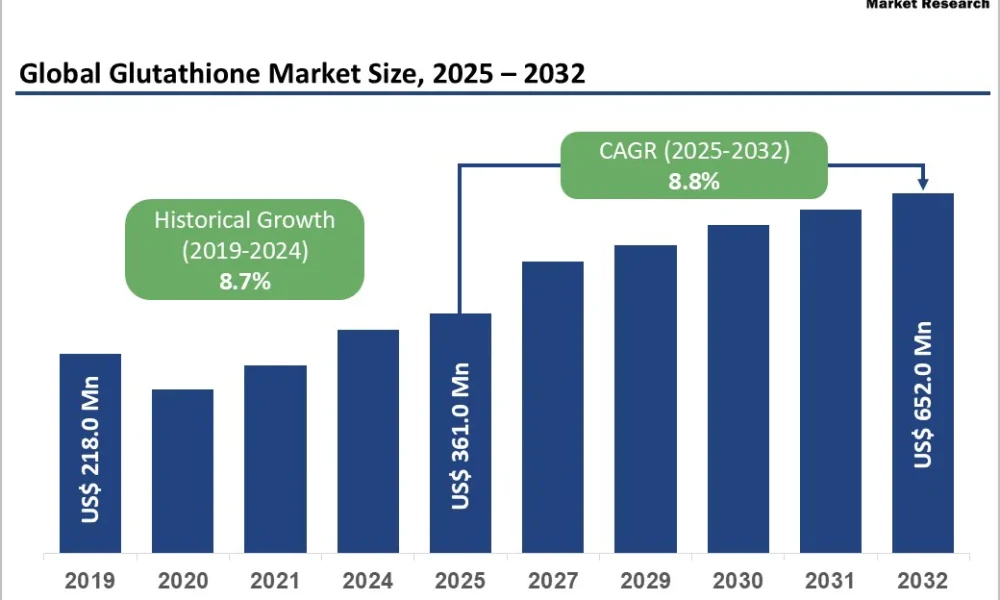
The global glutathione market has experienced significant growth, driven by increasing awareness about the benefits of antioxidants in improving overall health and combating oxidative stress. Glutathione, often referred to as the “master antioxidant,” plays a pivotal role in neutralizing free radicals and supporting cellular health. With growing consumer awareness surrounding the importance of antioxidant intake, glutathione has become an increasingly popular ingredient in pharmaceuticals, nutraceuticals, and cosmetics. Market analysts predict that the glutathione market, which was valued at approximately USD 361.0 million in 2025, will grow to reach an estimated USD 652.0 million by 2032, expanding at a compound annual growth rate (CAGR) of 8.8% from 2025 to 2032.
Several factors contribute to this market growth, including the rising prevalence of chronic diseases, a growing aging population, and increasing consumer demand for preventive healthcare products. The major segments driving this demand include pharmaceuticals and skincare products, both of which utilize glutathione’s antioxidant properties to address various health concerns. Moreover, new innovations in biotechnology and manufacturing processes have enabled more efficient production, further fueling market growth. The market’s momentum is amplified by both the advancement of biotechnology and a rise in demand from key regions, especially North America and Asia Pacific.
Download Your Free Sample & Explore Key Insights: https://www.persistencemarketresearch.com/samples/17779
Key Highlights from the Report:
• Dominant Region: North America is set to command approximately 30% of the market share in 2025.
• Fastest-growing Regional Market: Asia Pacific is expected to be the fastest-growing region for glutathione from 2025 to 2032.
• Leading Product Segment: Reduced glutathione leads the market, with about 62% market share in 2025.
• Leading Source: Naturally extracted glutathione dominates, accounting for 57% of market revenue in 2025.
• Major Driver: Heightened health awareness and an aging population are major drivers behind the increased adoption of glutathione.
• Fastest-growing Segment: Oxidized glutathione is the fastest-growing segment from 2025 to 2032.
Market Segmentation
The glutathione market can be segmented based on product type, source, application, and end-user.
Product Type: The market is primarily divided into two product types: reduced and oxidized glutathione. Reduced glutathione is the leading segment, holding a significant market share due to its active antioxidant properties and broad consumer acceptance. It is widely used in nutraceuticals, pharmaceuticals, and even cosmetic formulations due to its direct biological activity. On the other hand, oxidized glutathione is gaining popularity, particularly in metabolic research and cellular studies, where its role in redox signaling is highly valued. This segment is also the fastest-growing, attributed to its increasing use in clinical and scientific applications.
Source: Glutathione is extracted either naturally or through microbial fermentation. The natural extraction method, which is predominantly plant-based, captures a significant portion of the market revenue, driven by a growing preference for sustainably sourced and ethically derived ingredients. This method accounts for approximately 57% of the glutathione market share in 2025. On the other hand, microbial fermentation-based glutathione is the fastest-growing segment, owing to the scalability and purity it offers. Biotechnological advancements have made this method more cost-effective, ensuring increased production volumes and improved product consistency.
Application: Glutathione is extensively used in pharmaceuticals, cosmetics, and nutraceuticals. The pharmaceutical sector is the largest market for glutathione, owing to its therapeutic benefits in detoxification, liver health, and immune system support. Additionally, it plays a crucial role in treatments for diseases related to oxidative stress. In the cosmetics sector, glutathione is widely used for its skin-lightening properties, anti-aging effects, and general skin health benefits, making it a key ingredient in anti-aging creams, moisturizers, and lotions. The adoption of glutathione in personal care products is expected to grow rapidly in the coming years, driven by consumer demand for visible and sustainable skin benefits.
Regional Insights
North America: North America is set to dominate the glutathione market, accounting for approximately 30% of the global market share in 2025. This dominance is attributed to the region’s well-established healthcare infrastructure, advanced biotechnology capabilities, and a high level of consumer awareness regarding preventive healthcare. The increasing prevalence of chronic diseases in North America is fueling demand for antioxidant-rich supplements, further solidifying glutathione’s role in supporting overall health. Additionally, the region’s focus on premium glutathione products, such as liposomal and nano-encapsulated glutathione formulations, is contributing to market growth.
Europe: Europe holds a prominent position in the glutathione market, with countries like Germany, the United Kingdom, and France driving growth. The region’s strong pharmaceutical sector, coupled with an increasing demand for cosmeceuticals and dietary supplements, is boosting the market for glutathione. Europe is also home to some of the leading brands in the beauty and wellness space, further propelling the demand for glutathione-based skincare products. Regulatory harmonization within the European Union facilitates smooth market access, enabling companies to scale operations efficiently across the region.
Asia Pacific: Asia Pacific is expected to be the fastest-growing region in the glutathione market. The surge in health and beauty awareness, combined with the rising affluence of consumers in key countries like China, Japan, India, and South Korea, is driving the adoption of glutathione. As the region’s manufacturing infrastructure continues to evolve, the supply of glutathione will remain cost-competitive, benefiting both regional and international suppliers. With a growing focus on wellness, anti-aging, and detoxification, glutathione is increasingly being incorporated into personal care and nutraceutical products in Asia Pacific, leading to robust market growth.
Get Custom Insights Designed for Your Business: https://www.persistencemarketresearch.com/request-customization/17779
Market Drivers
The glutathione market’s expansion is primarily driven by a combination of health awareness, aging populations, and the increasing demand for preventive healthcare products. As more individuals become educated about oxidative stress and its role in accelerating aging and disease, the demand for antioxidants such as glutathione has surged. Glutathione’s ability to neutralize harmful free radicals and support cellular health makes it a preferred supplement for consumers seeking to improve their overall well-being.
Furthermore, the aging population globally is increasing the demand for glutathione in preventive healthcare. Older adults are more likely to suffer from oxidative stress, which is linked to various chronic diseases such as cardiovascular issues, diabetes, and liver dysfunction. As a result, glutathione is increasingly being recognized as a key ingredient in health supplements and pharmaceutical formulations aimed at addressing age-related health concerns. Additionally, the widespread use of glutathione in beauty products, particularly those targeting skin health and anti-aging, is contributing to the market’s growth.
Market Restraints
Despite the growth prospects, several factors present challenges to the glutathione market. One of the most significant restraints is the high cost of raw materials and the complex manufacturing processes involved in producing glutathione. Reduced glutathione, in particular, requires expensive raw materials and sophisticated production techniques, making it a high-cost product. The cost structure of raw materials and production has a direct impact on pricing, limiting its affordability for certain market segments.
Moreover, stringent regulatory requirements for glutathione-based products pose another challenge to market players. Manufacturers must comply with various regulations regarding product quality, labeling, and safety standards, which can lead to increased production costs and delays in market entry, particularly for smaller companies. While these regulations are critical for consumer safety, they also create barriers to entry and expansion in the market.
Market Opportunities
The glutathione market presents substantial opportunities, particularly within the expanding skincare and cosmetic segments. As more consumers prioritize skincare and wellness products, the demand for glutathione-based formulations in anti-aging, skin-lightening, and moisturization products is expected to grow rapidly. Additionally, the increasing adoption of nutraceuticals and functional foods is opening new avenues for glutathione in preventive health.
Biotechnological advancements in microbial fermentation provide an additional growth opportunity. The ability to produce glutathione through more sustainable and cost-effective methods will allow manufacturers to meet growing demand while keeping production costs under control. As the market for glutathione continues to evolve, companies that invest in research and development, particularly in the areas of bioavailability and novel delivery systems, will be well-positioned to capture a larger share of the market.
Checkout Now & Download Complete Market Report: https://www.persistencemarketresearch.com/checkout/17779
Company Insights
Several key players dominate the global glutathione market, providing innovative solutions across pharmaceuticals, nutraceuticals, and cosmetics.
• Kyowa Hakko Bio Co., Ltd.
• Ajinomoto Co., Inc.
• Gnosis S.p.A.
• Shandong Jincheng Pharmaceutical Group
• Sigma-Aldrich
• Mitushi Biopharma
• Herbal Creations
• Cayman Chemical
• Chemkart
• Yipin Biotechnology
• BioNutrients Solutions
Recent Developments
In August 2025, researchers at Rockefeller University discovered that mitochondrial glutathione plays a critical role in breast cancer metastasis, providing new insights into potential therapeutic applications.
In January 2025, a narrative review published in Cureus evaluated the efficacy and safety of glutathione in skin lightening, concluding that oral and topical glutathione formulations are effective with minimal side effects, while intravenous use presents significant safety risks.
Conclusion
The glutathione market is poised for robust growth, fueled by increasing consumer awareness, aging populations, and advancements in biotechnology. With a strong foothold in pharmaceuticals, nutraceuticals, and cosmetics, glutathione’s role as a powerful antioxidant makes it a key player in the global health and wellness industry. As the market expands, regional trends, product innovations, and advancements in production technologies will continue to shape the industry’s trajectory. Despite some challenges related to high production costs and regulatory hurdles, the glutathione market presents significant opportunities for players willing to invest in R&D and capitalize on growing demand across key regions.




