
The global drone payload market is entering a dynamic phase of expansion fueled by rising defense modernization programs, technological innovation in sensor miniaturization, and rapid commercialization of unmanned aerial vehicles (UAVs). Drone payloads—comprising sensors, cameras, radar systems, communication modules, and weapon systems—serve as the operational core of UAV platforms, transforming drones from basic aerial vehicles into advanced intelligence and mission-critical tools.
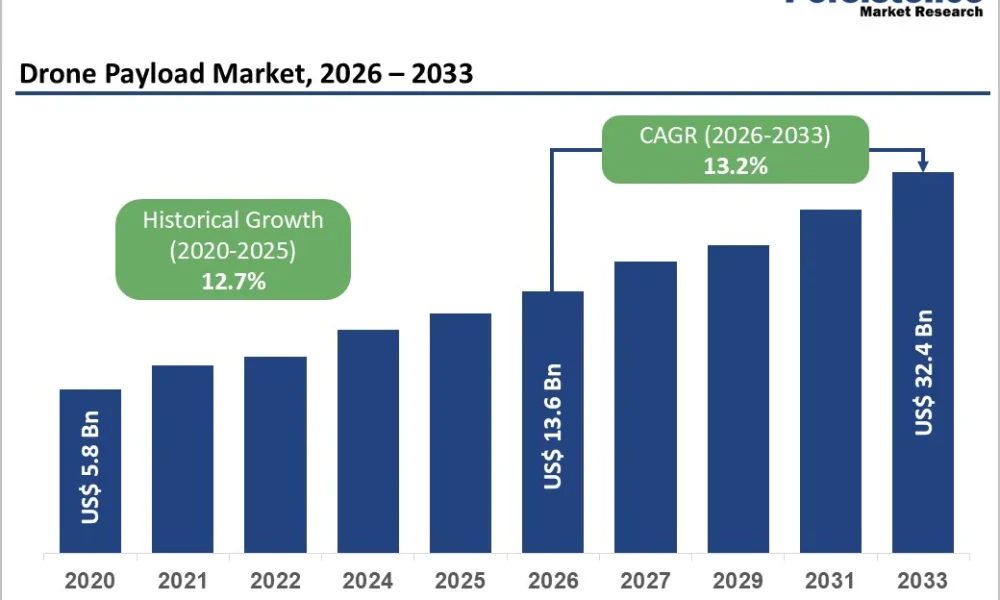
The global drone payload market size was valued at US$ 13.6 billion in 2026 and is projected to reach US$ 32.4 billion by 2033, growing at a CAGR of 13.2% between 2026 and 2033. Strong defense procurement, expanding ISR requirements, and accelerating commercial adoption across agriculture, infrastructure inspection, logistics, and emergency response are reshaping the competitive landscape.
Market Overview and Growth Outlook
The market’s acceleration is driven by three primary catalysts:
- Escalating global defense expenditures and ISR modernization
- Technological advancement in sensor miniaturization and AI-powered analytics
- Expanding commercial drone applications
Between 2020 and 2024, the market recorded a CAGR of 12.7%, reflecting steady demand recovery post-pandemic and increased geopolitical tensions. Looking forward, the projected 13.2% CAGR through 2033 indicates sustained structural growth rather than temporary procurement cycles.
Defense currently accounts for approximately 65% of total market demand, while the commercial segment is emerging as the fastest-growing category, projected to expand at nearly 18–19% CAGR during the forecast period.
Market Dynamics
Rising Global Defense Expenditures and ISR Modernization
Geopolitical tensions and evolving warfare strategies have placed unmanned systems at the center of modern defense operations. According to the Stockholm International Peace Research Institute, global defense spending reached US$ 2.24 trillion in 2022, reflecting sustained upward momentum.
Military operations increasingly rely on unmanned systems equipped with advanced payloads for intelligence, surveillance, reconnaissance (ISR), electronic warfare, and precision targeting. The U.S. Department of Defense maintains the world’s largest UAV budget, allocating significant funding toward EO/IR sensors, SIGINT systems, and integrated targeting payloads.
NATO member states are accelerating UAV procurement programs, incorporating lessons from recent conflicts where drone-based reconnaissance and electronic warfare demonstrated operational superiority. Defense payloads command substantial price premiums due to ruggedization, cybersecurity certifications, and mission-critical reliability standards.
Technological Advancements in Sensor Miniaturization and AI
Innovation in MEMS (Micro-Electro-Mechanical Systems), sensor fusion, and edge computing is transforming payload design. Over the past five years, payload weights have decreased by 40–50%, while performance capabilities have significantly improved.
Modern EO/IR gimbals now deliver stabilized high-definition imaging across visible and infrared spectra at weights below 2 kg. This allows small commercial drones to deploy capabilities once limited to military platforms.
AI-powered onboard processing enhances:
- Real-time target recognition
- Automated anomaly detection
- Threat assessment
- Predictive analytics
Edge computing reduces latency by eliminating dependency on cloud-based processing. For time-sensitive operations such as military missions or disaster response, this capability is critical.
Elevate your business strategy with comprehensive market data. Request a sample report now: https://www.persistencemarketresearch.com/samples/34627
Market Restraints
Despite strong growth momentum, several structural challenges remain:
Regulatory Complexity
Fragmented global regulatory frameworks limit cross-border operations. BVLOS (Beyond Visual Line of Sight) operations remain restricted in many jurisdictions, limiting large-scale logistics and inspection applications.
Privacy and Data Protection Concerns
Surveillance payloads face regulatory scrutiny regarding data collection and storage practices, particularly in densely populated urban areas.
High Development Costs
Advanced payload development requires investments ranging from US$ 10–50 million per product family. Integration complexity across diverse drone airframes extends deployment timelines by 12–24 months.
Supply Chain Vulnerabilities
Dependence on precision semiconductors, optical systems, and rare earth materials creates exposure to geopolitical and trade disruptions, affecting production timelines and costs.
Market Opportunities
Autonomous Drone Operations and Swarm Technology
AI-driven swarm capabilities represent a high-growth premium segment. Coordinated multi-drone operations enable:
- Distributed ISR coverage
- Electronic warfare saturation
- Coordinated strike missions
- Large-scale agricultural monitoring
- Disaster response coordination
Swarm-enabled systems command 35–50% price premiums compared to manually controlled platforms, reflecting significant value addition.
Emergency Response and Public Safety
Drone payload integration in emergency response is expanding rapidly. Applications include:
- Thermal imaging for search and rescue
- Disaster damage assessment
- Communication relay systems
- Firefighting situational awareness
- Law enforcement crowd monitoring
Search and rescue drones equipped with infrared sensors reduce response times by up to 45% compared to traditional ground-based search operations. This segment is projected to grow at 18% CAGR, outperforming overall commercial growth.
Category Analysis
Product Insights
EO/IR Payloads
EO/IR systems hold the largest share at approximately 25.4%, driven by defense ISR missions and industrial inspection applications. These systems enable day-night operation and multi-spectrum imaging. Companies such as Teledyne Technologies (through FLIR division) and Leonardo S.p.A. play major roles in this segment.
Camera Payloads
Camera payloads represent the fastest-growing category at 16% CAGR. Adoption across construction, agriculture, media, and mapping applications is accelerating due to falling CMOS sensor costs and improved onboard processing.
Payload Weight Insights
Under 25 kg Class
The <25 kg category holds 43.4% share, reflecting dominance in tactical surveillance drones and commercial UAV platforms. Miniaturization enables advanced EO/IR imaging, LiDAR, and AI-enabled modules within compact units.
51–100 kg Segment
The fastest-growing segment at 15–16% CAGR, driven by MALE-class UAV deployments in defense ISR missions. These platforms support radar, multi-sensor fusion, and SIGINT systems with extended endurance capabilities.
End-User Insights
Defense Sector (65% Share)
Defense remains the dominant segment, driven by ISR, border surveillance, and electronic warfare requirements. Payloads in this category are priced 300–500% higher than commercial systems due to compliance and durability standards.
Major contractors such as Lockheed Martin, Northrop Grumman, and BAE Systems collectively control a significant portion of the defense payload market.
Commercial Segment (Fastest Growing)
The commercial market is projected to expand at 19% CAGR. Applications include:
- Precision agriculture
- Infrastructure inspection
- Logistics and delivery
- Cinematography
- Public safety
Regulatory progress such as FAA Part 107 frameworks is gradually expanding commercial operational permissions.
Regional Insights
North America
North America commands 36% of the global market, valued at approximately US$ 4.5 billion in 2026. The United States dominates regional demand due to substantial defense procurement and advanced commercial adoption.
The region features a consolidated competitive structure led by defense giants and sensor manufacturers. Security initiatives promoting domestically manufactured UAV components further reinforce local supply chains.
Europe
Europe accounts for around 22% of global demand. Germany, the United Kingdom, France, and Italy collectively represent the majority of the region’s market value.
Collaborative programs such as the Eurodrone initiative enhance sensor and payload development capabilities. However, regulatory complexity and procurement cycle delays temper growth compared to Asia Pacific.
Asia Pacific
Asia Pacific represents approximately 25% of the global market and is the fastest-growing region at 15% CAGR. China commands nearly 40% of regional value, supported by manufacturing scale advantages.
Companies like DJI dominate commercial drone ecosystems, enabling cost-efficient payload integration. India is emerging as a high-growth market driven by defense modernization and expanding agricultural drone adoption.
The region benefits from semiconductor fabrication capabilities in Taiwan and large-scale component manufacturing in China, enabling 25–40% cost advantages compared to Western production.
Competitive Landscape
The drone payload market exhibits dual characteristics:
- Consolidated defense segment dominated by large contractors
- Fragmented commercial segment with specialized imaging and sensor manufacturers
Defense contractors leverage:
- Long-standing government relationships
- Export certifications
- Proprietary technologies
- Vertically integrated supply chains
Meanwhile, commercial manufacturers compete through rapid innovation cycles, AI integration, and cost optimization strategies.
Recent strategic developments include:
- Terra Drone Corporation entering distribution agreements for agricultural drone expansion
- Collaborative initiatives between research institutions and UAV payload developers to accelerate innovation
Companies operating in the drone payload market include:
- Elbit Systems Ltd
- IMSAR LLC
- BAE Systems PLC
- Parrot SA
- Draganfly Inc
- Teledyne FLIR LLC
- Northrop Grumman Corporation
- Israel Aerospace Industries Ltd
- DJI Technology
- Lockheed Martin Corporation
- AeroVironment Inc
- Autel Robotics
Future Outlook
Between 2026 and 2033, the drone payload market will continue evolving toward:
- AI-driven autonomous operations
- Swarm-enabled multi-drone ecosystems
- Multi-sensor fusion platforms
- Advanced edge computing integration
- Expanded commercial regulatory approvals
Defense modernization will remain the primary revenue engine, but commercial expansion will progressively rebalance market composition.
By 2033, commercial share could approach 40–45% of total demand as agriculture, infrastructure inspection, logistics, and public safety applications mature under supportive regulatory frameworks.
The convergence of AI, miniaturized sensors, and autonomous operations positions drone payload systems as critical enablers of next-generation aerial intelligence across military and civilian domains.
Conclusion
The global drone payload market stands at a pivotal transformation point. Valued at US$ 13.6 billion in 2026 and projected to reach US$ 32.4 billion by 2033, the sector reflects structural growth supported by defense modernization, commercial drone proliferation, and rapid technological advancement.
While regulatory and supply chain constraints pose short-term challenges, long-term fundamentals remain strong. The integration of AI, autonomous swarm capabilities, and multi-sensor payload architectures will redefine operational efficiency across defense, agriculture, infrastructure, and emergency response sectors.
As geopolitical priorities, industrial automation, and digital transformation converge, drone payload technologies will increasingly serve as the intelligence backbone of global unmanned systems ecosystems.
Related Reports:




