
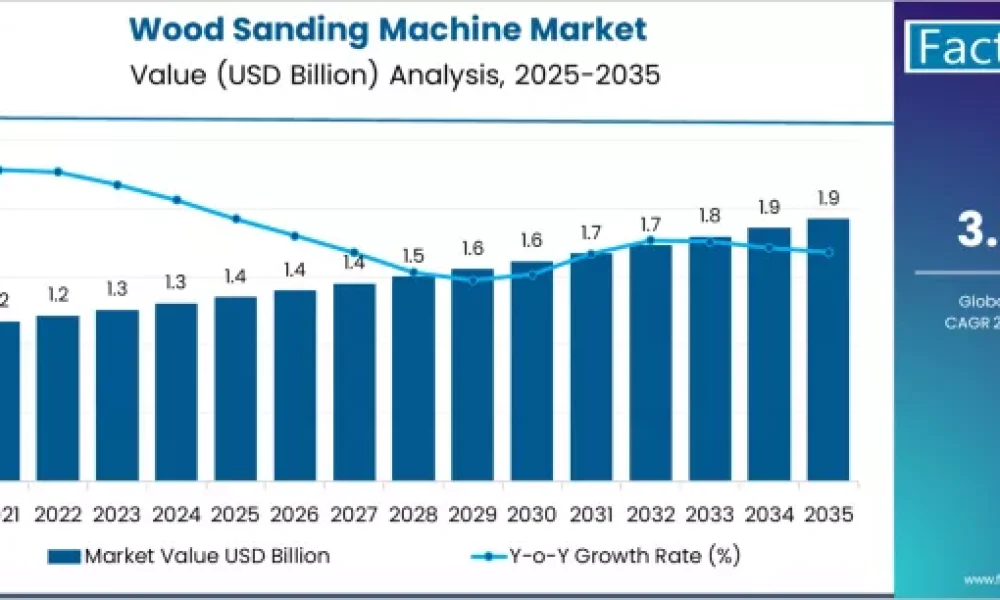
The global wood sanding machine market is set for steady expansion over the next decade, growing from USD 1.35 billion in 2025 to USD 1.92 billion by 2035, at a CAGR of 3.6%, according to the latest research by FactMR. Increasing demand for precision wood finishing, rising furniture production, and adoption of automated sanding technologies are driving growth across residential, commercial, and industrial woodworking sectors.
A Decade of Growth Fueled by Automation and Industrial Demand
The FactMR report, “Wood Sanding Machine Market Size, Share, and Forecast 2025–2035,” highlights that wide-belt sanders dominate the machine type segment with a 40% market share, reflecting their critical role in high-volume and precision wood finishing. Automatic CNC lines lead the operation segment with a 38% share, driven by manufacturers’ emphasis on efficiency, precision, and labor optimization.
Between 2025 and 2030, the market is projected to expand from USD 1.35 billion to USD 1.61 billion, adding USD 260 million and accounting for nearly 45% of the total growth forecast. This growth is supported by the expansion of furniture manufacturing hubs, increasing construction activity, and the rising popularity of engineered wood products such as MDF, plywood, and laminated timber.
From 2030 to 2035, FactMR anticipates a further increase to USD 1.92 billion, reflecting continued integration of smart manufacturing technologies, energy-efficient systems, and customized finishing solutions for specialized wood products. Advanced automation, robotics, and IoT-enabled monitoring in sanding machines are key factors enhancing operational efficiency, reducing material wastage, and ensuring high-quality output.
To access the complete data tables and in-depth insights, request a Discount On The Report here: https://www.factmr.com/connectus/sample?flag=S&rep_id=11261
Key Drivers Shaping Market Dynamics
- Furniture Manufacturing Demand:Urbanization, disposable income growth, and evolving consumer preferences boost the need for aesthetically appealing wooden furniture.
- Construction Expansion:Infrastructure development and residential projects fuel demand for quality wooden panels and decorative components.
- Engineered Wood Production:Consistent sanding and finishing requirements for plywood, MDF, and laminated wood support market adoption.
- Automation and Precision:CNC systems and multi-head configurations increase throughput, reduce labor dependency, and enhance process control.
- Sustainability and Energy Efficiency:Modern sanding machines integrate dust collection, energy-efficient motors, and environmentally conscious design features.
Segment Overview
- By Machine Type:Wide-belt sanders lead with 40%, followed by orbital/random orbit, drum/brush, and edge/profile sanders.
- By Operation:Automatic CNC lines dominate at 38%, followed by semi-automatic and portable/handheld machines.
- By End Use:Furniture & cabinetry, panel/engineered wood, flooring/doors, and joinery/other applications drive demand.
- By Sales Channel:Industrial OEM/lines, dealers/distributors, and online/direct channels serve manufacturers globally.
Regional Outlook
- Asia-Pacific:Fastest-growing market due to expanding furniture manufacturing hubs, rising construction activities, and investment in automation.
- Europe:Strong demand driven by mature woodworking industries and high adoption of automated solutions.
- North America:Growth supported by advanced manufacturing practices and established woodworking sectors.
Competitive Landscape
Key players in the wood sanding machine market include Biesse, SCM Group, HOMAG, Timesavers, Costa Levigatrici, and Weinig. Manufacturers are focusing on automation, energy efficiency, precision enhancement, and smart manufacturing integration to maintain competitiveness and capture emerging market opportunities.
Market Outlook: Precision and Productivity Lead the Future
Over the next decade, the wood sanding machine market will evolve toward fully automated, energy-efficient, and IoT-enabled solutions. Advanced features, including predictive maintenance, multi-head sanding, and real-time process monitoring, will redefine woodworking efficiency and surface quality.
“Wood sanding machines are no longer just finishing tools—they are central to high-precision, automated wood manufacturing systems,” said a FactMR research analyst. “Manufacturers that embrace automation, sustainability, and digital integration will lead the market’s growth in the coming decade.”
Purchase Full Report for Detailed Insights
For access to full forecasts, regional breakouts, company share analysis, and emerging trend assessments, you can purchase the complete report here: https://www.factmr.com/checkout/11261
Have a specific Requirements and Need Assistant on Report Pricing or Limited Budget please contact us – [email protected]
About Fact.MR
Fact.MR is a global market research and consulting firm, trusted by Fortune 500 companies and emerging businesses for reliable insights and strategic intelligence. With a presence across the U.S., UK, India, and Dubai, we deliver data-driven research and tailored consulting solutions across 30+ industries and 1,000+ markets. Backed by deep expertise and advanced analytics, Fact.MR helps organizations uncover opportunities, reduce risks, and make informed decisions for sustainable growth.



