
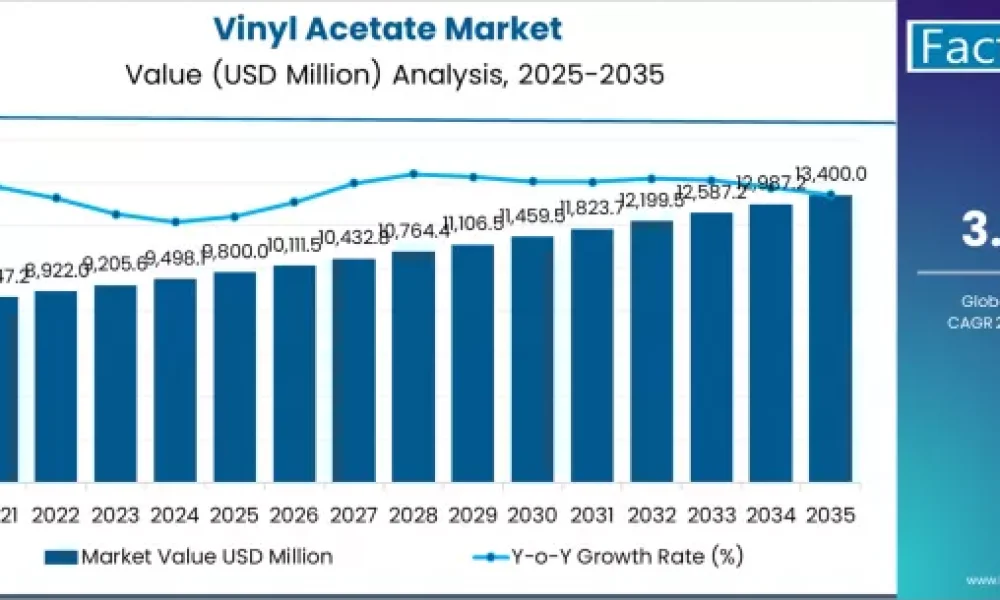
The global vinyl acetate market is projected to grow steadily from USD 9,800 million in 2025 to approximately USD 13,400 million by 2035, recording an absolute increase of USD 3,600 million over the forecast period, according to Fact.MR. This translates into a total growth of 36.7%, with a compound annual growth rate (CAGR) of 3.2% between 2025 and 2035.
The market’s growth is driven by rising demand for polyvinyl alcohol (PVA) and emulsion applications, increasing adoption in adhesives and coatings, and expanding construction activities that fuel premium chemical intermediate procurement across industrial and manufacturing sectors.
A Decade of Growth Driven by Industrial and Construction Expansion
The vinyl acetate market is expected to nearly double over the next decade, supported by industrial growth and increased demand for high-performance chemical intermediates. Between 2025 and 2030, the market is projected to grow by USD 1,200 million, led by PVA/emulsion production and industrial adhesive requirements. From 2030 to 2035, market expansion is expected to accelerate, adding USD 2,400 million, driven by construction material applications and specialized chemical processing innovations.
“Vinyl acetate remains critical for performance-driven industrial applications, particularly in adhesives, coatings, and packaging,” said a Fact.MR analyst. “Advanced manufacturing processes and regulatory compliance are shaping both production and application adoption globally.”
To access the complete data tables and in-depth insights, request a Discount On The Report here: https://www.factmr.com/connectus/sample?flag=S&rep_id=8755
Quick Stats for Vinyl Acetate Market
| Metric | Global Estimate |
|---|---|
| Market Value (2025) | USD 9,800 million |
| Forecast Value (2035) | USD 13,400 million |
| CAGR (2025-2035) | 3.2% |
| Leading Application Segment (2025) | PVA/Emulsions (45%) |
| Leading Process (2025) | Gas Phase (60%) |
| Leading End Use (2025) | Packaging (35%) |
| Key Growth Regions | Asia Pacific, North America, Europe |
| Top Companies | Celanese, Dow, LyondellBasell |
Key Market Drivers
Industrial Expansion: Continuous growth in manufacturing and chemical processing increases demand for high-performance vinyl acetate.
Construction Sector Growth: Rising infrastructure activities and advanced chemical delivery technologies drive demand for adhesives and coatings.
Premium Chemical Performance: Vinyl acetate offers superior processing properties, reliability, and resistance to environmental stressors, making it essential for industrial applications.
Advanced Processing Requirements: Gas-phase and liquid-phase manufacturing processes enable precise control and high-quality production standards.
Regulatory Compliance: Stringent quality standards, chemical safety, and performance benchmarks favor high-grade vinyl acetate over lower-quality alternatives.
Segment Overview
By Application:
PVA/Emulsions (45% share, 2025): Dominates market, used in packaging, adhesives, and coatings. Growth driven by predictable performance and mature supply chains.
Adhesives (30%): Well-established for construction and industrial bonding; growth in premium adhesives expected.
Coatings (15%): Specialized applications benefit from superior processing properties; rising adoption in industrial sectors.
Others (10%): Includes specialty formulations and novel chemical processing applications.
By Process:
Gas Phase (60%): Dominates due to operational efficiency, scalability, and ease of production control.
Liquid Phase (40%): Specialized applications requiring precise formulation control; growth supported by high-performance chemical needs.
By End Use:
Packaging (35%): Largest segment; growth driven by e-commerce and industrial packaging demand.
Construction (30%): Supported by infrastructure expansion and demand for high-performance adhesives and coatings.
Textiles (20%): Niche segment; steady growth with specialty industrial applications.
Others (15%): Includes automotive, electronics, and specialty manufacturing.
Regional Insights
Asia Pacific: Fastest-growing region, led by India and China. Rising industrial infrastructure, chemical processing capabilities, and PVA/emulsion adoption are key growth drivers.
North America: Sustains steady growth due to mature chemical manufacturing base and demand for premium vinyl acetate in packaging and construction materials.
Europe: Growth polarized between Western Europe’s precision chemical processing and Eastern Europe’s cost-competitive manufacturing. Germany and the UK dominate premium applications, while Poland, Hungary, and Czech Republic capture volume-driven processing.
Latin America: Brazil shows strong growth with industrial innovation, chemical manufacturing expansion, and increasing construction demand.
Middle East & Africa: Gradual adoption, supported by industrial expansion and infrastructure projects.
Country-Level Insights
India: Expected CAGR of 4.2%, driven by industrial expansion, packaging demand, and specialty chemical applications.
China: CAGR 3.5%, fueled by chemical manufacturing modernization and industrial processing capability.
USA: CAGR 3.0%, supported by advanced chemical systems, operational excellence, and compliance with quality standards.
Brazil: CAGR 3.1%, expanding industrial base and adoption of high-performance chemical ingredients.
Germany: CAGR 2.8%, focus on premium chemical processing and specialty vinyl acetate applications.
South Korea: CAGR 2.9%, industrial-focused end-use distribution with strong packaging and construction demand.
Japan: CAGR 2.6%, emphasizing precision chemical manufacturing and customized vinyl acetate formulations.
Competitive Landscape
Leading players include:
Celanese Corporation
Dow Inc.
LyondellBasell Industries N.V.
Sinopec Corporation
Kuraray Co., Ltd.
Wacker Chemie AG
Dairen Chemical Corporation
CNPC
SIPCHEM
Clariant AG
Companies focus on advanced manufacturing, multi-grade production capabilities, specialty formulations, and regulatory compliance. Consolidation and vertical integration strategies dominate, with a shift toward value-added, specification-driven vinyl acetate grades.
Market Dynamics:
Upstream: Production-scale efficiencies and operational reliability.
Downstream: Value-added specialty applications with certification, traceability, and consistent performance.
Opportunities: Premium chemical solutions, custom formulations, technical support services, and long-term partnerships.
Market Outlook
Over the next decade, the vinyl acetate market will increasingly focus on:
Advanced Processing Technologies: Integration of automated systems and intelligent chemical management.
Performance Enhancement: Custom formulations for adhesives, coatings, and industrial applications.
Specialty Chemical Development: High-value solutions for packaging, construction, textiles, and emerging industrial sectors.
“Vinyl acetate is evolving beyond a commodity chemical into a precision intermediate supporting industrial efficiency, sustainability, and regulatory compliance,” added the Fact.MR analyst. “Suppliers that integrate technical expertise
Purchase Full Report for Detailed Insights
For access to full forecasts, regional breakouts, company share analysis, and emerging trend assessments, you can purchase the complete report here: https://www.factmr.com/checkout/8755
To View Related Report :
Vinyl Acetate Monomer Market
“



