
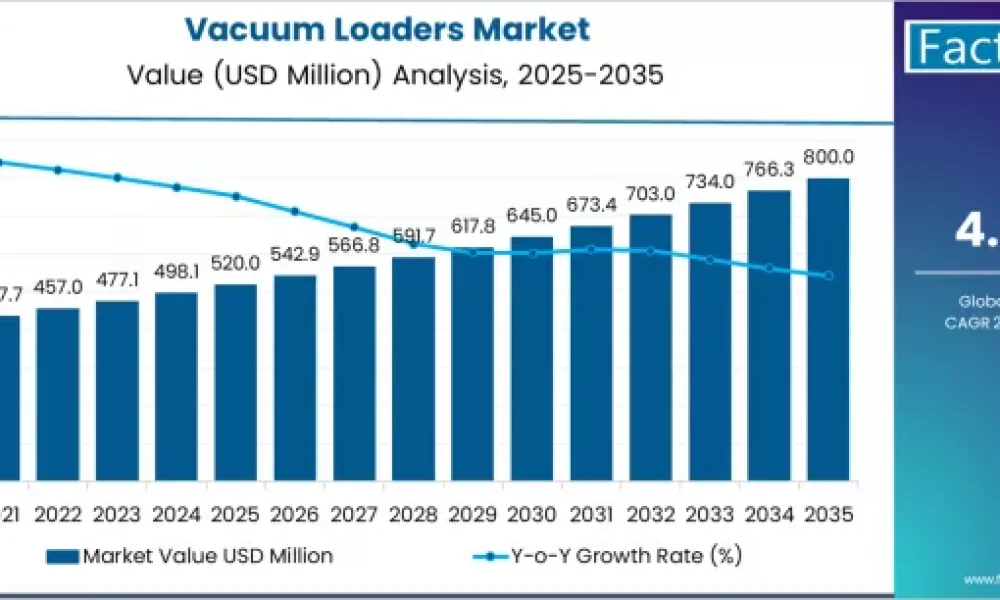
The global vacuum loaders market is on track for strong, sustained growth over the next decade, driven by rapid automation in material handling, expansion in plastic processing, and increasing adoption across food and pharmaceutical manufacturing. According to recent market analysis, the sector is valued at USD 390 million in 2023 and is projected to reach USD 640 million by 2033, expanding at a steady compound annual growth rate (CAGR) of 5.1% during the forecast period.
Vacuum loaders—automated systems that use suction to transport powders, granules, and pellets—have become essential to modern manufacturing environments. They improve productivity, prevent contamination, and support lean operations, making them indispensable for efficient and hygienic material handling.
Automation and Industry 4.0 Propel Market Momentum
The integration of Industry 4.0 principles into manufacturing has made vacuum loaders central to automated production lines. From 2023 to 2030, adoption is expected to increase significantly as industries seek to minimize manual labor and reduce material waste. Beyond 2030, large-scale investments in smart factories and sustainable manufacturing will accelerate market growth.
“Vacuum loaders are now core to automated manufacturing,” said a senior market analyst. “They not only improve plant hygiene and consistency but also reduce energy and operational costs, helping industries meet rising efficiency and sustainability standards.”
To access the complete data tables and in-depth insights, request a Discount On The Report here: https://www.factmr.com/connectus/sample?flag=S&rep_id=5538
Key Market Insights at a Glance
| Metric | Estimate |
| Market Value (2023) | USD 390 million |
| Forecast Value (2033) | USD 640 million |
| CAGR (2023–2033) | 5.1% |
| Leading Product Type | Single-phase vacuum loaders (~60% share) |
| Fastest-Growing Application | Food processing (CAGR ~6%) |
Market Segmentation Overview
By Throughput:
Medium-throughput vacuum loaders (150 to 500 lb/hr) are witnessing the strongest demand, particularly among small and mid-sized manufacturers seeking modular, easy-to-install solutions. High-capacity systems remain essential in large facilities where continuous material flow and long-distance conveying are critical.
By Loading Type:
Single-material loaders continue to dominate; however, ratio-loading systems are gaining popularity due to the need to handle multiple materials simultaneously—especially as manufacturers integrate recycled plastics and hybrid material blends into production lines.
By End Use:
- Plastic Processing: The largest segment, driven by global plastics consumption across packaging, automotive, and construction industries.
- Food & Beverage: Expected to expand rapidly due to stringent hygiene standards and the growing demand for automated, contamination-free conveying systems.
- Pharmaceuticals: Adoption continues to rise as vacuum loaders ensure precise dosing and safe transfer of powders and granules.
- Chemicals & Industrial Manufacturing: Increasingly using automated loading for handling resins, pigments, and fine materials safely.
By Region:
- North America holds a major share, supported by established automation infrastructure and strong demand from plastics and food industries.
- Europe continues to see growth, driven by strict environmental regulations and modernization of legacy equipment.
- Asia Pacific emerges as the fastest-growing region, led by industrial expansion in China, India, and Southeast Asia.
- Latin America and Middle East & Africa represent rising opportunities as local manufacturers embrace automation to improve efficiency and safety.
Key Growth Drivers
- Automation Integration:
The shift toward smart factories is propelling the installation of automated material-handling systems, replacing manual or semi-automatic alternatives. - Boom in Plastic Processing:
Global demand for plastics and recycled polymers is fueling investment in advanced, high-capacity vacuum loaders for consistent feeding and conveying. - Stringent Hygiene Standards:
In sectors such as food, beverages, and pharmaceuticals, closed vacuum systems prevent contamination, ensuring compliance with international quality norms. - Sustainability and Waste Reduction:
Manufacturers are prioritizing energy-efficient vacuum loaders that minimize product loss and enable clean transfer of raw materials. - Safety and Worker Protection:
Automated conveying systems reduce physical strain and exposure risks, aligning with workplace safety regulations and sustainability initiatives.
Market Challenges
Despite promising growth, the market faces challenges including high upfront equipment costs, limited conveying distance, and competition from alternative material-transfer systems. Smaller manufacturers may find advanced models cost-prohibitive without financial incentives or phased automation plans. Moreover, integration with legacy systems can be complex, requiring custom retrofitting and skilled technical support.
However, as equipment costs decline and modular vacuum loaders become more accessible, these barriers are expected to ease, enabling broader adoption across industries and regions.
Competitive Landscape
The vacuum loaders market is moderately fragmented, with established industrial equipment manufacturers and regional players competing on performance, energy efficiency, and system integration. Companies are focusing on developing intelligent, connected vacuum loaders that integrate seamlessly into broader automation systems.
Leading companies in this space are introducing:
- Smart control systems with real-time monitoring and predictive maintenance alerts.
- Brushless motors for higher efficiency and lower maintenance.
- Modular designs allowing easy scalability across production lines.
- Noise-reduction technologies for improved workplace safety and comfort.
Collaborations between vacuum loader manufacturers and automation integrators are expanding, enabling turnkey solutions for clients adopting Industry 4.0 systems.
Purchase Full Report for Detailed Insights
For access to full forecasts, regional breakouts, company share analysis, and emerging trend assessments, you can purchase the complete report here:
https://www.factmr.com/checkout/5538
Market Outlook: From Equipment to Intelligent Systems
The coming decade will see vacuum loaders evolve beyond basic material-transfer devices into data-driven, self-optimizing components of integrated manufacturing ecosystems.
Smart vacuum loaders equipped with sensors, IoT connectivity, and adaptive control algorithms will allow real-time monitoring of material flow, energy consumption, and system performance.
Key trends defining the next phase of market development include:
- Smart connectivity for automated diagnostics and performance tracking.
- Integration with robotic and centralized conveying systems.
- Hybrid systems supporting recycled and biodegradable materials.
- Compact modular designs catering to SMEs and decentralized facilities.
“Vacuum loaders are transitioning from stand-alone units to connected assets that enhance production visibility and operational intelligence,” commented an industry expert. “Their growing role in process automation makes them vital to manufacturing sustainability and competitiveness.”
Market Outlook Beyond 2030
By 2033, vacuum loaders are expected to become standard equipment across modern manufacturing facilities. Emerging economies will witness rapid adoption as automation becomes essential to address labor shortages, improve quality control, and enhance overall equipment effectiveness.
Technological advancements will enable loaders to operate over longer distances, handle multiple materials seamlessly, and provide integrated energy management systems—making them central to efficient material logistics.
To View Related Report :
Vacuum Excavator Market
About Fact.MR
Fact.MR is a global market research and consulting firm delivering quantitative insights and strategic intelligence across more than 30 industries and 1,200 markets worldwide. By combining deep industry expertise with forward-looking data analytics, Fact.MR empowers organizations to make informed, sustainable business decisions in an evolving industrial landscape



