
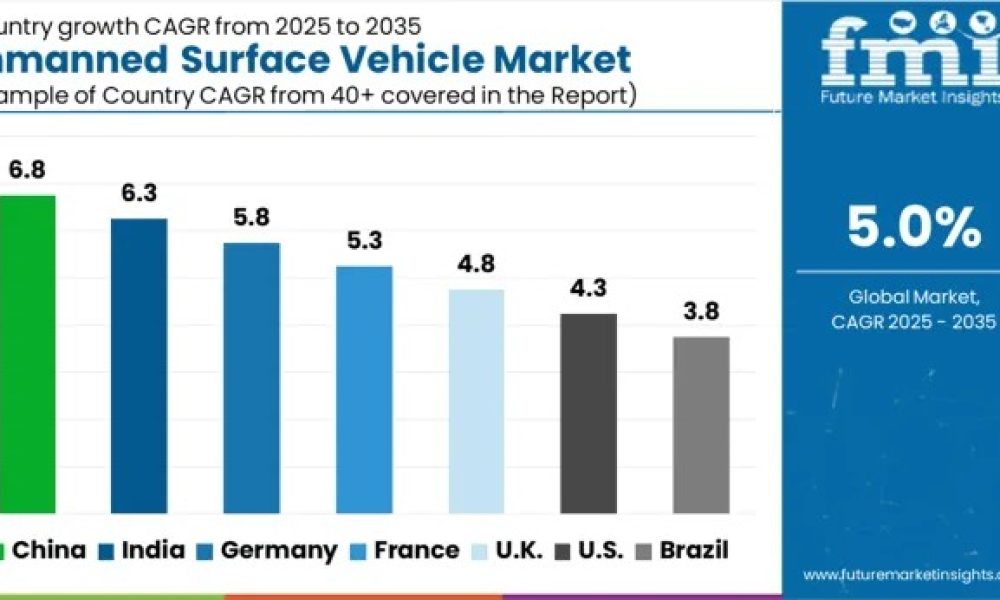
The global unmanned surface vehicle (USV) market is entering a decisive phase of structured growth, driven by rising demand for autonomous maritime operations across defense, research, and commercial sectors. Valued at USD 578.8 million in 2025, the market is projected to reach USD 942.8 million by 2035, expanding at a compound annual growth rate (CAGR) of 5.0% over the forecast period. This growth trajectory reflects a technology-intensive value chain where high-performance components, advanced software integration, and service-driven revenue models are shaping long-term market dynamics.
Unmanned surface vehicles represent a specialized segment within the broader autonomous marine systems and maritime robotics landscape. Their adoption is anchored in the ability to perform persistent surface-level missions such as surveillance, reconnaissance, hydrographic surveys, environmental monitoring, and offshore inspections without onboard human intervention. As maritime operations increasingly prioritize safety, efficiency, and data-driven decision-making, USVs are emerging as critical enablers of modern naval and commercial strategies.
Cost Structure Highlights Technology-Driven Value Creation
The cost structure of unmanned surface vehicles is dominated by high-value technological components and integration processes. Advanced sensor suites—including radar, LiDAR, sonar, and electro-optical systems—account for a significant share of manufacturing expenditure due to stringent precision, reliability, and durability requirements in maritime environments. Navigation systems, propulsion units, and corrosion-resistant hull materials further contribute to capital intensity, particularly as manufacturers adopt lightweight composite structures to improve endurance and operational efficiency.
Get access to comprehensive data tables and detailed market insights — request your sample report today!
https://www.futuremarketinsights.com/reports/sample/rep-gb-25287
Beyond hardware, substantial value is created in system integration, autonomy software development, and testing. Autonomous navigation algorithms, mission planning software, cybersecurity frameworks, and real-time communication systems require continuous investment to ensure safe and reliable operations in congested and contested waters. Post-deployment services such as predictive maintenance, software upgrades, and remote monitoring platforms add recurring revenue streams while reinforcing lifecycle value.
Defense and Security Remain Core Demand Drivers
Defense applications continue to anchor the unmanned surface vehicle market, accounting for an estimated 53.7% of total revenue in 2025. Heightened geopolitical tensions, maritime border protection requirements, and naval modernization programs are accelerating the deployment of USVs for missions including mine countermeasures, persistent surveillance, reconnaissance, and anti-submarine warfare support.
By removing personnel from high-risk environments, USVs enhance operational safety while enabling extended mission endurance. Integration with advanced command-and-control systems, real-time data transmission, and AI-assisted decision-making has expanded their tactical relevance. As maritime domain awareness becomes a strategic priority globally, defense-led demand is expected to sustain long-term market momentum.
Surface Platforms Dominate by Versatility and Endurance
By type, surface USVs are projected to command 62.1% of market revenue in 2025, reflecting their superior payload capacity, stability, and mission flexibility compared to smaller or sub-surface platforms. These vessels support modular payload architectures, allowing rapid reconfiguration for defense, research, or commercial use cases. Their ability to operate across nearshore, littoral, and open-ocean environments has made them the preferred platform for multi-mission deployments.
The 100–500 hours endurance category is expected to lead by endurance classification, capturing 44.5% of market revenue. This range offers an optimal balance between mission duration, system cost, and operational flexibility, making it well-suited for surveillance, mapping, and environmental monitoring across large maritime areas.
Commercial, Research, and Offshore Applications Expand Market Scope
Beyond defense, unmanned surface vehicles are gaining traction in scientific research, hydrographic surveying, and environmental monitoring. Research institutions and environmental agencies are increasingly deploying USVs to map seabeds, monitor water quality, track marine ecosystems, and assess climate change impacts in remote or hazardous locations. These platforms provide a cost-effective alternative to manned vessels while enabling consistent and repeatable data collection.
Commercial and offshore industrial applications are also expanding steadily. USVs are being used for port inspections, pipeline monitoring, offshore wind farm inspections, oil and gas infrastructure surveillance, and maritime logistics support. Their ability to reduce operational risk, lower inspection costs, and integrate seamlessly with digital monitoring platforms positions them as essential tools for modern offshore operations.
Regional Growth Led by Asia and Strategic Maritime Investments
Regionally, the market is witnessing steady expansion across North America, Europe, and Asia-Pacific. China leads global growth with a projected CAGR of 6.8%, supported by large-scale investments in maritime surveillance, defense modernization, and scientific research. India follows at 6.3%, driven by coastal security initiatives, naval modernization, and increasing adoption in oceanographic studies.
Germany, France, the United Kingdom, and the United States continue to advance the market through naval programs, offshore energy projects, and autonomous maritime research. Europe’s emphasis on environmental monitoring and regulatory compliance, combined with North America’s focus on advanced autonomy and defense applications, ensures balanced global demand.
Drive Your Business Growth Strategy: Checkout the Report for Key Insights
https://www.futuremarketinsights.com/checkout/25287
Competitive Landscape Driven by Autonomy and Integration
The competitive environment is defined by technology leadership, system reliability, and mission adaptability. Companies such as Kongsberg Maritime, BAE Systems, SAAB AB, Thales, Teledyne, and L3Harris Technologies focus on defense-grade platforms with advanced autonomy, secure communications, and sensor fusion capabilities. Meanwhile, players like Liquid Robotics, OceanAlpha, Maritime Robotics AS, and Fugro target commercial and scientific applications with modular, long-endurance platforms.
Strategic partnerships with defense agencies, research institutions, and offshore operators, combined with continuous investment in AI-driven navigation, renewable propulsion, and cloud-based data analytics, remain critical differentiators.
Outlook: Autonomous Maritime Operations Move Into the Mainstream
As maritime security requirements intensify and offshore industries demand safer, more efficient monitoring solutions, unmanned surface vehicles are transitioning from experimental platforms to operational assets. Continued innovation in autonomy, propulsion efficiency, and digital integration is expected to lower lifecycle costs while expanding mission capabilities. Over the next decade, USVs are set to play a defining role in reshaping maritime operations, reinforcing their position as a cornerstone of the evolving autonomous marine ecosystem.
This growing strategic relevance underscores why the unmanned surface vehicle market is poised for sustained expansion through 2035.
Why Choose FMI: Empowering Decisions that Drive Real-World Outcomes: https://www.futuremarketinsights.com/why-fmi
About Future Market Insights (FMI)
Future Market Insights, Inc. (FMI) is an ESOMAR-certified, ISO 9001:2015 market research and consulting organization, trusted by Fortune 500 clients and global enterprises. With operations in the U.S., UK, India, and Dubai, FMI provides data-backed insights and strategic intelligence across 30+ industries and 1200 markets worldwide.



