
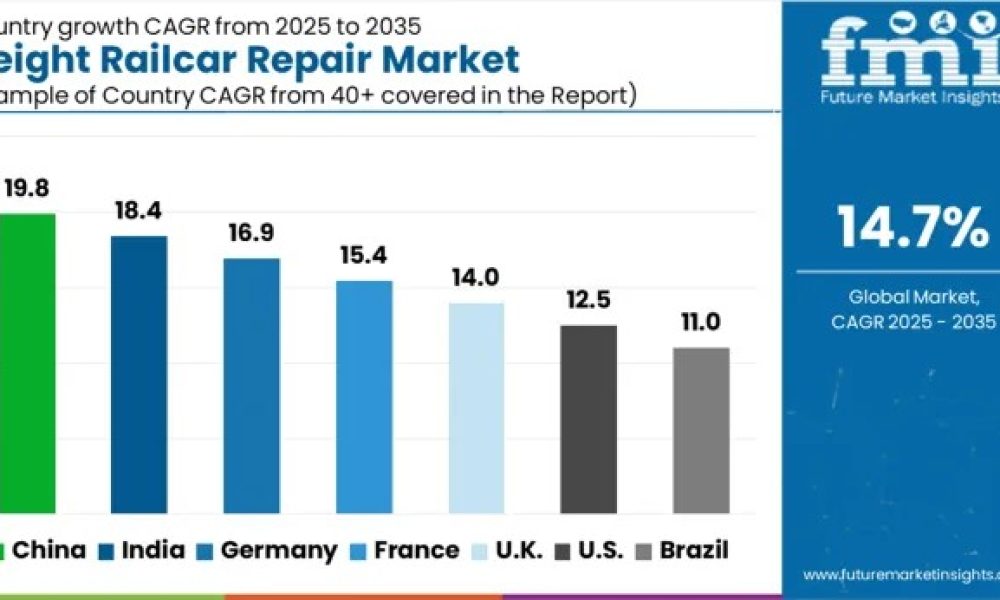
The global freight railcar repair market is entering a period of accelerated expansion, reflecting the growing importance of rail freight as a cost-efficient and sustainable mode of transportation for bulk commodities and industrial goods. The market is estimated to reach USD 25.7 billion in 2025 and is projected to surge to USD 101.3 billion by 2035, advancing at a robust compound annual growth rate (CAGR) of 14.7% over the forecast period. This sharp upward trajectory highlights the sector’s strategic role in maintaining operational efficiency, safety compliance, and asset longevity across global rail networks.
Market Evolution: From Early Adoption to Consolidation
The freight railcar repair market has evolved through clearly defined growth phases. During the early adoption phase from 2020 to 2024, demand was largely driven by pilot repair programs and preventive maintenance initiatives implemented by fleet operators on limited railcar volumes. These activities focused on minimizing service disruptions, extending asset life, and meeting baseline safety requirements.
Get access to comprehensive data tables and detailed market insights — request your sample report today!
https://www.futuremarketinsights.com/reports/sample/rep-gb-25688
As the market enters the scaling phase beginning in 2025, adoption is expanding rapidly. Rail operators are now investing in large-scale repair programs aimed at reducing downtime and improving network reliability. Service providers are responding by increasing repair capacity, standardizing processes, and expanding regional footprints. Rising freight volumes and aging rail infrastructure across major economies are creating sustained demand, supporting steady revenue growth across North America, Europe, and Asia-Pacific.
Looking ahead to the 2030–2035 period, the market is expected to reach USD 101.3 billion, maintaining its strong 14.7% CAGR. This phase marks industry consolidation, where leading service providers strengthen their positions through mergers, strategic alliances, and nationwide service networks. Smaller players are increasingly specializing in niche repair services or exiting the market altogether. By 2035, most rail operators are expected to operate under long-term repair contracts, resulting in a mature market characterized by predictable demand, standardized repair protocols, and stable competitive dynamics.
Market Structure and End-User Demand
The freight railcar repair market serves a diverse range of end users, each contributing distinct demand drivers. Large Class I railroads dominate with approximately 40% of total demand, driven by extensive fleets requiring frequent preventive maintenance and major overhauls. Regional and shortline railroads account for around 20%, relying heavily on outsourced repair services to maintain aging or smaller fleets efficiently.
Private freight operators represent about 15% of the market, balancing in-house capabilities with third-party workshops to reduce downtime. Intermodal and container transport companies contribute roughly 10%, prioritizing rapid turnaround times for specialized container cars. Mining and bulk commodity operators make up 8%, where heavy-duty railcars transporting coal, grain, and ores require frequent refurbishment. The remaining share comes from industrial logistics firms, railcar leasing companies, and government or military operations, each emphasizing reliability and compliance.
Revenue growth from USD 12.9 billion in 2020 to USD 25.7 billion in 2025, and further to USD 101.3 billion by 2035, reflects the combined impact of fleet modernization, increased freight traffic, and stricter regulatory maintenance standards worldwide.
Segmental Insights: Mechanical and Mobile Services Lead
By repair type, the mechanical segment is projected to hold 48.6% of total market revenue in 2025, making it the largest segment. Regular inspection, maintenance, and replacement of critical components such as brakes, couplers, and wheelsets are essential for safety and regulatory compliance. As railcar systems become more complex, demand for skilled labor and specialized tools continues to rise, reinforcing the dominance of mechanical repairs.
By service type, mobile repair services are expected to capture 56.4% of market revenue in 2025. On-site repair capabilities significantly reduce downtime by eliminating the need to transport railcars to fixed facilities. Advances in mobile diagnostics and repair equipment have expanded the range of issues that can be addressed in the field, making mobile services a preferred option for operators seeking flexibility, speed, and cost efficiency.
Growth Drivers Reinforcing Market Momentum
Several structural factors are driving sustained growth in the freight railcar repair market. Aging rail fleets in North America and Europe require frequent overhauls, retrofitting, and component replacement to meet safety and efficiency standards. In Asia-Pacific, expanding railcar volumes and industrial logistics demand timely maintenance to prevent service disruptions.
Regulatory compliance and safety standards further underpin demand, particularly in developed markets where inspection, certification, and documentation requirements are stringent. At the same time, technological integration is transforming repair operations. Predictive maintenance, IoT-enabled monitoring, automated inspection systems, and advanced welding techniques are improving turnaround times, reducing costs, and enhancing service reliability.
Supply chain reliability for spare parts and components also plays a critical role. While North America and Europe benefit from robust sourcing networks, Asia-Pacific markets are investing in regional supply chains and inventory management to support growing repair volumes.
Regional Growth Outlook
The market exhibits strong regional differentiation. China leads global growth with a CAGR of 19.8%, supported by expanding freight volumes, rail network modernization, and adoption of predictive maintenance technologies. India follows at 18.4%, driven by infrastructure expansion, rising industrial activity, and increasing focus on cost-effective, durable repair solutions.
In Europe, Germany (16.9%) stands out due to strict maintenance standards, advanced infrastructure, and high freight utilization, while the UK (14.0%) benefits from network modernization and increased industrial shipments. The United States, growing at 12.5%, represents a mature but resilient market, supported by steady freight demand, fleet modernization, and investment in advanced repair technologies.
Drive Your Business Growth Strategy: Checkout the Report for Key Insights
https://www.futuremarketinsights.com/checkout/25688
Competitive Landscape: Technology and Scale as Differentiators
Competition in the freight railcar repair market is shaped by service scale, geographic coverage, and technological capability. Leading players such as Siemens, Wabtec Corporation, Progress Rail, Alstom, TTX, Union Tank Car Company (UTLX), Trinity Industries, Watco Companies, The Greenbrier Companies, and Cathcart Rail have established strong positions through comprehensive repair and refurbishment offerings.
Innovation is central to competitive strategy, with increasing adoption of predictive maintenance, digital diagnostics, and customized repair solutions. Companies that combine nationwide service networks with advanced technology and standardized processes are best positioned to capture long-term value as the market matures.
Outlook
By 2035, the freight railcar repair market will represent a USD 101.3 billion industry with mature competition, predictable growth, and standardized practices. Its rapid expansion reflects the essential role of rail transport in global supply chains and underscores the importance of maintenance and repair services in ensuring safe, efficient, and resilient rail operations worldwide.
Why Choose FMI: Empowering Decisions that Drive Real-World Outcomes: https://www.futuremarketinsights.com/why-fmi
About Future Market Insights (FMI)
Future Market Insights, Inc. (FMI) is an ESOMAR-certified, ISO 9001:2015 market research and consulting organization, trusted by Fortune 500 clients and global enterprises. With operations in the U.S., UK, India, and Dubai, FMI provides data-backed insights and strategic intelligence across 30+ industries and 1200 markets worldwide.



