
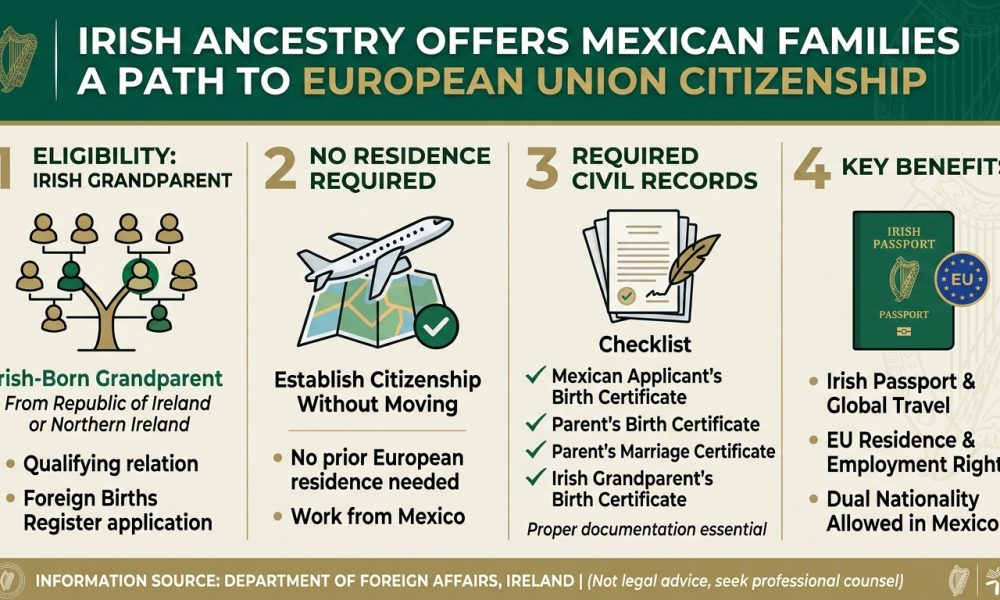
Mexican citizens with qualifying Irish-born grandparents may explore registration through Ireland’s Foreign Births Register, potentially establishing citizenship without first relocating to Europe and gaining access to European Union residence, employment, and family mobility opportunities under applicable nationality legislation.
WASHINGTON, DC, November 20, 2026 — Mexican citizens with Irish grandparents may qualify for European Union citizenship through Ireland’s ancestry-based nationality provisions, creating opportunities to obtain a second passport without first establishing residence in Ireland or completing the ordinary naturalization process.
Although many Mexican families associate European citizenship opportunities with Spanish or Italian ancestry, Ireland maintains a separate nationality framework that can recognize qualifying descendants of Irish-born grandparents through a formal registration process administered by the Department of Foreign Affairs and Trade.
For successful applicants, Irish citizenship can provide lawful residence and employment rights in Ireland and other European Union member states. At the same time, Mexico’s constitutional recognition of multiple nationalities generally protects Mexican citizens by birth against losing their original nationality.
However, applicants must establish an eligible family relationship, provide authentic documentation connecting successive generations, and meet the registration requirements under Irish law before becoming entitled to apply for an Irish passport.
Irish Citizenship Through Grandparents Does Not Require Prior European Residence
Ireland’s Foreign Births Register provides a nationality pathway for qualifying individuals born outside Ireland who have a grandparent born on the island of Ireland, allowing eligible applicants to establish citizenship through ancestry rather than ordinary residence-based naturalization.
A Mexican citizen whose grandmother was born in Dublin, Cork, Galway or Belfast may therefore have a potential citizenship claim even when the applicant and both parents were born in Mexico and have never lived in Europe.
The relevant legal question concerns the ancestor’s birthplace and nationality, the applicant’s documented family relationship and the statutory conditions governing citizenship transmission, rather than whether the applicant previously held an Irish visa or residence permit.
Once the qualifying application is approved and the applicant’s birth is entered in the Foreign Births Register, Irish citizenship takes effect from the date of registration, establishing eligibility to pursue an Irish passport through the appropriate government procedures.
Ireland’s Nationality Law Recognizes Citizenship Across Generations
The Irish Nationality and Citizenship Act 1956, as amended, provides the main legislative framework for citizenship by birth and descent, including the circumstances under which individuals born overseas may acquire citizenship through family relationships.
Where a qualifying parent was born on the island of Ireland, an individual born abroad may already possess Irish citizenship by descent, whereas someone relying on an Irish-born grandparent ordinarily must complete Foreign Births Registration.
This distinction is particularly important for Mexican families because the legal pathway can depend on which generation was born in Ireland, whether intervening relatives held Irish citizenship, and when any necessary registrations were completed.
Applicants should therefore establish the exact family lineage before beginning an application, ensuring records demonstrate a qualifying legal relationship rather than relying exclusively on family traditions, Irish surnames, or historical accounts of migration.
An Irish-Born Grandparent Can Be the Key to Eligibility
Consider a Mexican citizen born in Guadalajara whose maternal grandmother was born in Dublin before emigrating to Mexico, later marrying and raising children who continued to reside in Mexico throughout their adult lives.
If the grandmother’s Irish citizenship and the relevant family relationships satisfy Irish nationality legislation, the Mexican grandchild may qualify to enter the Foreign Births Register without first relocating to Ireland.
The application would ordinarily require documentary evidence linking the Irish grandmother to the applicant’s mother and then the mother to the applicant, along with additional records specified by Ireland’s registration authorities.
This example illustrates how a birth certificate preserved for decades can become legally significant, particularly when descendants previously assumed that European citizenship was unavailable because their immediate family members were born outside Europe.
Irish Citizenship Applications Have Attracted Growing International Interest
Interest in Ireland’s ancestry-based citizenship framework has expanded among internationally mobile families seeking additional residence rights and the flexibility associated with European Union citizenship, particularly in countries with substantial historical Irish emigrant communities.
In April 2026, the Financial Times reported that American applications for Irish citizenship increased by 63%, with Foreign Births Register applications from the United States rising from 11,601 in 2024 to 18,910 in 2025.
Although those figures specifically concern American applicants rather than Mexican nationals, they illustrate growing international attention toward documented ancestral citizenship pathways and the increasing importance of accurate government records.
Mexican families investigating Irish heritage should still distinguish general interest in European passports from actual eligibility, because Ireland’s registration process remains governed by statutory requirements rather than application volume or prevailing migration trends.
Mexican Birth Certificates Can Establish the Family Connection
A Mexican applicant’s birth certificate ordinarily provides the first essential documentary connection in an Irish ancestry claim, identifying the parents whose records must be linked to the qualifying Irish-born grandparent.
The parent’s birth certificate may then establish the relationship with the Irish ancestor. At the same time, relevant marriage certificates and official name-change records can help explain differences between surnames appearing across several generations.
When relatives changed names after marriage or immigration, applicants may need additional supporting documents showing that historical records refer to the same individual, particularly when Mexican and Irish authorities recorded names differently.
These documents establish an uninterrupted, legally recognized family relationship that Irish authorities can independently verify before approving registration and recognizing the applicant’s citizenship.
The Irish Ancestor’s Birthplace Must Be Verified
Irish citizenship claims through grandparents generally require evidence that the qualifying grandparent was born on the island of Ireland, making the ancestor’s original birth certificate a particularly important document within the application.
The island of Ireland includes both the Republic of Ireland and Northern Ireland, meaning a qualifying grandparent born in Belfast may potentially establish eligibility in circumstances comparable to an ancestor born in Dublin.
However, an ancestral connection to Ireland does not necessarily establish eligibility when the relevant ancestor was born elsewhere, because different statutory provisions may apply when citizenship depends upon parents or grandparents who themselves were born abroad.
Families should therefore obtain official records establishing the precise birthplace and nationality circumstances of their ancestor before making financial commitments or assuming that an Irish family surname provides sufficient evidence.
Great-Grandparents Create Different Citizenship Requirements
Mexican citizens whose closest Irish-born ancestor is a great-grandparent face a more complicated nationality assessment because Irish citizenship transmission through successive generations generally depends upon the citizenship status and registration history of the intervening parent.
For individuals born abroad whose parent acquired Irish citizenship through Foreign Births Registration, the parent generally must have been registered as an Irish citizen before the child’s birth for the child to qualify through that relationship.
This timing requirement can prevent an otherwise well-documented ancestry claim when a parent completed registration only after the applicant was born, even though the family can establish an authentic connection with an earlier Irish-born ancestor.
Consequently, an Irish great-grandparent should prompt a detailed examination of historical nationality registration rather than an assumption that ancestry alone provides an unlimited citizenship claim across future generations.
Registration Timing Can Affect Future Children
One of the most important aspects of Ireland’s Foreign Births Register concerns when citizenship legally begins, because individuals acquiring citizenship through registration generally become Irish citizens on the date their registration is completed.
A Mexican applicant who successfully registers before having children may therefore establish an important foundation for transmitting Irish citizenship to qualifying children subsequently born outside Ireland, subject to the relevant statutory provisions.
However, children born before their parent’s registration generally cannot acquire citizenship through that newly registered parental connection alone, making application timing particularly significant for families considering additional children.
Prospective applicants should examine their children’s existing eligibility independently, particularly when another parent or grandparent may provide a separate qualifying Irish citizenship connection under the applicable legislation.
Foreign Births Registration Is Different From Ordinary Naturalization
Irish citizenship through Foreign Births Registration operates under a different legal framework from residence-based naturalization, because eligible applicants rely on established family relationships rather than completing a prescribed number of years living in Ireland.
Ordinary naturalization generally requires qualifying residence, good character, and other criteria, while Foreign Births Registration focuses on the applicant’s documentary connection to an eligible Irish parent or grandparent.
This distinction can offer substantial practical advantages for Mexican citizens who want to keep their employment, family commitments, and permanent residence in Mexico while pursuing a legitimate European citizenship opportunity through ancestry.
Nevertheless, recognition is not automatic merely because an applicant provides family documents, since the Irish authorities must determine whether the evidence satisfies the relevant nationality legislation and administrative registration requirements.
Irish Authorities Require Detailed Supporting Documentation
The Department of Foreign Affairs and Trade administers Foreign Births Registration through an application process that generally requires an online submission, supporting identity evidence, and official documents establishing the applicant’s qualifying ancestral relationship.
Depending on the application category, required records may include birth certificates, marriage certificates, Identification documents, photographs, and documents showing any name changes in the applicant’s family history.
Applications may also require documentation about a deceased ancestor, including an official death certificate where applicable, but the exact evidence must match the current instructions for the relevant registration category.
Mexican applicants should verify the required forms and supporting documents before submission, because incomplete records can cause administrative delays and may require additional correspondence with Irish authorities after the application enters processing.
Historical Irish Records Can Be Essential
Families whose Irish ancestors emigrated decades ago may need to locate historical civil registrations, church records, or archival documents that later generations in Mexico never retained.
Irish civil registration records can provide important evidence concerning an ancestor’s birthplace and parentage. At the same time, church registers and historical family records may help researchers identify the correct person when official documents contain limited information.
However, genealogical discoveries should be distinguished from legally acceptable citizenship evidence, because Irish registration officials may require particular civil certificates or certified archival records rather than unofficial family histories.
Before filing an application, a careful search should establish consistent names, dates, and family relationships, especially when the ancestor’s identity is complicated by common surnames or historical variations in recorded information.
Mexican Family Records May Contain Important Clues
Mexican civil registries may preserve information about ancestors who arrived from Ireland or other European countries, including references to foreign birthplaces, parental nationality, and historical residence that can guide subsequent archival research.
An early Mexican marriage certificate identifying an immigrant as Irish-born may provide the information necessary to locate an original European birth record. In contrast,e children’s birth certificates can establish later family relationships.
These records become particularly useful when an ancestor’s exact Irish birthplace is unknown, because searches across several counties or parishes can otherwise become difficult when families possess only incomplete personal information.
Mexican applicants should therefore start with accessible family documents and official civil records before assuming overseas genealogical research will be necessary at every stage of the citizenship investigation.
Name Variations Can Complicate Ancestry Applications
Historical migrants sometimes adopted different spellings of their names or saw changes in how civil registrars recorded their personal information, creating discrepancies that may matter during foreign citizenship verification.
An Irish family surname may appear differently across birth, marriage, and immigration records. At the same time,e Mexican naming conventions can introduce additional paternal or maternal surnames that were not recorded in earlier Irish documents.
These variations do not necessarily invalidate a legitimate ancestral claim, but applicants may need official supporting evidence to establish that documents containing different names refer to the same individual.
Where government records contain actual errors, correcting the relevant civil documentation through authorized procedures can help prevent problems that might otherwise delay registration or require additional explanation during official review.
Certified Documents and Authentication Require Planning
Irish citizenship authorities may specify requirements for original civil certificates, certified copies, and the authentication of foreign-issued documents, making documentary preparation an important part of any Mexican application.
Mexican records used internationally may require certification, translation, or other formalities depending on the receiving authority’s instructions. Still, applicants should not assume every document requires identical authentication.
An apostille can establish the authenticity of a qualifying public document’s signature or seal under the relevant international convention. However, it does not independently prove that the underlying information meets Irish nationality law requirements.
Careful verification of document requirements can reduce unnecessary expenses, especially when applicants obtain multiple records across Mexican states, Irish counties, and historical archives maintained by different government institutions.
Foreign Births Registration Requires an Official Government Decision
Once the applicant has gathered the necessary information, they must complete Ireland’s prescribed Foreign Births Registration process and submit the required supporting evidence for examination by the competent government authorities.
A qualifying grandparent can provide an important legal basis for an application, but the Irish government must still determine whether the applicant meets the conditions for registration.
Applicants should avoid arranging international relocation on the assumption that citizenship has already been granted, particularly when registration remains incomplete, or the authorities have requested additional documentary verification.
Approval establishes citizenship through the registration mechanism, after which the individual can proceed with a separate passport application under the rules governing the issuance of Irish travel documents.
Irish Citizenship and Irish Passports Are Separate Legal Steps
Registering in Ireland’s Foreign Births Register makes a person an Irish citizen, but receiving a citizenship certificate does not automatically mean an Irish passport has been issued.
Passport issuance requires a separate application and identity verification, so applicants should distinguish legal recognition of nationality from the administrative process of obtaining a travel document.
This distinction becomes particularly relevant when Mexican families plan employment, education or residence in Europe, because authorities may require acceptable evidence of citizenship before completing immigration or local registration procedures.
A realistic international mobility plan should therefore account for both citizenship registration and passport processing without treating an advertised ancestry pathway as a guarantee of immediate international travel documentation.
Irish Citizenship Provides European Union Mobility Rights
Irish citizenship includes European Union citizenship, allowing qualifying individuals to exercise rights of movement and residence within participating member states under applicable European legislation and administrative requirements.
A Mexican citizen who successfully acquires Irish citizenship may then become eligible to pursue residence and employment in countries such as Germany, France, Spain, or Portugal without relying on the ordinary immigration pathways available only to Mexican nationals.
These rights can create substantial professional opportunities, particularly for individuals interested in international employment, university education, entrepreneurship or long-term residence with qualifying family members elsewhere in the European Union.
However, EU citizenship does not eliminate every administrative obligation, because individuals establishing residence abroad may still need to meet registration requirements and comply with applicable national rules on employment, professional qualifications, and public services.
Ireland Also Offers Distinct Residence Rights in the United Kingdom
Irish citizenship carries important rights beyond the European Union because the Common Travel Area provides longstanding arrangements allowing Irish and British citizens to live and work in each other’s countries, subject to applicable legal provisions.
For a Mexican citizen who lawfully obtains Irish nationality, these arrangements can create additional opportunities for residence, employment, and education in the United Kingdom that would not ordinarily arise from holding a Mexican passport alone.
The Common Travel Area should nevertheless be distinguished from European Union free movement, because the United Kingdom is no longer an EU member and the relevant citizenship rights arise through separate legal arrangements.
Individuals planning to reside in Britain should therefore examine the particular privileges attached to Irish citizenship and the requirements governing employment, family members, and access to public services before relocating.
Mexican Citizens by Birth Can Generally Retain Mexican Nationality
Mexico’s constitutional framework protects citizens by birth against deprivation of Mexican nationality, creating an important foundation for those who subsequently acquire Irish citizenship through a qualifying ancestral connection.
This Protection generally allows Mexican citizens by birth to retain their original nationality while acquiring the additional rights associated with Irish and European Union citizenship, without automatically relinquishing their Mexican citizenship.
However, Mexican nationals who acquired citizenship through naturalization occupy a different legal position, because Article 37(B) identifies circumstances involving possible nationality loss, including voluntary acquisition of another nationality.
An applicant’s classification under Mexican constitutional law should therefore be established before pursuing Irish citizenship, particularly when the individual was born outside Mexico and originally acquired Mexican nationality through a separate naturalization procedure.
Irish Citizenship Does Not Automatically Change Tax Residence
Obtaining Irish citizenship through ancestry does not necessarily make a Mexican applicant an Irish tax resident, because nationality and tax residence are separate legal classifications governed by different statutory requirements.
An individual who remains permanently resident in Mexico after Foreign Births Registration may remain subject to Mexican tax rules. At the same time, potential Irish taxation depends upon the circumstances recognized under Ireland’s applicable legislation.
Similarly, Irish citizens who later establish residence in another European country may face tax obligations under that country’s residence rules, income sources, and financial relationships rather than passport ownership alone.
For families maintaining international investments, employment income or business interests, coordinated tax planning can help distinguish the legitimate benefits of European citizenship from financial obligations created by actual relocation.
American-Mexican Families May Have Additional Citizenship Considerations
Some families living in Mexico also include members who possess American citizenship, creating circumstances in which an Irish ancestry claim could result in an individual holding three legally recognized nationalities.
American law generally permits citizens to acquire or retain foreign nationality, and the U.S. Department of State’s guidance on dual nationality explains the continuing obligations affecting American citizens who possess another citizenship.
An individual holding American, Mexican, and Irish citizenship would therefore need to consider each country’s passport requirements, nationality laws, and ongoing legal responsibilities when traveling internationally or establishing permanent residence abroad.
American citizenship also carries potential federal tax and financial reporting obligations, so it’s important to distinguish acquiring Irish nationality from any change in tax status or existing American citizenship rights.
European Citizenship Can Benefit Future Family Planning
Mexican parents who qualify for Irish citizenship may wish to examine how registration affects future children, particularly because the timing of Foreign Births Registration can determine whether citizenship may be transmitted to another generation born abroad.
Completing an eligible parent’s registration before a child’s birth can be especially important when the parent was also born outside Ireland, since later registration generally cannot retrospectively create citizenship eligibility through that parental relationship.
Families with existing children should also review whether another Irish-born grandparent or qualifying parent provides an independent entitlement, rather than assuming that the principal applicant’s later registration resolves every family member’s status.
These considerations can make ancestry-based citizenship planning especially important for younger Mexican families who want to preserve lawful European opportunities for children and future generations.
Second: Citizenship Does Not Guarantee Every Family Member a Passport
An approved Irish citizenship application does not automatically mean a spouse or child can obtain an Irish passport, because nationality eligibility depends on each individual’s legal circumstances.
A spouse without qualifying Irish ancestry may need to explore a separate residence or naturalization pathway. At the same time, children must meet the descent or registration rules relevant to their birth circumstances.
Consequently, family mobility plans should distinguish between the rights of the newly recognized Irish citizen and those available to relatives under applicable family residence or nationality legislation.
The objective should be to identify legitimate opportunities for every family member without promising automatic citizenship to individuals whose eligibility has not been established through Ireland’s prescribed legal procedures.
Irish Ancestry Can Provide a Long-Term Alternative to Investment Citizenship
For Mexican families with qualifying Irish grandparents, citizenship through descent may offer a different financial proposition from investment-based nationality programs that require substantial government contributions or qualifying investment commitments.
An ancestry application generally focuses on establishing a lawful family connection and satisfying administrative requirements, rather than making a large investment in exchange for consideration under a citizenship-by-investment framework.
However, applicants may still incur meaningful expenses to obtain historical documents, arrange translations, conduct genealogical research, and complete government registration procedures, particularly when records span multiple jurisdictions.
Those expenses should be evaluated realistically, while recognizing that the Irish government determines eligibility based on nationality law rather than the amount an applicant can spend pursuing citizenship.
Amicus International Consulting and European Citizenship Planning
Irish citizenship by descent can become part of a broader international mobility strategy for Mexican nationals seeking additional residence options, educational opportunities and long-term flexibility for themselves and their families.
Amicus International Consulting provides information about these wider considerations through its second-passport and international advisory services, including the importance of evaluating lawful citizenship opportunities alongside personal relocation objectives.
For applicants with documented Irish ancestry, the most relevant preliminary assessment involves confirming the ancestor’s birthplace, establishing the connecting family records, and identifying whether the applicant qualifies for Foreign Births Registration.
The Irish authorities make the final nationality determination, so accurate documentation, truthful application information, and compliance with official government procedures remain essential, regardless of any professional advisory assistance.
Applicants Should Confirm Their Family History Before Paying for Services
Mexican citizens investigating Irish descent should begin with official family documents and publicly available government guidance before committing to extensive genealogical services, particularly when the identity or birthplace of the qualifying ancestor remains uncertain.
A preliminary documentary review can establish whether the relevant Irish connection involves a parent, grandparent, or more distant relative, allowing applicants to identify the nationality rules that actually govern their circumstances.
This approach can prevent unnecessary expenditure on applications lacking a qualifying ancestral connection, while helping eligible families understand which missing documents they must obtain before submitting a complete registration application.
Government Processing Times Should Not Be Treated as Guarantees
Foreign Births Registration can involve detailed examination of records spanning three generations and several jurisdictions, making processing requirements more complicated than an ordinary passport renewal or straightforward identity-document application.
Application volumes, missing documents, and additional verification requirements can affect processing, so applicants should consult current Irish government guidance rather than relying on historical turnaround estimates or guaranteed completion promises.
Families planning employment, university attendance, or international relocation should avoid irreversible financial commitments before citizenships are confirmed and travel documents are issued.
Irish Citizenship Can Preserve Opportunities Across Generations
For qualifying Mexican families, Irish citizenship by descent is more than an additional passport because it can create an enduring legal connection to Ireland and potentially give future generations opportunities under European nationality law.
The benefits may include expanded international residence options, employment opportunities, and greater flexibility when family circumstances change, provided each generation meets any applicable requirements for citizenship acquisition and registration timing.
However, preserving those rights requires attention to statutory conditions, not assumptions that one successful ancestry application establishes permanent eligibility for every descendant, regardless of when future births occur.
Conclusion: Irish Grandparents May Open a Door to European Citizenship
Mexican citizens with qualifying Irish-born grandparents may possess a legitimate pathway to European Union citizenship through Ireland’s Foreign Births Register, potentially obtaining nationality recognition without first establishing residence in Ireland or completing ordinary naturalization requirements.
The opportunity depends on proving the relevant family relationship, meeting Ireland’s registration requirements, and understanding how citizenship is transmitted, particularly when applicants intend to secure future rights for children born outside Ireland.
Mexico’s constitutional Protection of citizenship by birth can make this pathway especially attractive for qualifying Mexican nationals, allowing them to keep their original nationality while gaining the residence and mobility rights associated with Irish citizenship.
Ultimately, well-documented ancestry can offer Mexican families meaningful European opportunities. Still, successful applications require authentic civil records, an accurate understanding of Irish nationality law, and official confirmation before an Irish passport can be issued.




