
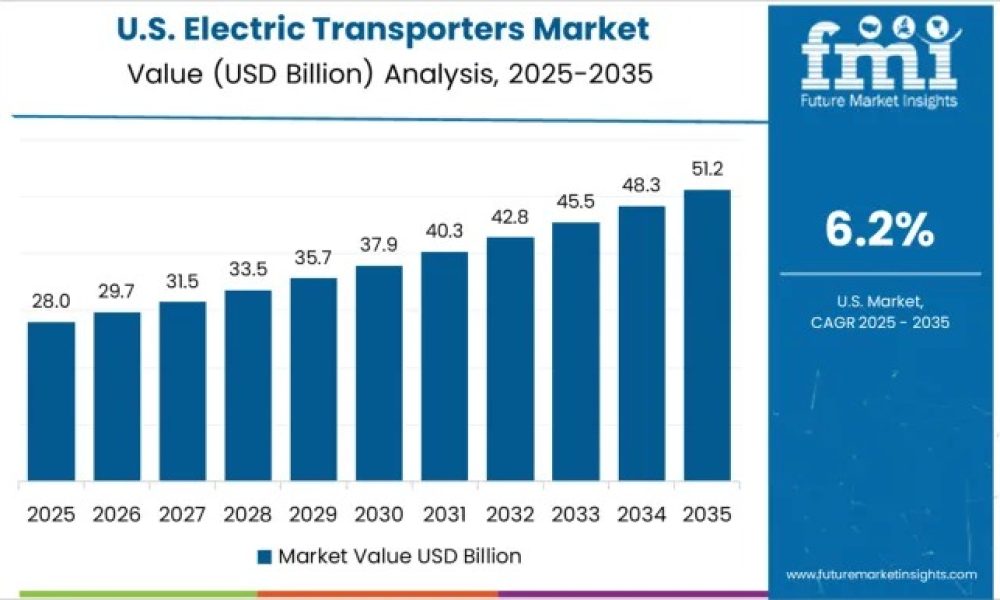
The global electric transporters market is entering a high-growth phase, projected to expand from USD 58.5 billion in 2025 to USD 118.3 billion by 2035, registering a compound annual growth rate (CAGR) of 7.3% over the forecast period. This expansion reflects accelerating adoption of zero-emission transport solutions across urban mobility, last-mile logistics, industrial transport, and commercial fleet operations.
Electric transporters—ranging from electric two-wheelers and personal transporters to cargo-focused mobility platforms—are increasingly positioned as a core component of sustainable transportation ecosystems. Their growing relevance is driven by tightening emission regulations, rapid urbanization, rising e-commerce volumes, and continuous improvements in battery efficiency, vehicle performance, and charging infrastructure.
Battery Electric Vehicles Anchor Market Growth
Battery electric vehicles (BEVs) remain the primary growth engine of the electric transporters market. Early market expansion from USD 58.5 billion in 2025 to USD 72.2 billion by 2028 is largely attributed to the widespread deployment of conventional BEV platforms, supported by advances in battery energy density, powertrain efficiency, and charging availability. These developments have reinforced adoption across both passenger-oriented and commercial transporter segments.
Get access to comprehensive data tables and detailed market insights — request your sample report today!
https://www.futuremarketinsights.com/reports/sample/rep-gb-25291
Hybrid electric transporters contribute steadily, particularly in regions where charging infrastructure gaps or range considerations limit full electrification. Their role as a transitional technology continues to support incremental market growth through the late 2020s. Fuel cell electric transporters, while still at an early stage, are beginning to appear in specialized applications requiring extended range and rapid refueling, adding technological diversity without materially altering near-term volume dynamics.
From 2030 onward, the adoption of advanced battery management systems, lightweight materials, and optimized electric drivetrains is expected to further strengthen BEV dominance, pushing total market value toward USD 118.3 billion by 2035.
Two-Wheelers Lead Adoption Across Urban Environments
By vehicle type, two-wheelers are projected to account for 38.5% of total market revenue in 2025, establishing them as the leading segment. Electric scooters and motorcycles have gained rapid acceptance in densely populated urban centers, where compact dimensions, low operating costs, and ease of maneuverability provide clear advantages.
Lower upfront costs compared with larger electric vehicles, combined with government incentives and reduced licensing requirements in several regions, have further supported adoption. The integration of connected features, efficient lithium-ion batteries, and improved charging access is expected to sustain the segment’s leadership as urban congestion and demand for agile transport solutions increase.
48V Systems and Lithium-Ion Batteries Define the Technology Mix
From a systems perspective, 48V architectures are anticipated to capture 45.9% of market revenue in 2025, reflecting their balance between performance, safety, and cost efficiency. These systems are well suited for lightweight and mid-range electric transporters and remain compatible with widely available charging infrastructure.
By battery type, lithium-ion technology is projected to account for 62.7% of market revenue, driven by its superior energy density, fast-charging capability, and long cycle life. Continuous cost reductions, safety enhancements, and scalability across multiple transporter categories have reinforced lithium-ion batteries as the preferred energy storage solution.
Policy Support and Urban Logistics Drive Structural Demand
Market growth is being reinforced by strong policy support for zero-emission vehicles, including subsidies, tax incentives, and low-emission zone regulations across major economies. Electric transporters are increasingly deployed in last-mile delivery, courier services, municipal operations, warehousing, and industrial facilities, where low noise, reduced maintenance, and operational efficiency offer measurable advantages over conventional fuel-powered alternatives.
The integration of IoT-enabled telematics, predictive maintenance, and route optimization software is further improving fleet efficiency and total cost of ownership. Modular vehicle designs, fast-charging capabilities, and smart fleet management platforms are enabling scalable deployment across both public and private sector operations.
Asia Leads Growth, While Europe and North America Focus on Fleet Electrification
Regionally, Asia-Pacific is emerging as the fastest-growing market, led by China and India. China is projected to grow at a CAGR of 9.9%, supported by large-scale deployment in urban logistics and strong domestic manufacturing capabilities. India follows at 9.1% CAGR, driven by government incentive programs, expanding e-commerce activity, and rising demand for electric three-wheelers and cargo transporters.
Europe and North America continue to see steady expansion, with growth driven by commercial fleet electrification, municipal procurement programs, and stricter emission standards. Germany, the UK, and the United States are focusing on integrating electric transporters into urban delivery and industrial logistics networks.
Drive Your Business Growth Strategy: Checkout the Report for Key Insights
https://www.futuremarketinsights.com/checkout/25291
Competitive Landscape Defined by Technology, Scale, and Connectivity
The electric transporters market is characterized by intense competition among established automotive brands and specialized electric mobility players. Companies such as Yamaha Motor, BMW Motorrad, Hero MotoCorp, KYMCO, Yadea, Niu Technologies, Segway Ninebot, Giant Group, Harley-Davidson, and Zero Motorcycles are strengthening their positions through investments in battery technology, connected vehicle platforms, and global distribution networks.
Competitive differentiation increasingly depends on battery efficiency, charging compatibility, connected features, and fleet integration capabilities, rather than vehicle hardware alone. Strategic partnerships with logistics providers, energy companies, and urban mobility platforms are shaping long-term market positioning.
Outlook: Electric Transporters Become Core to Urban and Commercial Mobility
As cities prioritize sustainability and logistics operators seek cost-efficient, low-emission solutions, electric transporters are transitioning from niche applications to mainstream deployment. With strong policy backing, rapid technological advancement, and expanding commercial use cases, the market is positioned for sustained growth through 2035.
The projected USD 118.3 billion market size underscores the electric transporter segment’s growing strategic importance within the broader electric mobility ecosystem, as manufacturers and fleet operators align transportation networks with long-term environmental and efficiency goals.
Why Choose FMI: Empowering Decisions that Drive Real-World Outcomes: https://www.futuremarketinsights.com/why-fmi
About Future Market Insights (FMI)
Future Market Insights, Inc. (FMI) is an ESOMAR-certified, ISO 9001:2015 market research and consulting organization, trusted by Fortune 500 clients and global enterprises. With operations in the U.S., UK, India, and Dubai, FMI provides data-backed insights and strategic intelligence across 30+ industries and 1200 markets worldwide.



