
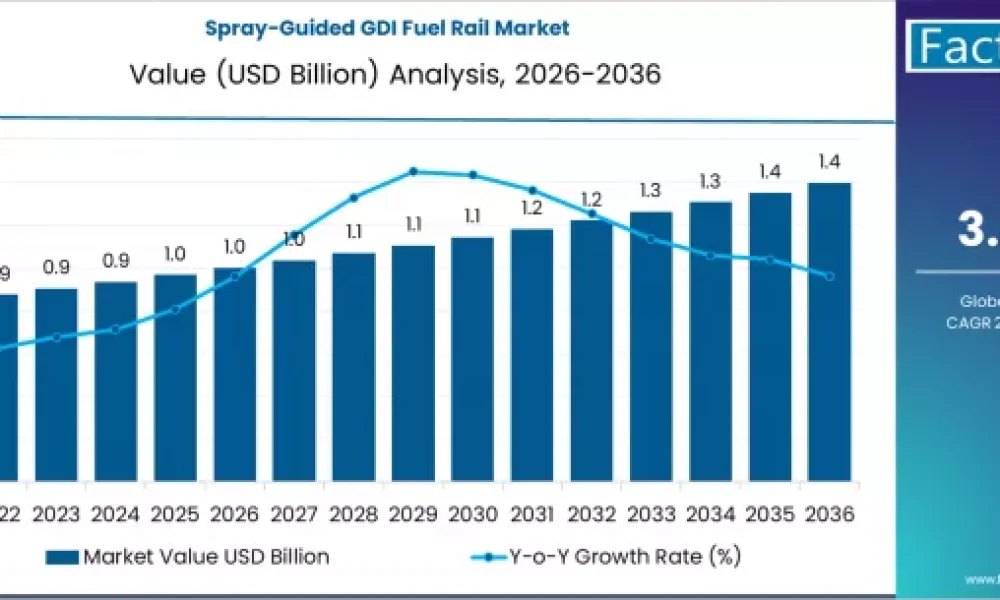
The global Spray-Guided Gasoline Direct Injection (GDI) Fuel Rail Market is entering a high-velocity growth phase, driven by the dual pressures of stringent carbon mandates and the automotive industry’s transition toward ultra-efficient, downsized engines. As the broader GDI system market scales toward an estimated USD 2.0 billion in 2026 valuation in 2026, the demand for spray-guided fuel rails—essential for achieving stratified, lean-burn combustion—is emerging as a critical priority for next-generation powertrain engineering.
The market’s evolution is being spearheaded by a shift from “wall-guided” systems to advanced spray-guided architectures. This transition allows for more precise fuel atomization directly at the spark plug, enabling vehicles to meet the rigorous Euro 7 emissions requirements set to become mandatory for new vehicle categories on November 29, 2026.
Request for Sample Report | Customize Report |purchase Full Report – https://www.factmr.com/connectus/sample?flag=S&rep_id=13572
Market Dynamics: Who, What, and Why
The resurgence of spray-guided technology addresses the industrial need for thermal efficiency without sacrificing the performance profile of modern internal combustion engines (ICE).
- Who: Market leadership is anchored by Tier-1 suppliers including Robert Bosch GmbH, Continental AG, Denso Corporation, Marelli, and Hitachi Astemo. These players are increasingly partnering with OEMs like Volkswagen, BMW, and Toyota to integrate high-pressure rail solutions.
- What: Spray-guided GDI fuel rails are high-pressure delivery components that support centrally mounted injectors. Unlike traditional systems, they facilitate a “stratified charge” mode, where a fuel-rich zone is maintained around the spark plug while the rest of the chamber remains lean.
- When: The 2025–2026 period marks a “Regulatory Milestone” as manufacturers move to optimize ICE platforms for hybrid powertrains and comply with global multi-pollutant standards.
- Where: While North America remains a dominant value market, the Asia-Pacific region is the fastest-growing hub, fueled by massive production volumes in China and India and the adoption of Bharat Stage (BS) VI and beyond standards.
- Why: Traditional port injection cannot meet the 50% greenhouse gas reduction targets projected for the 2030s. Spray-guided GDI provides the precision necessary to reduce soot emissions and improve fuel economy by up to 23% in boosted engine concepts.
Strategic Drivers: Downsizing and the Euro 7 Mandate
The 2026 landscape is defined by the industry’s “Right-Sizing” strategy, where smaller displacement engines rely on high-pressure fuel rails to maintain high torque and power.
- The Stratified Charge Advantage
Spray-guided injection allows for unthrottled operation at part-load, which drastically reduces pumping losses. By delivering a finely atomized spray at pressures now reaching 350 to 500 bar, these fuel rails ensure that the air-fuel mixture is perfectly timed for ignition, reducing unburned hydrocarbons and particulate matter at the source.
- Lightweighting and Material Innovation
To offset the complexity and weight of advanced GDI systems, the market is pivoting toward aluminum alloy and composite fuel rails. These materials provide the high-pressure integrity required for spray-guided systems while contributing to overall vehicle weight reduction—a key factor in extending the range of the internal combustion component in hybrid vehicles.
Future Outlook: The Path to 2035
As the global GDI device market is predicted to reach $21.43 billion by 2035, the spray-guided niche will remain at the forefront of “Clean ICE” technology. Investors are closely monitoring the integration of AI-based Rate of Injection (ROI) modeling, which allows fuel rails and injectors to adapt in real-time to varying driving conditions. This digital-physical integration is expected to be the primary differentiator for companies seeking to lead the automotive fuel delivery sector over the next decade.
About Automotive Engineering Insights:
We provide fact-driven, journalistic reporting on the global automotive and propulsion sectors. Our analysis focuses on the engineering breakthroughs and regulatory shifts that empower industry leaders and investors to navigate the transition toward sustainable mobility.
About Fact.MR
Fact.MR is a global market research and consulting firm, trusted by Fortune 500 companies and emerging businesses for reliable insights and strategic intelligence. With a presence across the U.S., UK, India, and Dubai, we deliver data-driven research and tailored consulting solutions across 30+ industries and 1,000+ markets. Backed by deep expertise and advanced analytics, Fact.MR helps organizations uncover opportunities, reduce risks, and make informed decisions for sustainable growth.



