
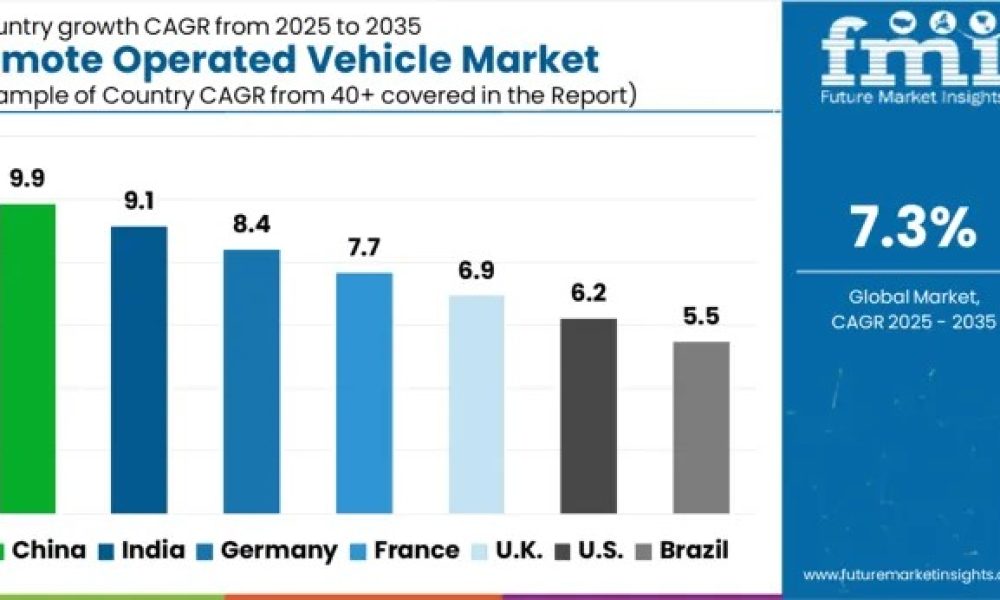
The global remote operated vehicle (ROV) market is entering a phase of sustained, high-quality growth as offshore industries intensify investments in deepwater operations, automation, and underwater inspection technologies. Valued at USD 1.9 billion in 2025, the market is forecast to reach USD 3.9 billion by 2035, expanding at a robust compound annual growth rate (CAGR) of 7.3% over the forecast period. This trajectory reflects the increasing strategic importance of ROVs as essential assets for safe, precise, and cost-efficient operations in complex subsea environments.
Between 2021 and 2025, the market expanded steadily from USD 1.4 billion to USD 1.9 billion, supported by rising demand across oil and gas, underwater exploration, defense, and marine research. During this phase, operators prioritized ROV deployment to reduce human risk, improve operational accuracy, and ensure continuity in environments that are hazardous or inaccessible to divers. This foundational growth has created strong momentum for broader market penetration and higher-value applications over the next decade.
Offshore Energy and Underwater Robotics Drive Core Demand
Offshore oil and gas remains the dominant demand center, accounting for an estimated 35–40% of total ROV utilization. ROVs are extensively used for subsea exploration, drilling support, pipeline inspection, and maintenance, particularly as offshore assets move into deeper waters and harsher operating conditions. As mature fields require more frequent inspection, repair, and maintenance (IRM), ROVs are increasingly viewed as indispensable tools for extending asset life and optimizing operational efficiency.
Beyond hydrocarbons, the broader underwater robotics ecosystem contributes approximately 25–30% to the market, underscoring the central role of ROVs in subsea exploration, inspection, and intervention. Marine and maritime applications contribute a further 12–15%, encompassing underwater surveying, marine research, shipwreck exploration, and port and harbor infrastructure maintenance. Defense and military applications account for roughly 8–10%, driven by the use of ROVs in mine countermeasures, underwater surveillance, reconnaissance, and explosive ordnance disposal. Emerging deep-sea mining activities add another 7–9%, highlighting the expanding application base of ROV technology.
Get access to comprehensive data tables and detailed market insights — request your sample report today!
https://www.futuremarketinsights.com/reports/sample/rep-gb-25739
Technology Advancements Strengthen Adoption Economics
Market growth is being reinforced by rapid advancements in ROV technology. Enhanced depth ratings, high-definition imaging systems, real-time data transmission, and improved manipulator arms are significantly increasing operational efficiency and mission reliability. Investments in autonomous navigation, sensor fusion, and AI-enabled decision support are enabling ROVs to perform more complex tasks with reduced operator intervention, lowering operational costs while improving safety outcomes.
These technological gains are particularly relevant as offshore wind energy installations expand globally. ROVs are increasingly deployed for seabed mapping, cable inspection, turbine foundation monitoring, and ongoing maintenance, positioning them as critical enablers of renewable energy infrastructure. This diversification beyond oil and gas is strengthening the long-term demand outlook and insulating the market from cyclical volatility in any single end-use sector.
Work Class ROVs Anchor Revenue Concentration
By class, work class ROVs are projected to account for 53.6% of total market revenue in 2025, maintaining clear leadership within the segment. Their dominance is driven by robust construction, high payload capacity, and compatibility with advanced tooling required for heavy-duty subsea tasks. These systems are designed to operate at extreme depths while maintaining precision, making them the preferred choice for complex offshore construction, intervention, and inspection programs.
While light work class, observation class, and micro/mini ROVs continue to gain adoption in cost-sensitive and nearshore applications, revenue concentration remains firmly tied to high-specification platforms where performance, uptime, and reliability directly influence project economics.
Aquaculture Emerges as a High-Growth Application Segment
Among applications, aquaculture is expected to account for approximately 41.8% of total market revenue by 2025, reflecting a structural shift in fish farming and marine food production practices. ROVs are increasingly used for net inspection and cleaning, stock monitoring, and infrastructure maintenance, enabling operators to reduce manual labor, improve inspection accuracy, and enhance livestock health through non-invasive monitoring. As aquaculture operations scale industrially and regulatory scrutiny increases, ROV adoption is expected to accelerate further.
Asia-Pacific Leads Growth as Global Adoption Broadens
Regionally, North America, Asia-Pacific, and Europe remain the primary growth engines. Asia-Pacific is emerging as the fastest-growing region, led by China with a projected CAGR of 9.9% and India at 9.1%, driven by offshore energy expansion, defense modernization, and investments in marine infrastructure and underwater robotics. In Europe, Germany is forecast to grow at 8.4%, supported by offshore wind energy and automation-led maritime industries, while the UK market expands at 6.9% on the back of offshore oil, gas, and renewable projects. The United States, growing at 6.2% CAGR, continues to benefit from deepwater energy operations, defense demand, and technological leadership in autonomous systems.
Drive Your Business Growth Strategy: Checkout the Report for Key Insights
https://www.futuremarketinsights.com/checkout/25739
Competitive Landscape Defined by Depth, Reliability, and Integration
Competition in the ROV market is shaped by technological capability, operational depth, and application-specific expertise. Leading players including Oceaneering, Saab Seaeye, Deep Trekker, VideoRay, TechnipFMC, Forum Energy Technologies, Subsea 7, and DOF Subsea are strengthening their positions through innovation, fleet expansion, and integrated service offerings. Differentiation increasingly depends on the ability to deliver reliable, high-performance systems that integrate seamlessly with offshore workflows and comply with stringent regulatory standards.
Outlook
As offshore energy, renewable infrastructure, defense, and marine research activities continue to expand, ROVs are transitioning from specialized tools to strategic assets within the global subsea economy. Their ability to enhance safety, reduce costs, and unlock access to deeper and more challenging environments positions the remote operated vehicle market for sustained growth through 2035. The full market report provides a detailed assessment of technology trends, competitive dynamics, regional opportunities, and investment outlook shaping the future of the global ROV industry.
Why Choose FMI: Empowering Decisions that Drive Real-World Outcomes: https://www.futuremarketinsights.com/why-fmi
About Future Market Insights (FMI)
Future Market Insights, Inc. (FMI) is an ESOMAR-certified, ISO 9001:2015 market research and consulting organization, trusted by Fortune 500 clients and global enterprises. With operations in the U.S., UK, India, and Dubai, FMI provides data-backed insights and strategic intelligence across 30+ industries and 1200 markets worldwide.



