
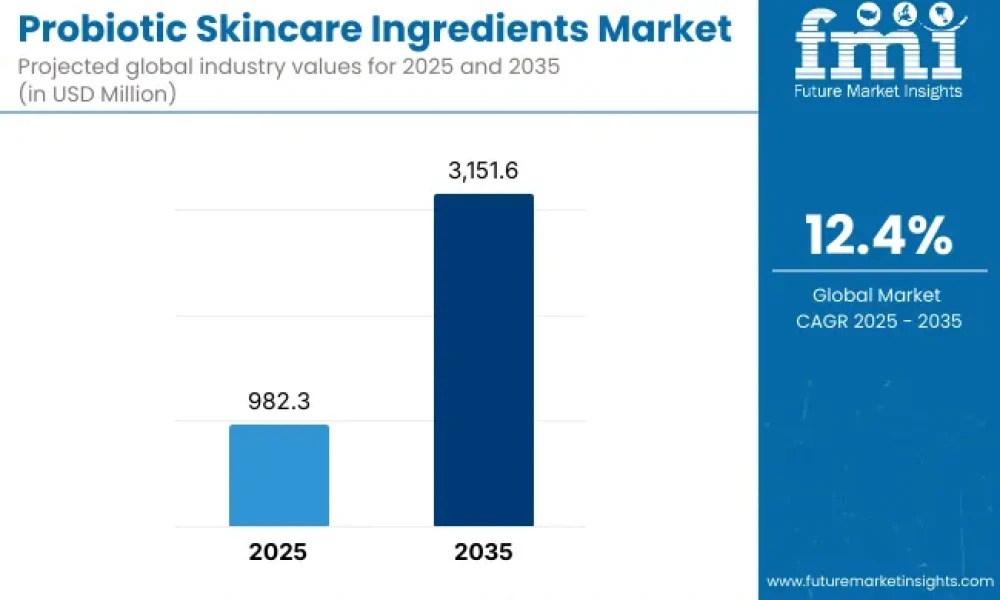
The Global Probiotic Skincare Ingredients Market is projected to expand from USD 982.3 million in 2025 to USD 3,151.6 million by 2035, representing a 221% increase and a compound annual growth rate (CAGR) of 12.4%. This growth reflects a 3.2X increase in market size over the decade, underpinned by rising consumer awareness of skin microbiome health, advances in probiotic stabilization, and accelerating demand for clean-label and premium skincare products.
Gain access to detailed segment-wise analysis and forecast statistics – Request the Sample Report Today
Market Context and Growth Trajectory
During the first half of the forecast period (2025–2030), the market is expected to grow from USD 982.3 million to USD 1,759.5 million, adding USD 777.2 million and accounting for 35.8% of total decade growth. This phase is characterized by steady adoption of probiotic ingredients in barrier-repair hydration, sensitivity relief, and anti-aging applications. Serums and ampoules dominate this period, representing more than 46% of functional formulations due to their suitability for delivering concentrated probiotic actives.
From 2030 to 2035, growth accelerates sharply, contributing USD 1,392.1 million, or 64.2% of total expansion, as the market climbs to USD 3,151.6 million. This surge is driven by widespread deployment of microbiome-friendly formulations, increasing vegan and clean-label compliance, and premium skincare adoption across Asia-Pacific. By the end of the decade, prebiotics and live probiotics together are expected to capture more than 50% of ingredient share, supported by improved formulation technologies and evolving regulatory acceptance.
Ingredient, Format, and Functional Leadership
Postbiotics and lysates are the leading ingredient category, accounting for 49.5% of global market share in 2025. Their dominance reflects superior stability, safety, and proven efficacy in barrier repair and hydration compared with live probiotics, which face shelf-life and formulation challenges. Postbiotics are increasingly integrated into mainstream cosmetic formulations, particularly in premium serums and lotions, supported by expanding clinical validation and strain-specific claims.
By product format, serums and ampoules lead with a 46.5% market share in 2025. These formats are favored for targeted hydration, sensitivity relief, and brightening benefits, and they align with multi-step skincare routines popular in Western and Asian beauty markets. Their compatibility with high-potency postbiotics and prebiotic complexes continues to support widespread adoption.
Functionally, barrier repair and hydration represent the largest segment, contributing 42.4% of global revenue in 2025. This leadership reflects rising prevalence of sensitive and dry skin conditions, driven by pollution, urbanization, and environmental stressors. Probiotic formulations in this category are widely adopted across serums, lotions, and toners, offering daily-use appeal and broad demographic relevance.
Regional and Country-Level Outlook
Growth is uneven across regions, reflecting differences in consumer adoption and market maturity. India (19.4% CAGR) and China (17.3% CAGR) are forecast to lead global expansion through 2035, supported by rising disposable income, premium skincare adoption, and strong demand for hydration and brightening claims. Japan follows with a 14.0% CAGR, driven by its advanced cosmeceutical sector and emphasis on skin longevity.
In developed markets, growth is steadier but slower. The United States, valued at USD 221.0 million in 2025, is projected to reach USD 630.3 million by 2035 at a CAGR of 7.2%. Demand is led by microbiome-friendly and fragrance-free claims, with postbiotics accounting for 43.7% of U.S. ingredient share in 2025. The United Kingdom (11.2% CAGR) and Germany (8.4% CAGR) remain key European hubs, where sustainability, vegan positioning, and clinical validation shape adoption.
Competitive Landscape and Industry Dynamics
The market is moderately fragmented. DSM-Firmenich leads with a 9.1% global share in 2025, leveraging biotechnology expertise and partnerships with premium skincare brands. Other multinational players—including Givaudan Active Beauty, BASF, Croda, Evonik, Symrise, Lubrizol, and IFF–Lucas Meyer—are strengthening portfolios with microbiome-friendly actives and vegan formulations. Mid-sized innovators such as CLR Berlin and Lallemand focus on strain-specific research and targeted probiotic complexes.
Competitive differentiation is shifting from ingredient availability to ecosystem strength, combining clinical validation, regulatory compliance, and co-development partnerships. Ingredient suppliers increasingly integrate R&D support, claims substantiation, and delivery-system innovation to maintain relevance as digital-first biotech players enter the market with AI-driven strain discovery and cloud-based microbiome testing platforms.
Drivers, Restraints, and Key Trends
Market growth is driven by rising consumer awareness of skin microbiome health and expansion of premium and clean beauty segments. Advances in probiotic stabilization have improved shelf life and efficacy, enabling broader inclusion in cosmetic formulations. Postbiotics, in particular, benefit from safety, stability, and regulatory compatibility.
Key restraints include regulatory complexity, lack of harmonized standards for probiotics in cosmetics, and formulation challenges for live probiotics. These factors increase compliance costs and limit mass-market adoption of live cultures.
Dominant trends include a shift toward postbiotics and next-generation prebiotic–postbiotic complexes, along with growing integration of personalization and AI-backed microbiome skincare. These developments are setting the stage for hyper-personalized, clinically validated probiotic skincare regimens.
Outlook
With sustained innovation, expanding clinical evidence, and strong consumer alignment with microbiome-friendly and clean-label claims, the Global Probiotic Skincare Ingredients Market is positioned for robust long-term growth. Postbiotics, serums, and barrier-repair applications are expected to remain the backbone of market expansion through 2035.
Have a specific Requirements and Need Assistant on Report Pricing or Limited Budget please contact us – [email protected]
About Future Market Insights (FMI)
Future Market Insights, Inc. (FMI) is an ESOMAR-certified, ISO 9001:2015 market research and consulting organization, trusted by Fortune 500 clients and global enterprises. With operations in the U.S., UK, India, and Dubai, FMI provides data-backed insights and strategic intelligence across 30+ industries and 1200 markets worldwide
Why Choose FMI: https://www.futuremarketinsights.com/why-fmi



