
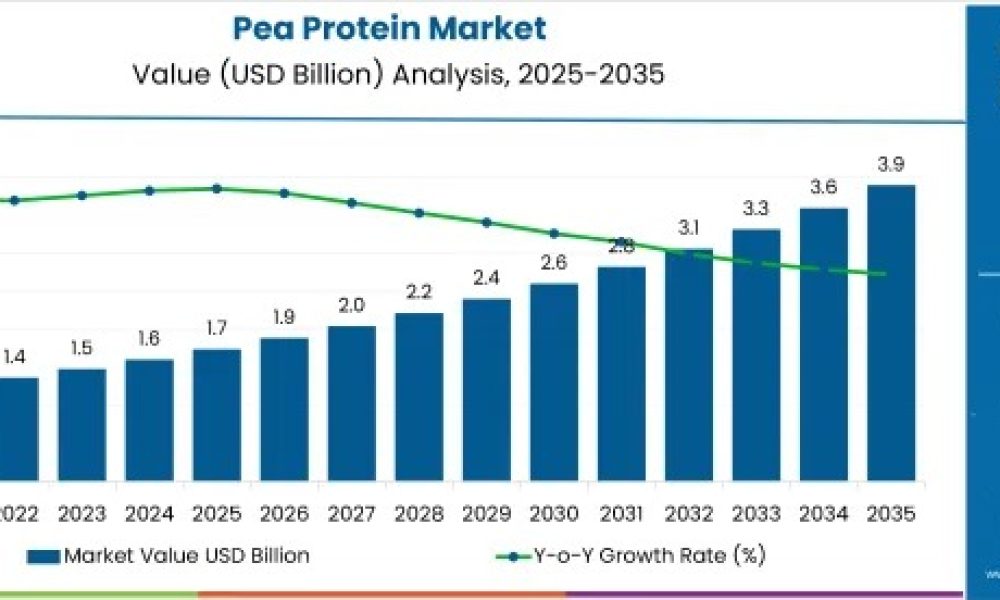
The global pea protein market is set for remarkable growth, with its value estimated at USD 1.82 billion in 2026 and projected to climb to USD 4.08 billion by 2036, representing a CAGR of 8.4% over the forecast period. Market expansion is fueled by rising consumer preference for plant-based protein sources, increasing health consciousness, and heightened environmental awareness driving demand for alternative protein ingredients.
Pea protein’s versatility and nutritional profile position it as a preferred choice across food processing, nutritional supplements, and sports nutrition segments. Its complete amino acid profile, hypoallergenic nature, and functional benefits make it a vital ingredient for manufacturers catering to dietary restrictions and modern lifestyle trends.
Explore trends before investing – Request a sample report today!
Pea protein isolates dominate the product landscape due to their high protein content, functional performance, and adaptability in diverse formulations. Food processing leads end-use applications, with manufacturers incorporating pea protein into meat analogues, bakery items, and other processed foods to leverage clean-label trends and nutritional enhancement opportunities. Retail partnerships and global ingredient supply chains further strengthen market penetration, connecting pulse farming regions to manufacturing hubs worldwide.
Key Market Insights (2026-2036):
- Market Value (2026): USD 1.82 billion
- Market Forecast Value (2036): USD 4.08 billion
- Forecast CAGR: 8.4%
- Leading Product Type: Pea Protein Isolates (47% market share)
- Leading End-Use Segment: Food Processing (50% market share)
- Key Growth Regions: China, USA, Germany
China, the USA, and Germany are emerging as top growth regions, driven by plant-based diet adoption, government support for alternative proteins, and consumer preference for sustainable ingredients. Major industry players, including Roquette Freres, The Scoular Company, Burcon Nutrascience, Cosucra Groupe Warcoing SA, and Axiom Foods Inc., compete through advanced extraction technologies, supply chain efficiency, and innovative product development strategies that enhance protein purity and functional performance.
Segment Analysis:
Product Type:
- Pea Protein Isolates: Lead globally with 47% share, offering high protein content and superior functional properties.
- Pea Protein Concentrates: Target cost-sensitive applications with moderate protein content.
- Textured Pea Protein: Optimized for meat alternatives requiring specific texture and mouthfeel.
- Hydrolyzed Pea Protein: Niche segment for enhanced absorption and specialized formulations.
End Use:
- Food Processing: Dominates with 50% share, supporting broad ingredient integration and scalable manufacturing.
- Nutritional Supplements: Serve targeted health-focused applications.
- Sports Nutrition: Cater to performance-oriented products emphasizing rapid absorption and muscle recovery.
- Other Applications: Include beverages, bakery, dairy alternatives, and meat substitutes.
Agricultural factors, processing costs, and regulatory compliance significantly shape market scalability. Seasonal crop yields, regional production capacity, and investment in extraction and purification technologies affect supply reliability and pricing strategies. Regulatory frameworks ensure food safety and labeling standards, influencing long-term investment in plant-based protein operations.
Regional Growth Dynamics:
- China: CAGR of 10.1% due to rapid food industry expansion, urbanization, and rising health consciousness. Pea protein adoption spans dairy alternatives, meat substitutes, and nutritional supplements.
- USA: CAGR of 5.9% driven by sports nutrition growth, clean-label trends, and diverse plant-based food adoption.
- Germany: CAGR of 8.0% supported by environmental awareness, regulatory support, and demand for healthier, sustainable product formulations.
Unlock the complete analysis—Get the full report now.
Competitive Landscape:
The pea protein market is moderately consolidated with several key players advancing technology and product offerings:
- Roquette Freres: Focused on extraction technologies and global ingredient solutions.
- The Scoular Company: Specializes in agricultural sourcing and supply chain optimization.
- Burcon Nutrascience: Innovates in protein extraction and purification technologies.
- Cosucra Groupe Warcoing SA: Offers specialty protein ingredients for functional applications.
- Axiom Foods Inc.: Develops allergen-free protein solutions for sensitive formulations.
Other notable players include Shandong Jianyuan Group, Nutri-Pea Ltd., Sotexpro SA, Ingredion Inc., Martin & Pleasance, and Fenchem Inc.
The global pea protein market continues to expand as manufacturers leverage its nutritional advantages, functional versatility, and alignment with consumer health and sustainability trends. Market growth is supported by technological innovation, efficient supply chains, and expanding application opportunities across diverse food and nutritional sectors.
About Future Market Insights (FMI)
Future Market Insights, Inc. (FMI) is an ESOMAR-certified, ISO 9001:2015 market research and consulting organization, trusted by Fortune 500 clients and global enterprises. With operations in the U.S., UK, India, and Dubai, FMI provides data-backed insights and strategic intelligence across 30+ industries and 1,200 markets worldwide.



