
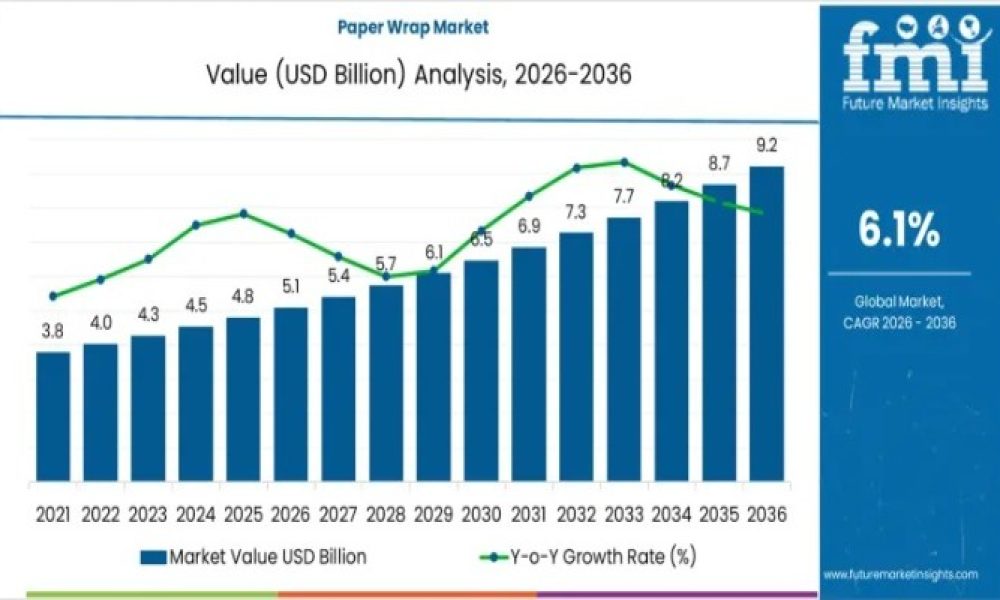
The global paper wrap market is entering a decade of steady, compliance-led expansion as packaging value chains realign around recyclability, waste reduction, and material substitution. Valued at USD 5.1 billion in 2026, the market is forecast to reach USD 9.2 billion by 2036, growing at a compound annual growth rate (CAGR) of 6.1%. This growth reflects not a surge in discretionary packaging spend, but a structural shift driven by regulation, operational efficiency, and evolving procurement priorities across foodservice, retail, and logistics.
Unlike branding-led packaging segments, paper wrap demand is anchored to functional necessity. Consumption volumes closely track foodservice throughput, retail turnover, and logistics handling frequency. Regulatory pressure on plastic packaging, coupled with waste reduction targets, is reshaping buyer behavior and accelerating the transition toward fiber-based wrapping formats with short lifecycle usage.
Discover Growth Opportunities in the Market – Get Your Sample Report Now
Quick Stats: Paper Wrap Market at a Glance
- Market Value (2026): USD 5.1 billion
- Forecast Value (2036): USD 9.2 billion
- Forecast CAGR (2026–2036): 6.1%
- Leading Basis Weight: 40–50 GSM
- Fastest-Growing Countries: India, China, Indonesia, UK, USA
- Top Global Players: Mondi Group, Smurfit Kappa, International Paper, WestRock, DS Smith
Market Structure and Pricing Dynamics
Pricing dynamics in the paper wrap market remain tightly constrained. Volatility in pulp prices, rising energy costs, and conversion efficiency at paper mills directly influence margins. As a result, capital allocation favors incremental capacity additions, coating upgrades, and process optimization, rather than disruptive material innovation.
Replacement cycles are tied to consumption intensity rather than technological obsolescence, reinforcing predictable volume growth. Automation investments continue, but often require recalibration to accommodate tensile strength and thickness variability inherent to paper substrates. This has moderated adoption speed in some high-throughput operations, while sustaining long-term demand stability.
Why Demand for Paper Wrap Is Growing
Demand growth reflects a convergence of regulatory, operational, and consumer-driven factors:
- Regulatory frameworks restricting single-use plastics
- Expansion of foodservice, takeaway, and quick-service restaurants
- Rising preference for recyclable and compostable packaging
- Growth of e-commerce and direct-to-consumer delivery
- Advances in coating and barrier technologies improving performance
Retailers and institutional buyers increasingly specify paper wrap for dry goods, produce, and takeaway foods to align with recycling infrastructure and waste reduction mandates. Procurement teams are prioritizing certified paper grades that meet food-contact and sustainability standards, reinforcing long-term supplier relationships.
Segment Insights: Basis Weight and Application
Dominant Basis Weight: 40–50 GSM
The 40–50 GSM segment accounts for 38.2% of global demand, representing the largest share. This range offers an optimal balance between strength, flexibility, and material efficiency, making it ideal for high-volume wrapping applications.
Key Points:
- Leads basis weight segmentation with a 38.2% share
- Balances tear resistance and lightweight handling
- Favored for automated wrapping compatibility
- Other GSM ranges serve niche durability or premium needs
Leading Application: Food Wrapping
Food wrapping dominates the market, accounting for 52.3% of total demand. High consumption frequency, single-use patterns, and strict hygiene requirements drive sustained volume growth.
Key Points:
- Food wrapping leads with a 52.3% share
- Frequent replacement cycles support steady demand
- Gift and protective wrapping serve lower-frequency uses
Key Market Dynamics and Performance Constraints
While adoption is broadening, scalability remains influenced by several structural factors:
- Sensitivity to pulp and energy input costs
- Barrier limitations in high-moisture or frozen applications
- Recycling challenges linked to certain chemical coatings
- Dependence on forestry management and regional mill utilization
- Certification and compliance costs for food-contact grades
These constraints shape selective substitution rather than universal replacement of plastic wraps, reinforcing disciplined, application-specific growth.
Regional Growth Outlook: A Global Shift Toward Paper
High-Growth Markets by CAGR
| Country | CAGR (%) |
| India | 8.8% |
| China | 7.4% |
| Indonesia | 7.2% |
| UK | 5.8% |
| USA | 5.6% |
India leads growth as enforcement of single-use plastic bans accelerates adoption across foodservice and retail. Expansion of domestic converting capacity and e-commerce packaging needs further strengthen demand.
China benefits from policy-driven plastic reduction, high-volume food delivery platforms, and integrated paper manufacturing ecosystems aligned with circular economy goals.
Indonesia sees rising adoption driven by urban retail growth, municipal plastic waste regulations, and bakery and food processing demand.
The UK shows moderate but steady growth, supported by strict packaging waste regulations, mature recycling infrastructure, and premium food packaging requirements.
The USA experiences selective expansion driven by corporate sustainability commitments, large restaurant chain conversions, and state-level regulations.
Competitive Landscape: Established Leaders and Emerging Opportunities
The global paper wrap market is characterized by established multinational players alongside regional converters and new entrants seeking to expand capacity, develop performance coatings, and integrate automated wrapping compatibility.
Leading companies include:
- Mondi Group – Broad paper wrap portfolios backed by sustainability credentials and global manufacturing reach
- Smurfit Kappa – Integrated paper and corrugated solutions supporting retail and industrial wrapping
- International Paper – Diverse wrap grades with extensive distribution and technical support
- WestRock – Strong presence in retail and protective paper wrap applications
- DS Smith – Renewable wrap papers combined with design and branding expertise
For both established and emerging manufacturers, competitive differentiation increasingly depends on:
- Consistent quality across grades
- FSC and PEFC certification
- Conversion and application support
- Ability to meet regulatory and recycling requirements
As packaging regulations tighten and operational priorities shift, the paper wrap market offers measured, resilient growth opportunities for companies investing in efficiency, compliance, and functional innovation rather than speculative expansion.
Why FMI: https://www.futuremarketinsights.com/why-fmi
About Future Market Insights (FMI)
Future Market Insights, Inc. (FMI) is an ESOMAR-certified, ISO 9001:2015 market research and consulting organization, trusted by Fortune 500 clients and global enterprises. With operations in the U.S., UK, India, and Dubai, FMI provides data-backed insights and strategic intelligence across 30+ industries and 1200 markets worldwide.



