
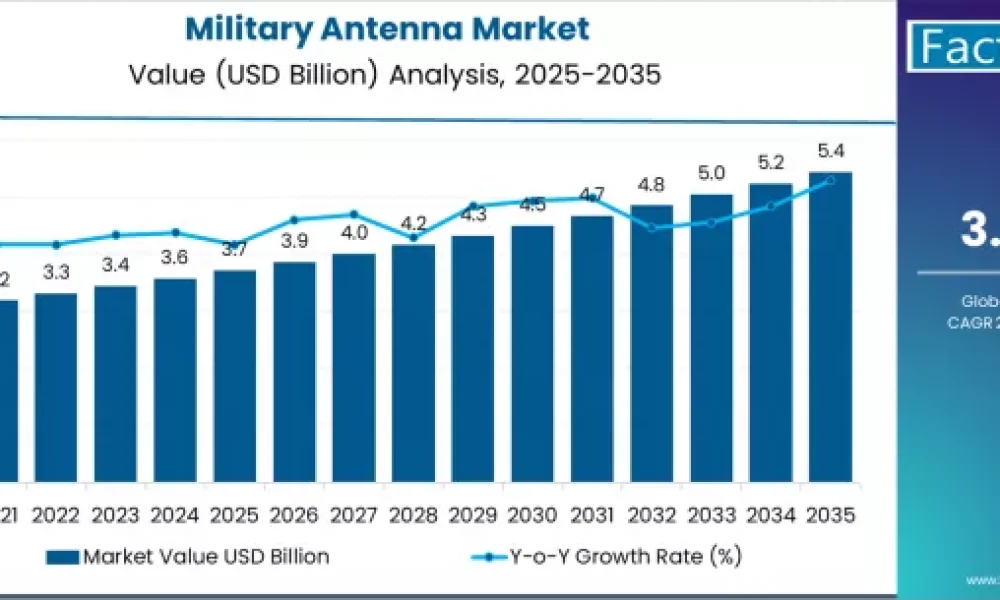
The global military antenna market is set for steady expansion over the next decade, driven by increasing defense modernization programs, rising geopolitical tensions, and the growing need for secure, reliable, and high-bandwidth communication systems across military platforms. According to a new analysis by Fact.MR, the market is projected to grow from USD 3,710.4 million in 2025 to approximately USD 5,420.7 million by 2035, registering an absolute growth of USD 1,710.3 million over the forecast period.
This growth represents a 46.1% increase, with the market expected to expand at a CAGR of 3.9% between 2025 and 2035, reflecting sustained investments in next-generation defense communication technologies worldwide.
The rising integration of advanced antennas in land, naval, airborne, and space-based military systems, along with increased demand for satellite communications (SATCOM) and electronic warfare capabilities, is significantly accelerating global adoption.
To access the complete data tables and in-depth insights, request a Discount On The Report here: https://www.factmr.com/connectus/sample?flag=S&rep_id=9360
Strategic Market Drivers
Defense Modernization and Network-Centric Warfare
Modern armed forces are rapidly transitioning toward network-centric warfare, requiring uninterrupted, secure, and high-speed data transmission. Military antennas play a critical role in enabling:
- Command, control, communications, computers, intelligence, surveillance, and reconnaissance (C4ISR)
- Real-time battlefield situational awareness
- Secure voice and data communication
Ongoing upgrades of legacy systems and deployment of advanced communication infrastructure are fueling antenna demand across defense forces.
Growing Demand for SATCOM and ISR Systems
Satellite-based communication and intelligence systems rely heavily on high-performance military antennas for long-range, beyond-line-of-sight connectivity. Increasing deployment of:
- Unmanned aerial vehicles (UAVs)
- Surveillance aircraft
- Naval vessels
- Tactical ground stations
is driving the need for ruggedized, high-gain, and multi-band antenna systems.
Expansion of Unmanned and Autonomous Defense Platforms
The rapid growth of drones, autonomous vehicles, and unmanned naval systems is boosting demand for compact, lightweight, and high-frequency antennas capable of operating in harsh environments and contested electromagnetic spectrums.
Rising Focus on Electronic Warfare and Spectrum Dominance
Modern military strategies emphasize electronic warfare (EW), including signal intelligence (SIGINT), jamming, and countermeasure operations. Advanced antennas designed for wideband frequency coverage and signal interception are becoming mission-critical components.
Regional Growth Highlights
North America: Defense Spending and Technological Leadership
North America remains the largest market, supported by:
- High defense budgets
- Continuous investments in C4ISR and SATCOM systems
- Strong presence of leading defense contractors
The United States dominates the region due to ongoing modernization of military communication networks and space-based defense assets.
Europe: NATO Commitments and Security Upgrades
European countries are increasing military expenditure to meet NATO defense targets. Rising investments in:
- Secure tactical communication systems
- Border surveillance
- Naval and airborne platforms
are driving antenna demand across Germany, the U.K., France, and Eastern Europe.
Asia-Pacific: Rapid Military Expansion and Regional Tensions
Asia-Pacific is witnessing strong growth due to:
- Expanding defense budgets in China, India, Japan, and South Korea
- Indigenous defense manufacturing programs
- Increasing focus on satellite and electronic warfare capabilities
Middle East & Emerging Markets: Strategic Defense Investments
Countries in the Middle East, Latin America, and Africa are strengthening defense infrastructure amid regional security challenges, boosting demand for advanced military communication and radar antenna systems.
Market Segmentation Insights
By Antenna Type
- SATCOM Antennas – Largest segment due to rising satellite-based military operations
- HF/VHF/UHF Antennas – Widely used in tactical and ground communications
- Radar Antennas – Growing demand for surveillance and missile defense systems
By Platform
- Airborne – UAVs, fighter jets, and surveillance aircraft
- Naval – Warships, submarines, and coastal defense systems
- Ground-Based – Tactical communication and radar installations
- Space-Based – Military satellites and space surveillance systems
By Frequency Band
- L & S Band – Tactical and satellite communications
- C, X, and Ku Band – Radar, SATCOM, and EW applications
- Ka Band – High-speed data transmission and next-gen SATCOM
Challenges Impacting Market Growth
High Development and Deployment Costs
Military-grade antennas require advanced materials, ruggedization, and precision engineering, leading to higher costs and longer development cycles.
Complex Integration Requirements
Integrating antennas with sophisticated defense platforms and encrypted communication systems increases technical complexity.
Stringent Regulatory and Security Standards
Compliance with defense regulations, export controls, and cybersecurity requirements can slow market entry for new players.
Competitive Landscape
The military antenna market is moderately consolidated, with companies focusing on innovation, multi-band capabilities, miniaturization, and enhanced durability for extreme operational environments.
Key Companies Profiled
- L3Harris Technologies
- Raytheon Technologies
- Cobham Limited
- Thales Group
- Northrop Grumman
- Lockheed Martin
- BAE Systems
- Rohde & Schwarz
- Antcom Corporation
Leading players are investing in phased array antennas, electronically steerable systems, and advanced SATCOM solutions.
Recent Developments
- 2024: Deployment of electronically steerable antennas for next-generation military SATCOM systems
- 2023: Increased adoption of compact antennas in UAVs and unmanned combat systems
- 2022: Expansion of Ka-band antennas to support high-throughput military satellite communications
Future Outlook: Secure and Connected Defense Ecosystems
Over the next decade, the military antenna market will continue to evolve, supported by:
- Rising global defense spending
- Growth of satellite-based military communications
- Expansion of unmanned and autonomous systems
- Increased focus on electronic warfare and spectrum dominance
- Technological advancements in phased array and multi-band antennas
As defense forces worldwide prioritize secure, resilient, and high-speed communication, the global military antenna market is positioned for steady and sustainable growth through 2035.
Have a specific Requirements and Need Assistant on Report Pricing or Limited Budget please contact us – [email protected]
About Fact.MR
Fact.MR is a global market research and consulting firm, trusted by Fortune 500 companies and emerging businesses for reliable insights and strategic intelligence. With a presence across the U.S., UK, India, and Dubai, we deliver data-driven research and tailored consulting solutions across 30+ industries and 1,000+ markets. Backed by deep expertise and advanced analytics, Fact.MR helps organizations uncover opportunities, reduce risks, and make informed decisions for sustainable growth.



